
What if the very thing we call “story” is holding us back?
What if the structures we rely on – the three act, the five act, the Hero’s Journey, the pyramid – were not just outdated, but fundamentally incompatible with the worlds we are trying to build today?
What if the true revolution in experience design is not VR, AI, or immersive tech, but the shift from plot driven storytelling to guest driven narrative physics?
This is the provocation Stephanie Riggs brought to the stage at our latest WXO Campfire, and it landed like a split in the timeline. A before and after.
Because what Riggs is proposing is not a tweak to the craft. It’s a paradigm break.
The Problem With Stories Today
“The pyramid collapses the moment the audience moves…”
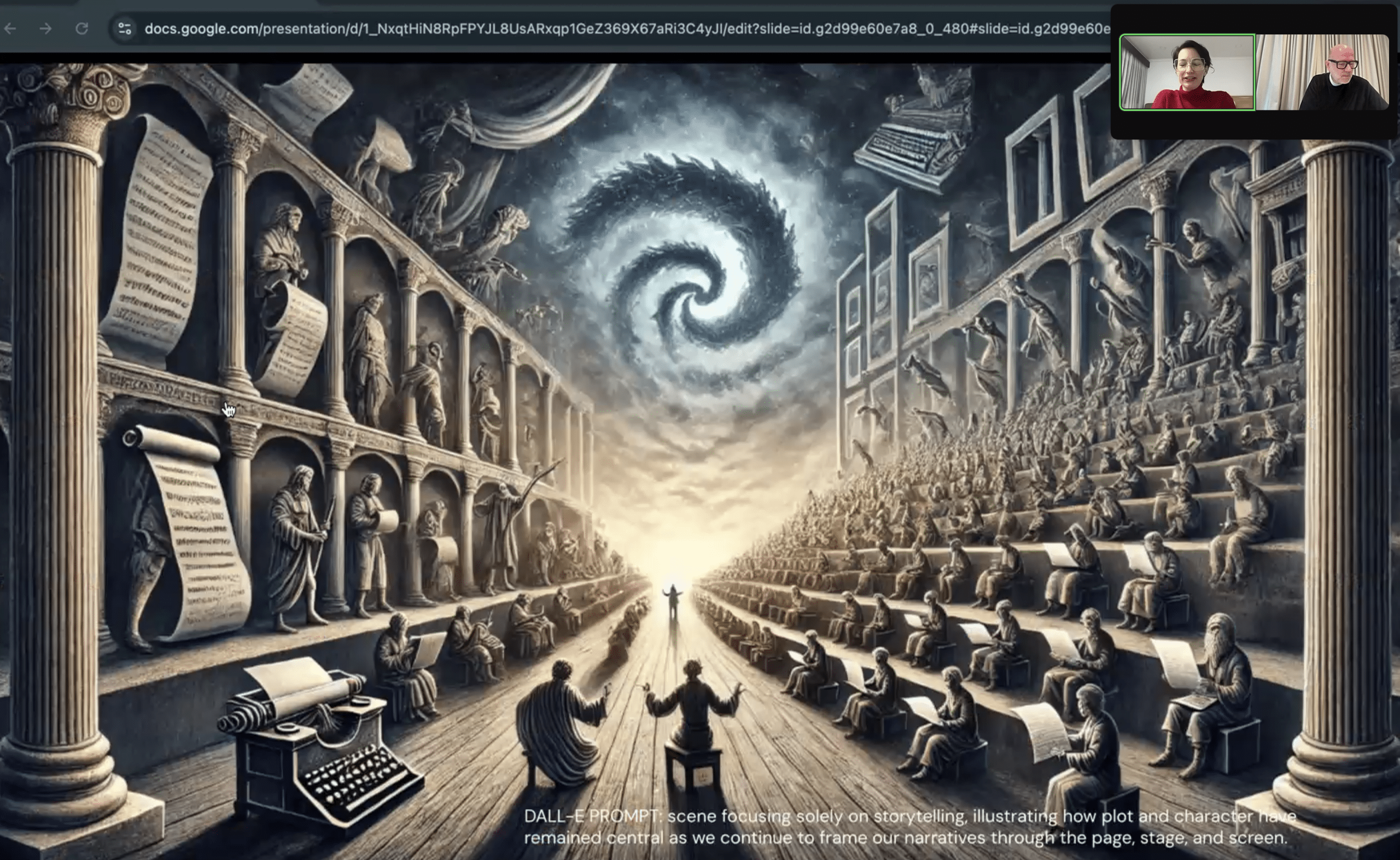
For 2,300 years, storytellers have been good Aristotelians, whether they realise it or not. Aristotle’s Poetics gave us the foundation:
- Plot as the “soul of the drama”
- Character in service of plot
- Events unfolding in fixed sequence toward catharsis
It worked.
For books.
For theatre.
For film.
But then something changed.
We invented:
- Games
- Open worlds
- Immersive theatre
- Interactive museums
- AI-powered characters
- Spatial computing
- Free roam VR
- Feal time systems
Suddenly the audience was no longer a spectator. They moved. Explored. Touched things. Talked to characters. Made choices. Arrived late. Skipped ahead. Compared notes.
And so the entire Aristotelian structure collapsed. Riggs captured why this fracture happened clearly:
“Aristotle’s narrative did not account for guests.”
This is the core of the crisis. Plot requires control. Experiences require agency.
This is the Narrative Paradox. The more you control the story, the less freedom the guest has. The more freedom you give, the more the story breaks.
Immersive creators have been stuck in this tension for a decade. Riggs offers the way forward.
Why Drama Is An Approximation, Not A Mirror
And why experience design demands a different kind of truth.
Riggs draws a powerful comparison between classical storytelling and classical physics. Both are elegantly structured, internally consistent, and ultimately insufficient when the world gets bigger.
Just as Newton could not explain black body radiation or quantum tunnelling, Aristotle cannot explain:
- Branching narratives
- Emergent story
- Sandbox worlds
- Dynamic systems
- Multiplayer audience behaviour
- Non-linear experience paths
- Emotional arcs that begin at different times for different guests
Drama is a model, a simplification, an approximation of life. But immersive experiences are built from life itself.
They are messy, unpredictable, observer dependent, socially entangled, emotionally variable, and profoundly shaped by personal entry points. Riggs describes this as relative linearity:
“The story begins when the guest enters, not when the plot says it should.”
Two guests can walk into the same world and have entirely different beginnings, middles, and ends, yet both walk away with a meaningful emotional arc. This is impossible in a pyramid. It is natural in a quantum system.
Quantum Narratives: Storytelling After the Pyramid
A framework built for agency, interactivity, and worlds that breathe.
If classical narratives resemble a railway line, quantum narratives resemble weather patterns.
They prioritise:
- Systems instead of scripts
- Forces instead of beats
- Fields instead of scenes
- Patterns instead of plots
- Guests as active agents instead of passive protagonists
Riggs adapts five foundations from physics and translates them into narrative design:
1. Influences (Theme Forces)
The emotional gravity of the world. What pulls everything into motion: justice, corruption, desire, entropy.
2. Sensory Forms (Characters, Objects, Signals)
Everything the guest can perceive. Actors, props, sound cues, lighting shifts, interactive objects, reactive environments.
3. Dramatic Flow (System Behaviours and Genre Logic)
Not beats. Rules. How tension rises and falls within this world.
4. Dynamics (Cultural and World Interactions)
The networks of relationships, histories, biases, factions, rituals that shape cause and effect.
5. Guests (The Missing Variable)
Not characters. Not heroes. Active agents with unpredictable behaviour, personal motivations, and unique timelines.
Once you account for the guest as a force, everything changes.
A New Profession: Building Worlds, Not Stories
From narrative to narrative physics.
The experience designer becomes a world architect. The job is no longer:
- Write a plot
- Script a climax
- Define a beat sheet
- Control the path
The job becomes:
- Define the rules of the world
- Shape the forces
- Create systems that respond
- Build feedback loops
- Design for emergent meaning
This mirrors modern game design. Children already understand this instinctively. Adults require permission. Designers must supply the container. Quantum narratives describe how people truly experience immersive worlds, not how writers wish they would.
The Ethical Stakes: Why This Matters Beyond Story
Agency is not just a design choice. It is a psychological requirement.
Riggs closes with a provocation that lingers. What happens to a society trained on hero centric stories? Stories in which one individual matters most? Stories shaped around personal triumph?
What if our stories taught something else? Interdependence. Systems thinking. Responsibility. Ripple effects. Consequences. The humility of being one among many.
Martin Seligman, the man who brought the world the concept of positive psychology, told me once (at the World Happiness Summit in Miami, actually!) that his research shows that societies flourish when people believe their actions matter. Agency is a driver of human progress. So if we care about human flourishing, and progress, we should design experiences that encourage agency. And realise that experiences can become a training ground for agency itself.
By acknowledging the guest as a real force in the system, quantum narratives shift us away from passive spectatorship toward active, meaningful participation.
The WXO Take Out
What this means for the future of experience design.
If you are building immersive theatre, XR, theme parks, museums, games, exhibitions, festivals, or branded worlds, Stephanie Riggs’ message is clear: The classical story models cannot support interactive story realities. To create meaningful experiences in a world full of movement, multiplicity, and agency, we need:
- Systems instead of scripts
- Patterns instead of plots
- Rules instead of beats
- Guests as forces instead of vessels
- Stories that emerge, adapt, and evolve
The creators who master this will define the next chapter of the Experience Economy. Not by telling better stories. By building better worlds.
To access the Quantum Narrative Toolkit, to discover more ways that tech is changing how experiences are, and can be made – join the WXO.