
Stone Mantel’s four-part framework starts with growth, customer need and lasting value – not the look and feel.
A common definition of experience strategy goes something like this:
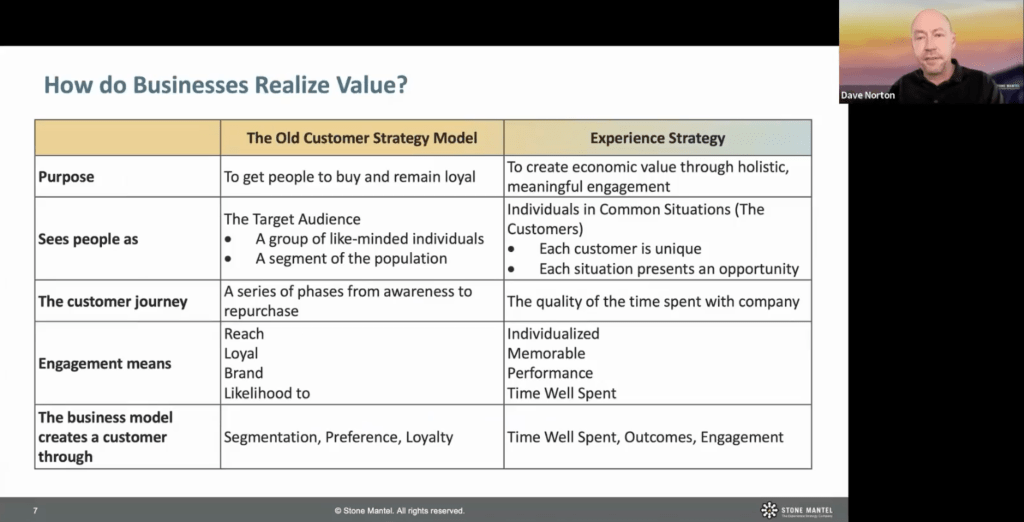
The business decides its strategy. The experience team then works out how to execute it.
Dave Norton says this is wrong.
Experience strategy is not the part of an existing business plan handed to designers, creative teams or customer-experience specialists. It should help determine how the business creates value in the first place.
“Experience strategy is foundational. It’s not decorative. It’s not aesthetic.”
That makes it relevant before an experience is designed, a journey is mapped or a technology is selected.
It asks whether the underlying proposition can grow, whether it meets a complete customer need and whether people will continue to consider it worth their time.
TL;DR: your experience strategy is fundamental to the success of your experience business. Here’s why – and how.
This Experience Briefing draws on a WXO Campfire with Dave Norton and distils its most useful ideas for experience leaders.

Dave Norton is the founder and principal of Stone Mantel, an experience strategy consultancy that uses research and strategic frameworks to help organisations create meaningful experiences. Clients include Coca-Cola, Marriott, Disney, Nike, Walmart, Blue Cross, and many other well-known brands. They know what they’re doing.
Norton traces his work in this field to a 1998 Royal Caribbean project, when he applied the newly emerging Experience Economy framework and brought its co-author Joe Pine into the work. Norton and Pine have continued to collaborate on experience strategy, research and publishing.
Experience strategy is not experience design
- Experience design asks what should be created and how people will encounter it.
- Innovation develops and tests possible solutions.
- Brand strategy shapes how the organisation presents itself and what it promises.
- Customer experience management improves the services, journeys and interactions surrounding the customer.
All of these disciplines matter. None of them, by themselves, answers the full strategic question:
How will this business create economic value through experiences?
Norton describes experience strategy as a business-model approach rather than a department or specialist discipline. It affects everyone whose work supports the proposition.
This moves experience professionals upstream.
They are not simply making somebody else’s strategy more attractive. They are helping to decide what the company should offer, who needs it, why it matters and where growth can come from.
Four questions define the strategy
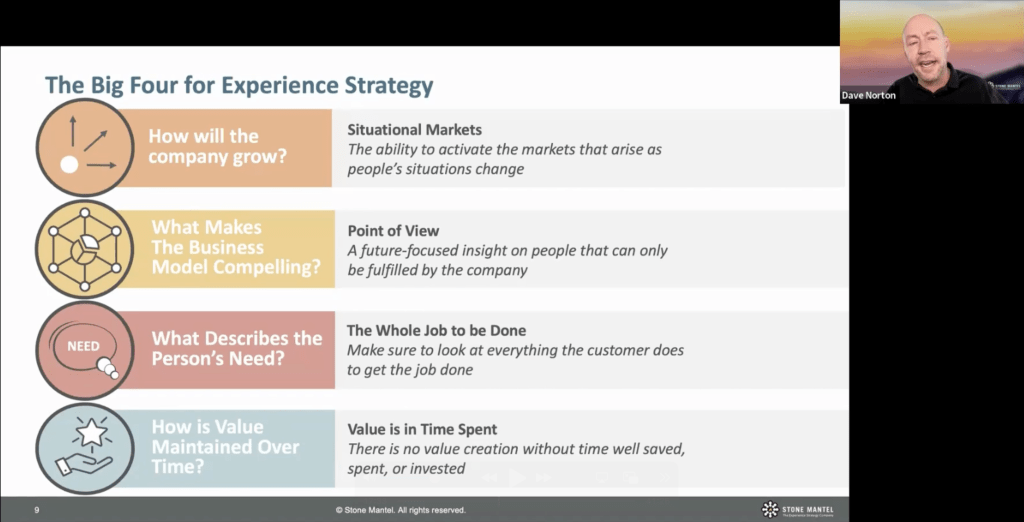
Stone Mantel organises experience strategy around four questions:
- How will the company grow?
- What makes the business model compelling?
- What describes the customer’s need?
- How is value maintained over time?
The corresponding principles are:
- Situational markets
- A strategic point of view
- The whole job to be done
- Value in time spent
Together, they describe how an experience business finds demand, develops a defensible proposition, serves customers completely and remains valuable.
Let’s take the questions one by one.
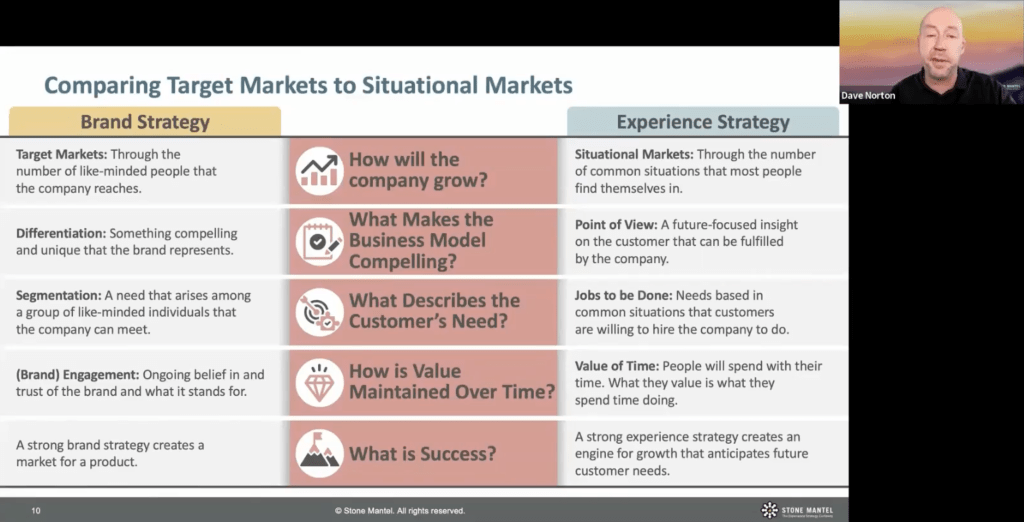
Q1. How will the company grow?
A. Replace target markets with situational markets
Most markets are defined around groups of people.
Businesses tend to divide customers according to age, income, attitudes, preferences or behaviour. They then develop propositions for the segments that research shows as the most attractive.
Norton proposes a different starting point:
“A market is not a group of people. It is a situation in which a need arises, and the company can fulfil it.”
Ten days before Christmas is a situation.
Breaking an arm is a situation.
Arriving in London for a short holiday and wanting to experience the city like a temporary local is a situation.
People within each group may have little else in common beyond the situation. What creates the market is the circumstance and the need produced by it.
This changes the growth question.
Instead of asking how many people fit the existing customer profile, the strategist asks:
- In what situations does this need arise?
- How often do those situations occur?
- Which related situations could the business also support?
- What prevents the company from being chosen when the need appears?
The more relevant situations the organisation can serve, the larger its potential market becomes.
Example: Taking a picture is situational
Norton contrasts a dedicated camera business with a smartphone ecosystem.
A camera company may define its market around photographers and compete through the quality of the equipment.
A smartphone is present whenever a picture-taking situation occurs.
The customer does not have to plan to become a photographer. Something happens, and they want to capture it.
The stronger strategic position belongs to the company that is available when the need arises.
That does not make demographics or personas redundant. It simply illustrates they should not be mistaken for a complete growth strategy.
Theory: A situation is not a mode
- A situation is external. It describes what is happening around the customer.
- A mode is internal. It describes a temporary mindset and set of behaviours.
- The job to be done is what the customer is willing to hire the company to help accomplish.
Someone may remain in planning mode while moving between several situations. They may also be in planning mode without wanting a particular company to help them.
Modes are therefore a useful research lens, but they are not an additional principle in the four-part framework.
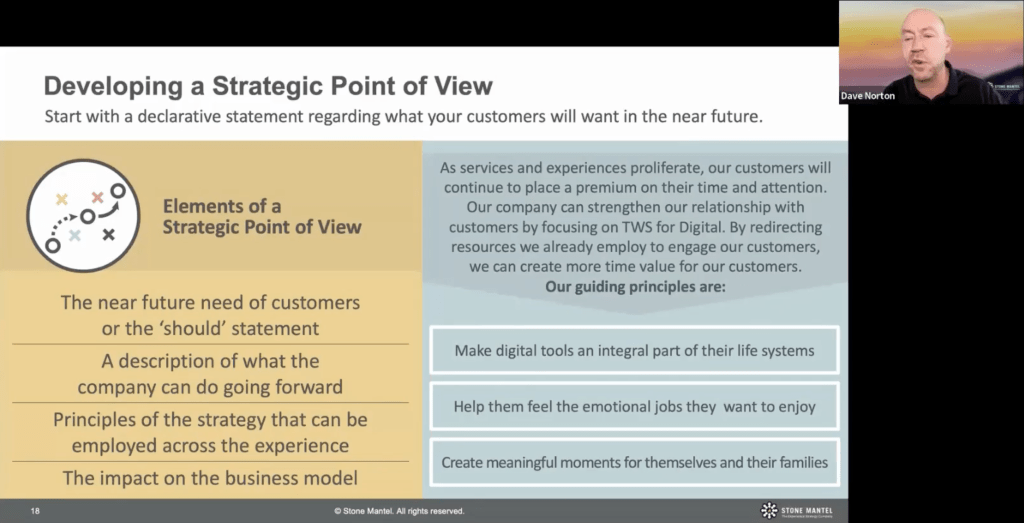
Q2. What makes the business model compelling?
A. Replace simple differentiation with a strategic point of view
Brand strategy often begins with differentiation:
- What makes the company distinctive?
- What position should it occupy?
- What should people associate with it?
Norton argues that an experience business needs something more fundamental: a strategic point of view.
This is not simply an executive’s personal opinion. It is a future-focused insight into what customers will need and how the company is equipped to respond.
A useful point of view includes:
- A near-future customer need
- What the company can do about it
- Principles that guide decisions across the experience
- The implications for the wider business model
“A point of view gives you an edge.”
For example, a company might believe that as digital services proliferate, customers will place a growing premium on their time and attention.
That belief should do more than inspire a campaign.
It should influence:
- the products the company develops
- the resources it allocates
- the measures it uses
- the experience it provides
This is the difference between a position and a point of view.
A brand position describes how the organisation wants to be perceived.
A strategic point of view describes what the organisation believes about its customers’ near future and what it intends to do as a result.
Example: Individualisation as a point of view
Stone Mantel’s own research offers an example.
Personalisation typically says: we know you.
It uses past preferences and behaviour to allow the company to customise what a person receives.
However individualisation says: we know how to empower you.
It places more control with the individual and responds to their current context, situation and job.
The distinction becomes strategically useful when the organisation commits to one side of it and changes its business accordingly.
It stops being a slogan based on a position and becomes a point of view.
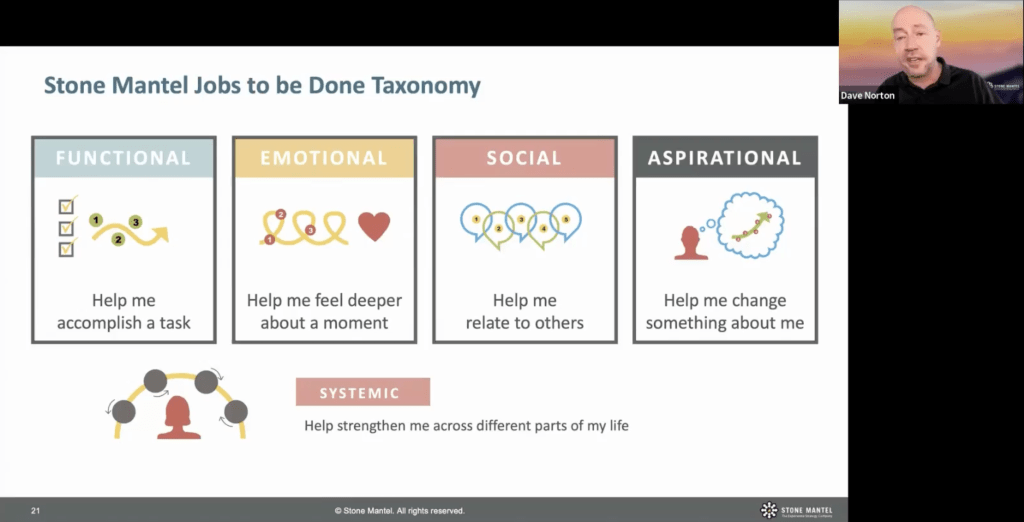
Q3. What does the customer need accomplished?
A. Replace isolated needs with the whole job to be done
Jobs-to-be-done thinking asks what the customer is hiring a product, service or experience to help them accomplish.
Stone Mantel extends this to the whole job to be done.
Its taxonomy includes:
- Functional jobs Help me accomplish a task.
- Emotional jobs Help me feel more deeply about a moment.
- Social jobs Help me relate to other people.
- Aspirational jobs Help me change something about myself.
- Systemic jobs Help strengthen me across different parts of my life.
An experience may need to support several of these at once.
In an experience, a visitor does not simply need to enter a venue, find a seat or complete a transaction. They may also want to connect with someone, feel part of a community or become more confident in future situations.
“Companies, for a long time, have been marketing things that sound aspirational, social and emotional, and then delivering things that look functional.”
Norton identifies a common gap:
- The marketing promises belonging, confidence or transformation.
- The experience processes a transaction.
Looking at the whole job forces the organisation to connect its original promise with what it can actually deliver.
It also prevents one department from treating a single touchpoint as the customer’s complete need.
The whole job may cross physical environments, digital channels, services, people and time.
Experience strategy thus decides what the customer needs accomplished before design teams determine how to provide it.
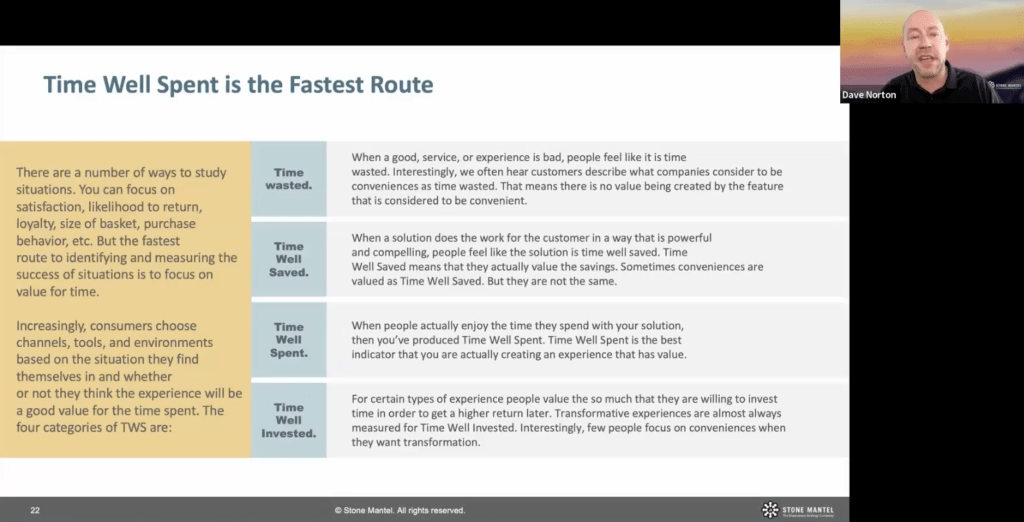
Q4. How will value be maintained over time?
A. Replace loyalty as the objective with value in time spent
Businesses often use repeat purchases, retention or recommendation as evidence of a strong relationship.
These measures describe what customers did.
They do not always explain whether the experience was valuable to them.
Norton argues that customers increasingly make choices according to time.
Stone Mantel distinguishes four possible outcomes.
(i) Time wasted
The customer feels that the process, product or experience was not worth the effort it required.
A feature described by the company as convenient may still feel like wasted time if it does not create meaningful value.
(ii) Time well saved
The company removes unnecessary effort or delay.
The customer reaches the desired outcome more quickly or with less work.
(iii) Time well spent
The customer values the experience while it is happening.
The time feels enjoyable, meaningful, engaging or personally worthwhile.
(iv) Time well invested
The experience creates a benefit that the customer can use later.
They gain knowledge, confidence, capability or insight that improves a future situation.
This is particularly important for transformational experiences. The value may not be fully realised during the event itself.
The customer invests time now to become better equipped for what follows.
The amount of time spent is not, by itself, proof of value. Someone may remain inside a digital platform because it is difficult to leave or spend longer completing a poorly designed process.
The smarter strategic question is how the customer judges that time.
How the four principles work together
Stone Mantel’s framework is most useful when its parts are connected.
- Situational markets identify where demand arises.
- The strategic point of view explains why the company should address that demand and how it believes the need will develop.
- The whole job to be done defines what customers actually need accomplished.
- Value in time spent determines why the relationship remains worthwhile.
Together, these answers form a business strategy.
Only then should the organisation decide what to build, how the journey should operate or which technology should support it.
What is the experience strategist’s role in this?
An experience strategist is not sat around waiting for the business strategy to be completed. They should be a part of creating it.
They help the organisation determine:
- where future demand may come from
- which customer need it is best placed to address
- what the complete proposition must deliver
- how customers will judge the value of their time
This work may involve primary research, strategic frameworks or applying the four questions to an existing proposition.
It should allow the business to explain not only what it intends to create, but why the proposition can grow and continue to matter.
“Experience strategy isn’t a discipline so much as it is a business-model strategy approach.”
That gives experience professionals a clearer position in a business setting.
Their role is not limited to making the proposition more entertaining, intuitive or attractive.
They help define how it creates value.
What to ask in your next meeting
Norton’s final slide turns the framework into a practical strategy review.
1. Situational markets
- What situations arise for customers that our proposition could address?
- What evidence helps us understand those situations?
2. Strategic point of view
- What future-focused customer insight currently informs our strategy?
- What do we still need to understand about the customer’s near-future needs?
3. The whole job to be done
- What does the customer do before, during and after using our proposition?
- How much of that complete job do we currently support?
4. Value in time spent
- How does the organisation currently measure success?
- What do we know about how customers judge the time they spend with us?
The central question is:
Do we have an experience strategy, or have we moved directly from a business ambition to an experience solution?
Norton’s wider argument is not that experience strategy should replace brand, design, innovation or operations.
It should give them a stronger foundation.
A good experience is not simply something that looks impressive or keeps people engaged.
It is a core part of a business model that knows where growth will come from, which human need it fulfils and why the customer will continue to consider it time well spent.
Further reading
- Stone Mantel’s official introduction to What Is Experience Strategy, including its distinction from marketing and brand strategy.
- Stone Mantel’s overview of the four principles of experience strategy.
- The original WXO Campfire listing for Dave Norton’s session.
- Stone Mantel’s Experience Strategy Certification overview, which develops each of the four principles in greater depth.
For more Experience Briefings, head here.
For more information on how to join the WXO, head here.