

- This event has passed.
Backrooms: From Creepypasta To Box Office #1 | How the Hit Horror Film Turned Internet Mythology Into Experiential Marketing Gold
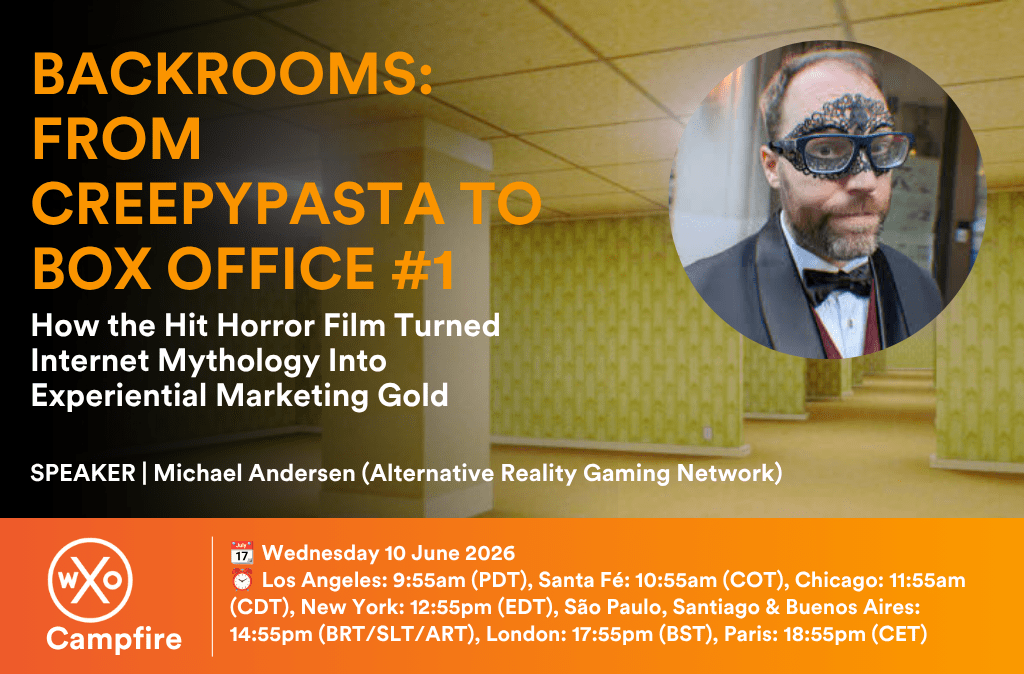
What happens when a piece of community-created internet folklore becomes the number one film in America?
Backrooms began life as a single unsettling image posted online.
From there it evolved into a collaborative creepypasta or unfiction phenomenon, inspired millions of fan theories, videos and discussions, spawned a hugely successful YouTube series, and has now become a major Hollywood release that opened at #1 at the US box office.
But the success of Backrooms isn’t simply a film story. It’s a masterclass in modern audience-building.
In this Campfire, WXO member and ARGnet (Alternative Reality Gaming Network) senior editor Michael Andersen explores how the film’s viral marketing campaign embraced the film’s online origins rather than replacing them with traditional studio promotion.
By leaning into mystery, community participation, fan speculation, analogue horror aesthetics and the immersive world-building that only ARGs can bring, the campaign has transformed cinema audiences from passive consumers into active collaborators.
Whether you’re an experience designer, a marketer or a storyteller, Michael deep dives into the Backrooms campaign offering an invaluable case study in how participatory culture, online mythology and experiential thinking can combine to create cultural momentum on a massive scale.
You’ll never look at a furniture store the same way again…
Key Takeaways:
• How a single piece of user-generated content evolved into a global entertainment franchise.
• Why creepypasta communities are among the earliest examples of participatory storytelling at scale.
• The role of mystery, ambiguity and audience speculation in driving engagement.
• How the Backrooms campaign blurred the line between marketing, world-building and fan culture.
• What experiential marketers can learn from alternate reality games, analogue horror and internet folklore.
• Why modern audiences increasingly want to participate in stories rather than simply consume them.
• How community ownership can become a competitive advantage rather than a threat to IP.
• Lessons for creating “viral by design” experiences that encourage sharing, discussion and collective discovery.
Who Should Attend?
• Experience designers and creative directors
• Brand marketers looking to build communities rather than campaigns
• Immersive and interactive experience creators
• Entertainment, media and franchise owners
• Audience development and engagement professionals
• ARG, gaming and transmedia storytellers
• Cultural strategists and trend forecasters
• Anyone interested in how internet culture is reshaping marketing, storytelling and audience behaviour.
About the host:
Michael Andersen is a writer, researcher and long-time observer of alternate reality games, immersive storytelling and participatory media. Michael is a Director of Cultural Intelligence at Simon & Schuster, and previously worked in Strategy & Analytics at Digitas Health.
He previously served as an adjunct professor at Villanova University, on the editorial board for the Health Matrix: Journal of Law-Medicine, as a senior editor of the Journal of Law, Technology & the Internet, and has published a number of articles exploring the intersection between business, communications, and the law.
After serving as a staff writer at ARGNet for three years, Michael took over as owner and senior editor in 2009.

How to watch this Campfire:
- Campfires are available for WXO members only
- To join the WXO, please head to our Application page
- The WXO is a global home for the leaders, shapers and doers in the Experience Economy
- As a member, you’ll get live access to Campfires like this one plus unlock an on demand library of over 100 Campfire recordings
Timings:
Campfire #2 is suitable for those in the US or Europe, but everyone is welcome! Here’s when we kick off in your time zone:
- London: 17:55 – 19:00
- Paris: 18:55 – 20:00
- Los Angeles: 09:55 – 11:00
- Santa Fe: 10:55 – 12:00
- Chicago: 11:55 – 13:00
- New York: 12:55 – 14:00
- São Paulo, Santiago & Buenos Aires: 13:55 – 15:00