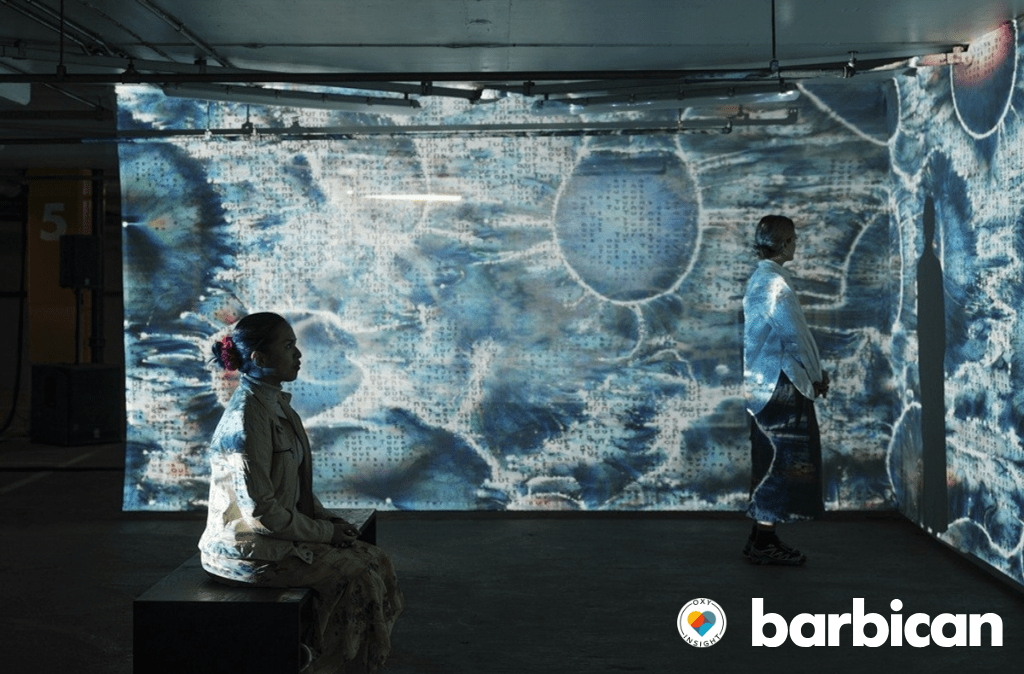

An iconic cultural venue used audience research to explore an emerging format without diluting its artistic identity. The result was not simply better data, but a new way of developing immersive experiences.
The Barbican approached immersive experiences from a position of strength.
It already had an internationally recognised artistic identity, a distinctive building and established audiences across music, theatre, dance, film and visual art.
That made the opportunity significant, but also complicated.
“Immersive” could mean digital art, participatory theatre, projection-led spectacle, gaming, wellbeing, education or entertainment. The category was growing, but its boundaries remained unclear.
The Barbican therefore faced a more useful question than whether it should “do immersive”:
What should immersive mean at the Barbican?
The answer could not come from copying successful attractions or asking audiences to approve individual concepts. It required the organisation to understand the category, identify the audiences it could credibly serve and connect that knowledge to programming, communications and experience design.
This Experience Briefing draws on a WXO Campfire with Sonia Joao and distils its most useful ideas for experience leaders.
Sonia Joao is Research Director at Oxy Insight. Working with quantitative research specialist Sam Rogers and the Barbican Immersive team, Oxy Insight created a research programme spanning audience strategy, brand proposition and the development of exhibitions including Feel the Sound and In Other Worlds.
The project shows how an established institution can enter an emerging experience category without abandoning its creative judgement.
The challenge: embrace the format without losing the institution
For an iconic venue, innovation creates a particular tension.
Move too cautiously and the organisation risks feeling remote from new audiences and emerging forms of culture.
Move too quickly and it risks following trends that do not fit its purpose, capabilities or artistic identity.
The Barbican was not trying to become a commercial immersive attraction. Nor did it want to restrict immersive work to existing visitors and familiar cultural conventions.
It needed to find the credible stretch between the two.
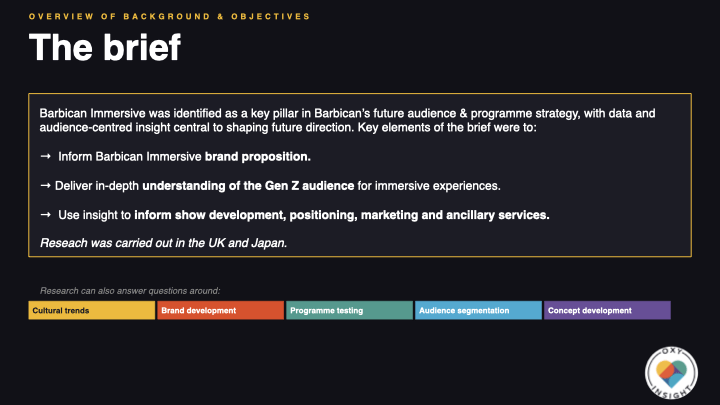
The brief therefore connected several questions:
- What should the Barbican Immersive proposition be?
- Who currently engages with immersive experiences?
- Which new audiences could the Barbican realistically reach?
- What do those audiences seek from immersive work?
- How should the findings influence shows, communications and the wider venue journey?
This was not one research question.
It was an organisational learning challenge.
Step one: understand the cultural territory
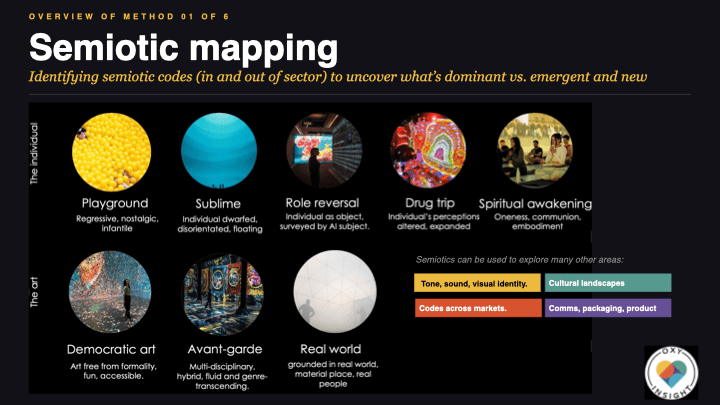
The programme began with semiotic mapping.
Semiotics examines the meanings carried by imagery, sound, language, colour and other cultural signals. It helps teams understand not only what they are communicating, but what audiences may infer from it.
For Barbican Immersive, Oxy Insight examined codes used across immersive entertainment and adjacent sectors including gaming, education and wellbeing.
This widened the frame.
Audience expectations are not formed only by other cultural institutions. They are also shaped by video games, digital platforms, commercial attractions, nightlife, wellness experiences and popular entertainment.
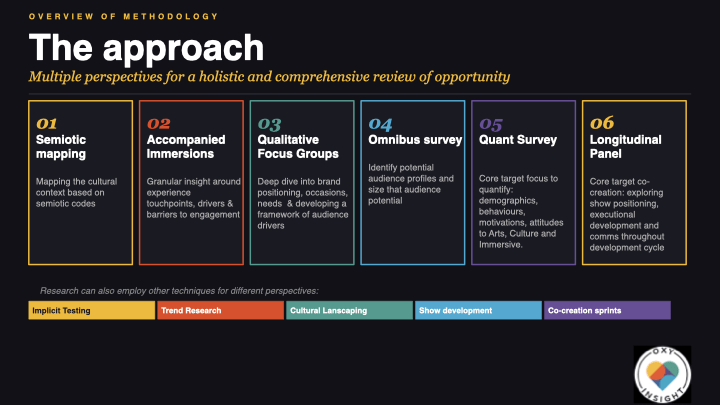
The wider research programme combined six methods:
- Semiotic mapping
- Accompanied immersions
- Qualitative focus groups
- An omnibus survey
- A targeted quantitative survey
- A longitudinal audience panel
The value was not simply in using several methods. It was in using each one to answer a different part of the Barbican’s challenge.
The semiotic research identified different creative territories and examined whether they felt established, overused or emerging.
One territory was the sublime: individuals dwarfed by vast landscapes, light or digital environments. This visual language can create awe, infinity and a feeling of human smallness.
It fitted naturally with some forms of immersive art.
But the research also identified a limitation.
The sublime can offer scale and spectacle without offering participation. For audiences expecting to influence, explore or interact with an experience, visual wonder alone may not be enough.
This distinction helped the Barbican examine not merely how an immersive experience should look, but what promise its visual language was making.
The international comparison also revealed that creative formats may travel more easily than cultural meanings.
Codes linked to psychedelia and drug culture resonated differently in the UK and Japan. Japanese audiences had different relationships with artificial intelligence, virtual performers and ideas rooted in concepts such as ma: the meaningful interval or space between things.
For experience leaders, the lesson is important:
Do not assume that an experience’s visual language will retain the same meaning when it enters a new market.
Step two: experience the category through the audience’s eyes
Cultural mapping established the wider territory.
The next stage examined what audiences actually encountered.
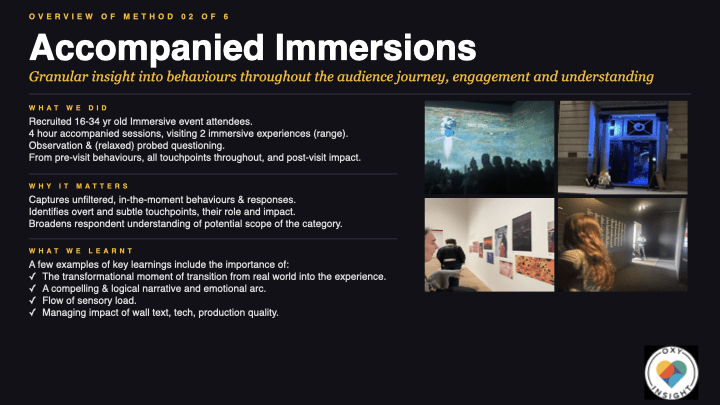
Researchers accompanied participants aged 16 to 34 on four-hour visits to two immersive experiences. They observed the whole journey:
- preparation
- arrival
- entrance
- navigation
- interaction
- reflection
This revealed details that conventional interviews can miss.
Participants may not remember every moment of uncertainty. They may struggle to explain why their attention dropped or why a space felt difficult to enter.
Observation makes those moments visible.
One of the most useful findings concerned the transition from the street into the experience.
- For an internal team, the entrance may appear to be an operational threshold.
- For a participant, it marks the moment the ordinary world should begin to change.
“That moment of going in is really important, and actually needs to signal that there’s a transformation happening.”
– Sonia Joao
Jeff Wayne’s The War of the Worlds: The Immersive Experience used imposing doors and an ominous reveal to signal entry into another reality.
Elsewhere, participants encountered an abrupt entrance followed by large quantities of wall text. The information may have been relevant, but it arrived before visitors had entered the experience emotionally.
The finding was not simply “reduce the text”.
It was about sequence.
An immersive experience must prepare people to cross a threshold. It needs to establish new rules, create anticipation and give participants confidence about how to behave.
The accompanied visits also highlighted:
- narrative and emotional flow
- sensory overload
- unclear instructions
- visible production technology
- inconsistent audio or visual quality
- points where participants followed companions rather than the intended journey
These are difficult for creators to assess from inside the project.
The team already knows what the space means and what the participant is supposed to do.
The audience does not.
Step three: define what audiences seek from immersion
The qualitative stage explored the motivations behind participation.
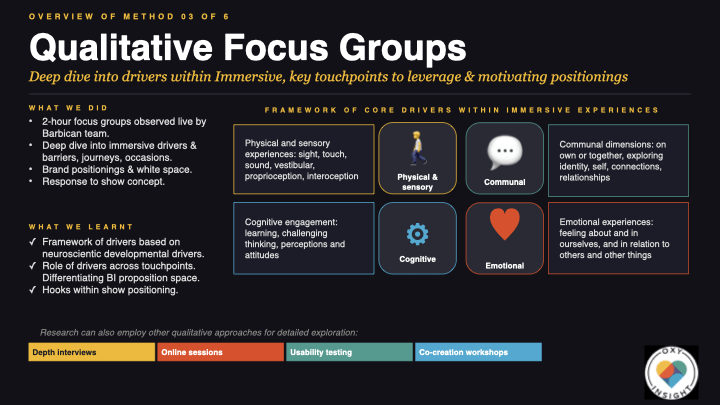
From this work, Oxy Insight developed a framework of four audience drivers.
1. Physical and sensory
The desire to experience sound, light, touch, vibration, movement, scale and spatial awareness.
2. Cognitive
The desire to learn, encounter unfamiliar ideas, challenge assumptions or see the world differently.
3. Emotional
The desire to feel something about oneself, other people or the wider world.
4. Communal
The desire to connect, belong, share or experience something alongside others.
The value of the framework extended beyond audience segmentation.
It gave the Barbican a shared language.
- Programming teams could examine which drivers a show was intended to activate.
- Creative teams could assess whether the design delivered those promises.
- Marketing teams could decide which benefits to communicate.
- Venue teams could consider whether the surrounding journey supported or undermined the experience.
This is one of the most significant outcomes of the project.
Audience research did not remain inside an insight department. It became a tool different teams could use to discuss the same experience.
It also challenged assumptions.
Social sharing and photo opportunities were less important to UK audiences than the team expected. High-quality audio and visuals, fun, novelty and the opportunity to escape into another world ranked more highly.
That does not mean audiences never share content.
It means shareability should not automatically be treated as the primary audience benefit.The desire to feel something about ourselves, other people or the wider world.
Step four: size a Barbican-shaped opportunity
Qualitative research showed what audiences might want.
The Barbican then needed to understand how widely those needs were shared and how large the potential audience might be.
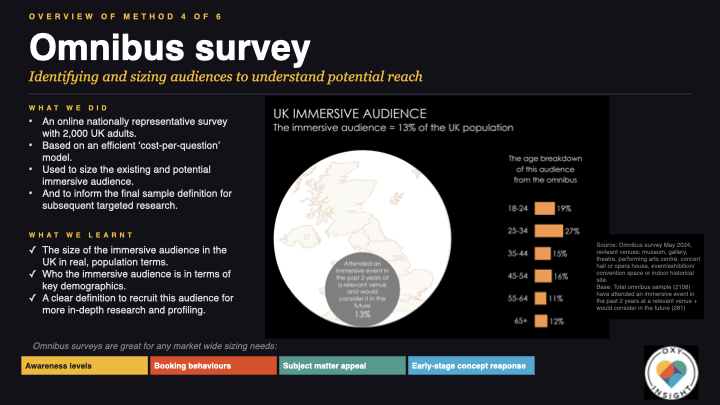
An omnibus survey of more than 2,000 UK adults provided a nationally representative view.
But the team avoided defining the opportunity as everyone interested in anything described as immersive.
That category could include escape rooms, theme parks, museums, theatre, digital art and branded activations. A large number would be commercially impressive but strategically unhelpful.
Instead, the research defined a Barbican-shaped immersive audience.
These were people who had attended, or would consider attending, immersive experiences in venues and cultural contexts the Barbican could credibly provide.
This distinction matters.
The relevant market is not always the largest possible category. It is the audience whose expectations match what the organisation can authentically deliver.
“We want to speak to people whose expectations fit with what the Barbican could realistically put on.”
– Sonia Joao
The omnibus research sized and profiled that audience. A further survey of approximately 500 people then explored their motivations, booking behaviour, priorities and price sensitivity in greater depth.
The sequence allowed the team to move from exploration to prioritisation:
- qualitative research revealed possible needs
- quantitative research showed how common those needs were
- profiling identified which audiences represented the strongest opportunity
This gave the Barbican a more credible basis for programming, positioning and investment decisions.
Step five: keep the audience involved during development
Many research programmes end with a presentation.
The Barbican’s research programme continued through the development process.
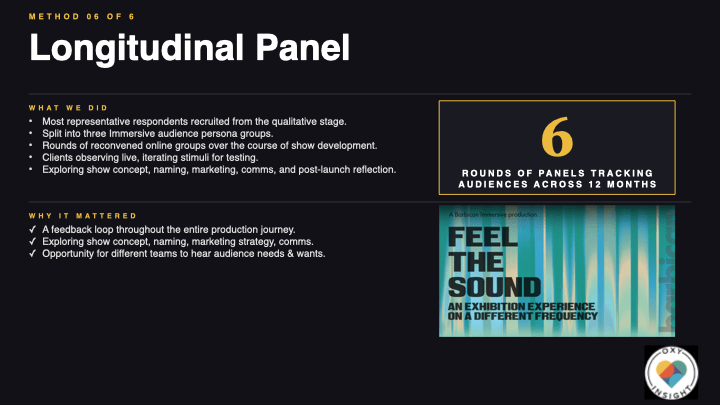
Representative audience members took part in a longitudinal panel, reconvening across six rounds over approximately 12 months.
The timing of each round aligned with real production decisions.
The panel explored:
- initial concepts
- show names
- website introductions
- positioning
- marketing communications
- exhibition layout
- sensory load
- post-launch response
This changed the role of research.
Instead of delivering a final judgement, it became a feedback loop.
When the team was developing a name, the audience could respond to the name.
When communications were being prepared, the research could identify which promises were clear, motivating or misleading.
When the layout was taking shape, participants could help the team understand where confusion or overload might occur.
Research arrived while change was still possible.
Crucially, the panel did not give audiences control over the creative idea.
Participants were not asked to design the exhibition.
They helped the team identify what they understood, what excited them, what felt alienating and where the intended idea was not yet landing.
Rogers describes these useful responses as the “gems” people take from a concept, alongside the watch-outs that may prevent it from connecting.
Research cannot reliably predict whether an unfinished experience will become a success.
That boundary protected the creative process.
From individual studies to organisational capability
The Barbican’s journey was not simply a sequence of methods.
It was a shift in how the organisation developed immersive work.
Different departments were involved from the beginning. Teams observed research sessions, heard audience language directly and participated in interim discussions.
This reduced the risk of insight being filtered into separate departmental reports.
Programming, creative, commercial, marketing and operational teams gained a shared understanding of:
- who Barbican Immersive was for
- what those audiences valued
- which experience drivers mattered
- how the proposition should be communicated
- where the venue journey affected the work
- which decisions required further evidence
This made research part of the organisation’s operating system rather than an external validation exercise.
It also gave the Barbican a stronger way to discuss immersive internally.
An emerging category can be difficult to support because different stakeholders may use the same word to mean different things.
A shared evidence base makes the conversation more precise.
What changed
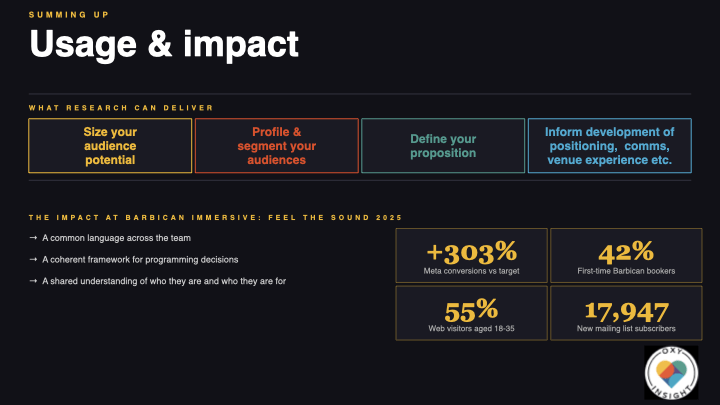
For Feel the Sound, the Oxy Insight case-study material associated the programme with:
- Meta conversions reaching 303% of target
- 42% first-time Barbican bookers
- 55% of website visitors aged 18 to 35
- 17,947 new mailing-list subscribers
The figures suggest that the programme reached beyond established audiences and created meaningful commercial and audience-development outcomes.
But the more durable result may be the capability developed around them.
The Barbican gained:
- a clearer immersive proposition
- a defined potential audience
- a framework for audience motivations
- a process for involving audiences during development
- a shared language across departments
- evidence that could inform future programming and investment
That is the difference between researching one show and building an immersive strategy.
What experience leaders can learn
1. Define the version of immersive that fits your organisation
Do not begin with the category label. Begin with what your organisation can uniquely contribute to it.
2. Study adjacent sectors
Your audience’s expectations may be shaped by games, hospitality, retail, entertainment and technology, not only your direct competitors.
3. Observe thresholds and transitions
The experience begins before the principal content. Entrances, instructions, queues and orientation determine whether people are ready to participate.
4. Turn audience needs into a shared framework
Insight becomes more useful when programming, creative, marketing and operational teams can all apply it.
5. Size the credible audience, not the theoretical maximum
A smaller, organisation-shaped opportunity may be more valuable than a large but irrelevant market estimate.
6. Place research beside live decisions
The right finding delivered too late has little value. Build audience contact around the moments when concepts, names, communications and designs can still change.
7. Keep the creative boundary clear
Audience-centred does not mean audience-directed. Research should sharpen creative judgement, not replace it.
The bigger lesson
The Barbican did not embrace immersive by commissioning a spectacular installation and hoping an audience would appear:
- It built the knowledge required to make immersive credible within an iconic institution.
- It mapped the culture around the format.
- It observed how audiences experienced the category.
- It translated audience motivations into a shared design language.
- It defined the opportunity on its own terms.
And it kept audience insight active while the work developed.
This approach allowed the Barbican to expand without simply chasing novelty.
The research did not reduce creative ambition.
It gave ambitious work a better chance of connecting.
The lesson for other established venues is not that they need six research methods or a year-long panel.
It is that entering a new experience category requires more than a new programme.
It requires a way to learn.
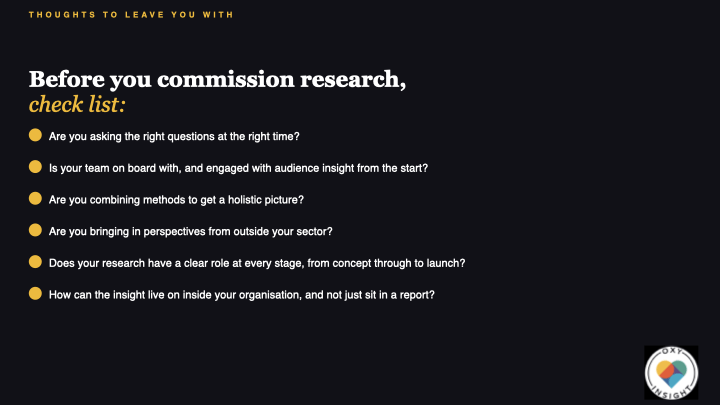
What to ask in your next meeting
- What should this emerging format mean for our organisation?
- Which audiences could we credibly serve?
- What expectations are they bringing from other sectors?
- Where does the current audience journey create friction?
- Which human needs should the experience activate?
- What evidence does each team need to make its next decision?
- How will audience learning remain active throughout development?
- The best experiences are not designed by committee.
- But iconic institutions do not remain iconic by designing in a vacuum.
For more Experience Briefings, head here.
For more information on how to join the WXO, head here.