
Diagnose your experience’s problem before you add more content, technology or spectacle.
Some experiences are easy to criticise.
They’re badly organised. Poorly produced. Confusing.
The more nuanced problem is the experience where everything looks good individually but the whole thing still feels… wrong.
✅ The technology works.
✅ The set looks impressive.
✅ The individual moments have been oh-so carefully designed.
Yet guests still leave the experience without feeling what the creators expected them to feel.
Emma Oliver calls this the Story Gap.
This Experience Briefing draws on a WXO Campfire with Emma Oliver and distils its most useful ideas for experience leaders.

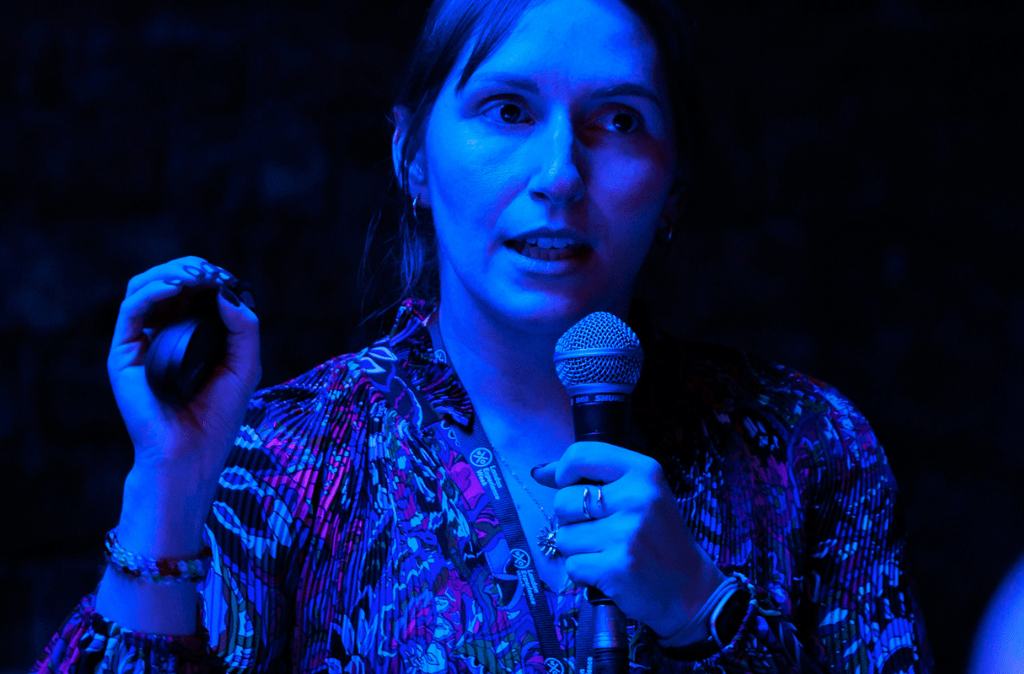
Emma Oliver is a writer and experience director who leads experience development through story. Her work has included Disney Live Entertainment, Universal Studios Japan and projects across live entertainment, attractions and immersive experience.
In April 2026, Oliver ran a popular Tools for Transformative Experiences workshop at London Experience Week, where she delivered a breakdown of the narrative fundamentals that directly drive return visits, advocacy and stronger guest impact.
Building on this, her recent WXO Campfire had one clear intention to differentiate it from any previous workshop: she wanted to remove “story” from the narrow world of plot and characters. In Oliver’s world:
- The guest is the protagonist.
- The experience is the journey.
- The eventual feeling, understanding or takeaway is the resolution.
For Oliver, story is now a way to organise the experience rather than an extra layer of content.
And that’s where Oliver aims her guns – an experience’s story.
It’s in your experience‘s story where there may be gaps that are seriously affecting your guest‘s enjoyment of your latest creation – stopping them getting to any form of resolution.
In this latest Experience Briefing, we show you what you can do specifically to identify – and fill – these Story Gaps.
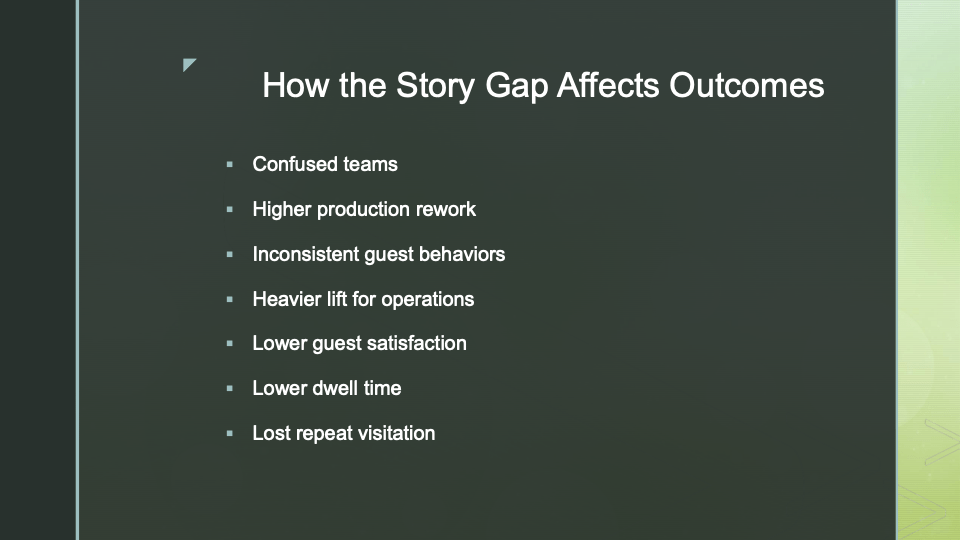
Warning! Your experience may have a Story Gap
Oliver identifies three different ways – or types of Story Gap – where an experience can fail.
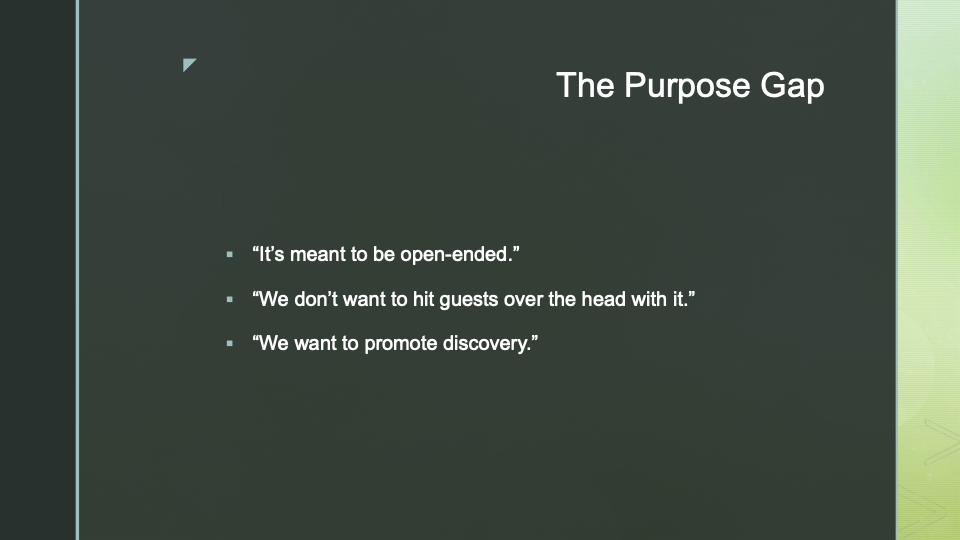
1. The Purpose Gap
The experience is unclear about what it is for.
The team may talk about discovery, openness or subtlety without having actually agreed what it wants the guest to do, feel or become.
Result: Guests experience that ambiguity as confusion.
2. The Cohesion Gap
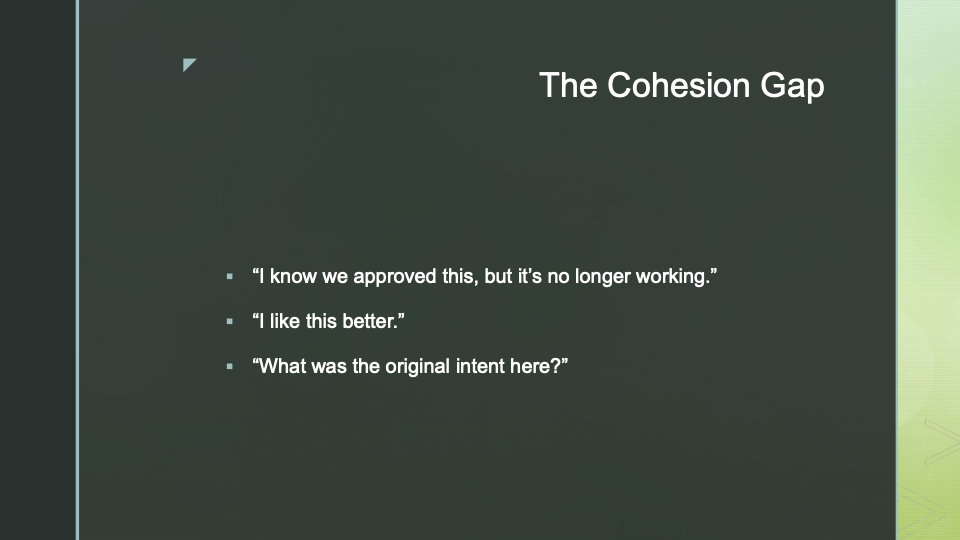
The parts work individually but compete as a whole.
Design, narrative and operations may all be solving slightly different versions of the problem.
Result: A collection of impressive moments rather than one coherent experience
3. The Emotional Gap
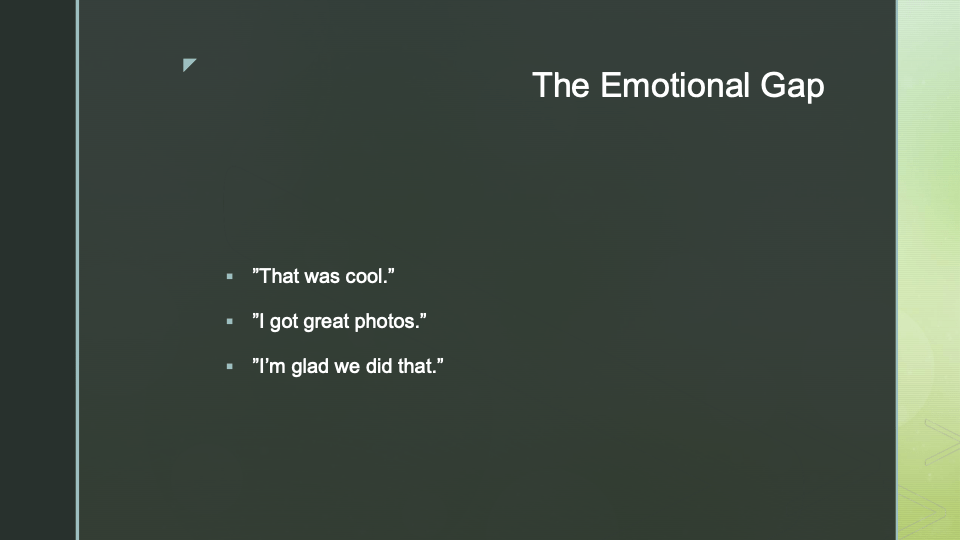
The experience performs functionally but does not create the intended emotional journey.
Result: Guests may say it was cool, photograph it and enjoy themselves without wanting to return, recommend it or think about it afterwards.
These are all different gaps.
They all expose different faults.
They all need different fixes.
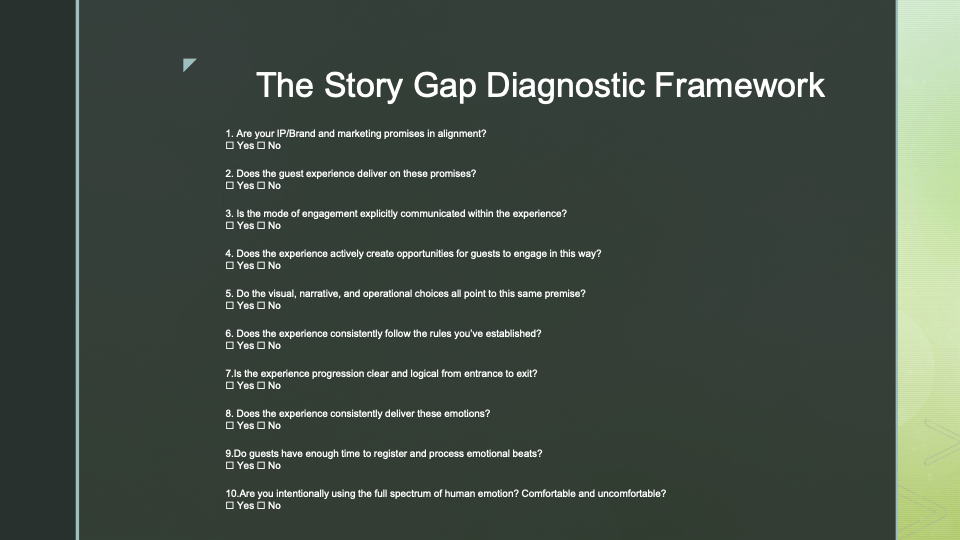
The 10-question Story Gap audit
This is the most useful part of Oliver’s framework for you to take away and use.
To begin, take an existing experience and answer the below questions honestly.
Section 1.
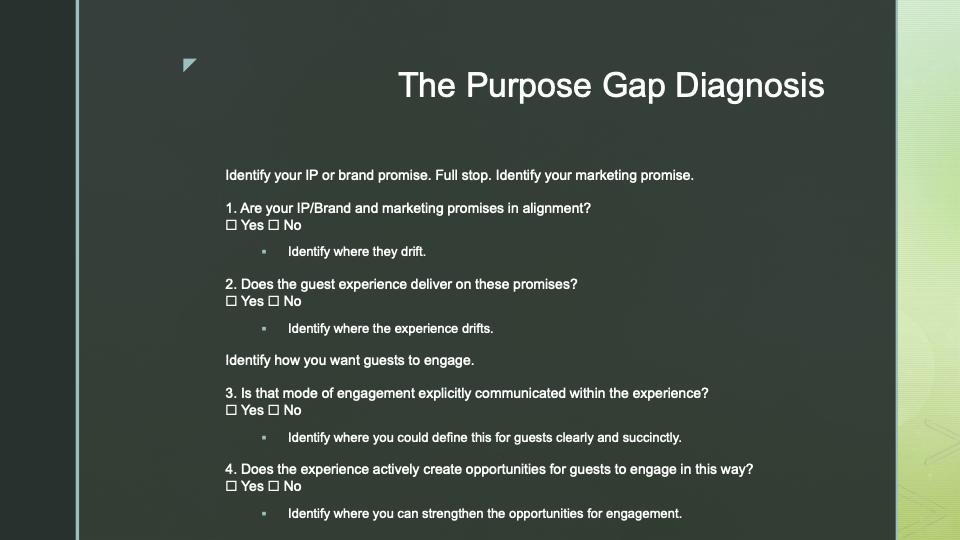
Purpose: is the promise clear and delivered?
1. Are the brand or IP promise and the marketing promise aligned?
What does the brand make people expect?
What does the title, advertising and positioning lead audiences to expect from this particular experience?
Those promises should not point in different directions.
2. Does the experience actually deliver them?
A marketing promise is part of the experience.
If the campaign promises adventure but guests spend most of their time waiting, the problem cannot be solved by saying the marketing and experience are separate disciplines.
Look specifically for the places where expectation and delivery drift apart.
3. Do guests understand how they are supposed to participate?
Are they…
- Playing?
- Exploring?
- Watching?
- Reflecting?
- Solving?
- Participating actively?
The team should know.
The guest should not need to guess.
4. Does the experience actually give them opportunities to do it?
Telling somebody they are an explorer is meaningless if the journey gives them no meaningful choices.
Promised participation has to appear in the structure of the experience.
Section 2.
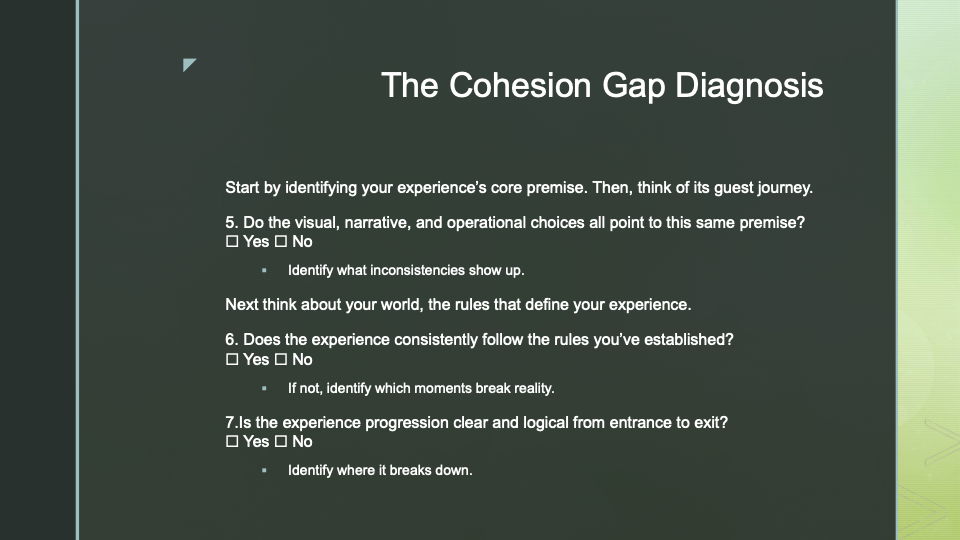
Cohesion: is everybody building the same experience?
5. Do all the choices point to the same premise?
- Visual design.
- Narrative.
- Operations.
- Music.
- Technology.
- Staff behaviour.
The experience needs a central idea strong enough for each discipline to test decisions against it.
6. Does the experience obey its own rules?
Every designed world establishes expectations.
Those rules can be physical, narrative, emotional or operational.
Breaking them unintentionally weakens belief in the experience.
7. Does the journey make sense from entrance to exit?
A collection of good moments is not enough.
The guest needs to understand why one thing leads to another.
Oliver borrows a useful test from screenwriting:
Therefore or but should connect the beats.
If the structure is simply:
this happened, then this happened, then this happened…
there may be activity without progression.
“If you use the word ‘then’ between scenes, we’ve abandoned causality and have more than likely lost our audience.”
Section 3.
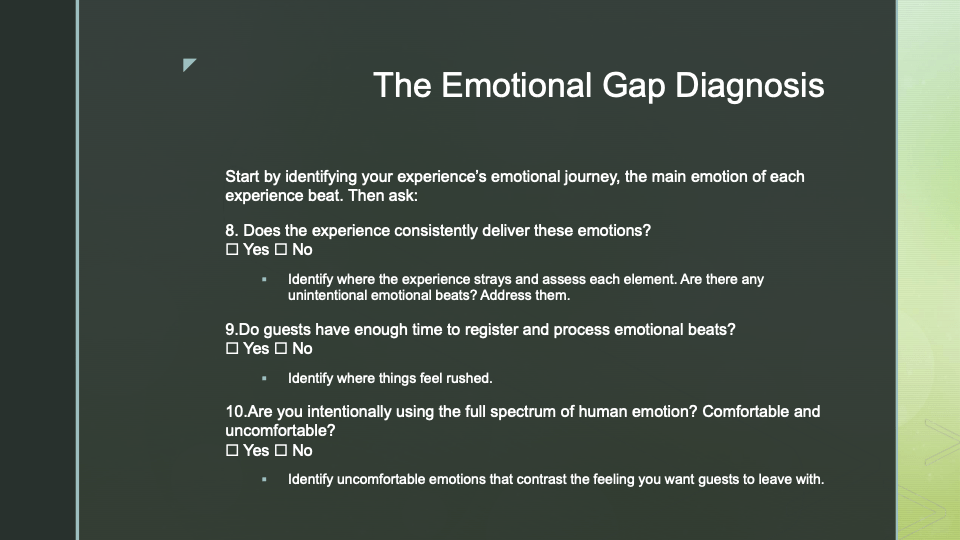
Emotion: does the experience feel the way you intended?
8. Is each beat creating its intended emotion?
Dialogue, lighting, sound, pacing, spatial design and performance all influence the feeling.
If the team cannot name the intended emotion, it becomes difficult for multiple disciplines to reinforce it.
9. Does the guest have time to feel it?
Experiences can move too fast.
Oliver pays particular attention to beginnings and endings because guests need time to enter an emotional state and time to process what happened before being pushed out of it.
10. Is there enough emotional contrast?
Not every beat needs to feel good.
- Tension can strengthen relief.
- Uncertainty can strengthen achievement.
- Loss can strengthen redemption.
Oliver’s point is not to make guests miserable for dramatic effect. It is that meaningful emotional movement requires contrast rather than one continuous emotional note.
Found your gap? Now use the right tool to fix it
The diagnostic tells you where the experience is failing.
Oliver’s narrative systems help decide what to do about it.
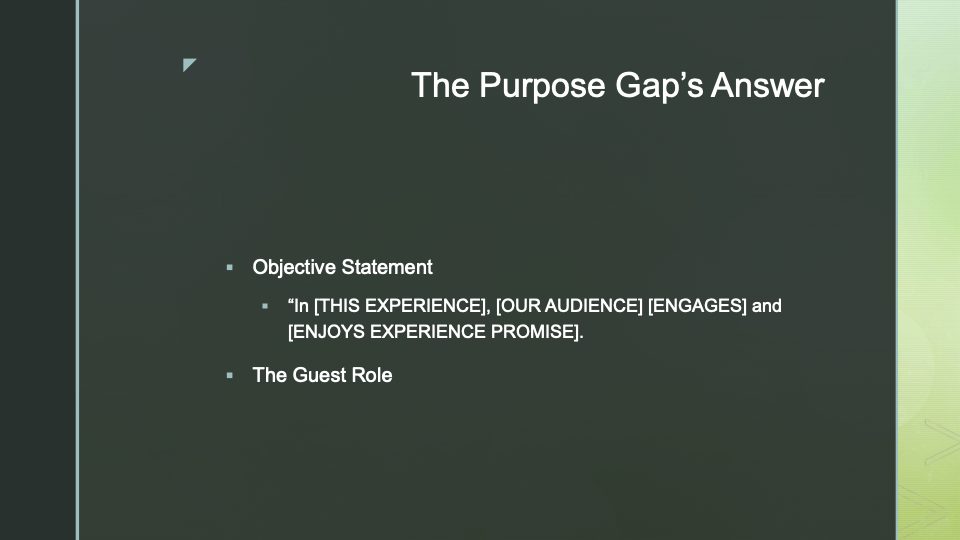
1. Fix Purpose with an objective and a guest role
An objective statement can be one or two sentences.
It identifies:
the audience + what they do + the experience promise.
Oliver keeps this at the top of project documents so different teams are repeatedly working from the same definition.
Then give the guest a role.
It might be specific, such as spy or recruit.
It might simply be observer, player or participant.
The purpose is not mandatory role-play.
It is clarity about the relationship between guest and experience.
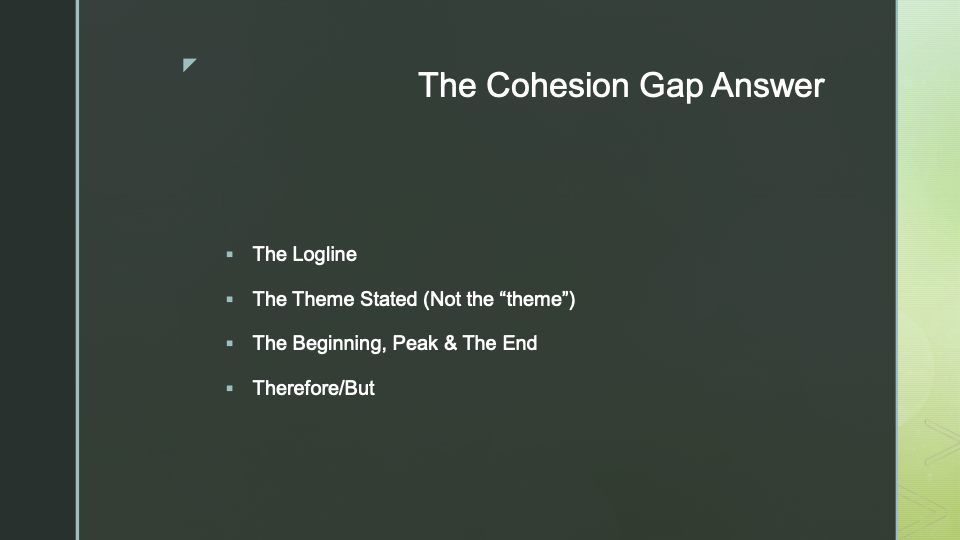
2. Fix Cohesion with a North Star
A complicated experience often needs something simple at its centre.
That might be as simple as a logline that explains what happens.
Or a theme stated expressing what the experience is ultimately saying.
Oliver describes one heavily world-built project that became clearer when its central idea was reduced to:
We are stronger together.
Once that existed, unnecessary material and conflicting ideas became easier to identify.
Some example loglines:
Sherlock Holmes & The Curse of the Rose Sword:
▪ When a faceless villain holds the guests of a horror movie premier hostage, the guests must help Sherlock Holmes and Dr. Watson unmask the villain and thwart their evil plan.
Museum of Money
▪ Through playful, hands-on exhibits and data-driven storytelling, we trace money’s journey from minting presses to blockchain nodes.
A Fictional Money Museum
▪ Guests explore taxes, trade restrictions, and control of currency in America during the 1700s then vote on whether or not to declare the American Revolution.
This is what makes the tool operational rather than literary.
When a team proposes another feature, the discussion becomes:
Does it strengthen the agreed experience?
not:
Which idea does the most senior person like?
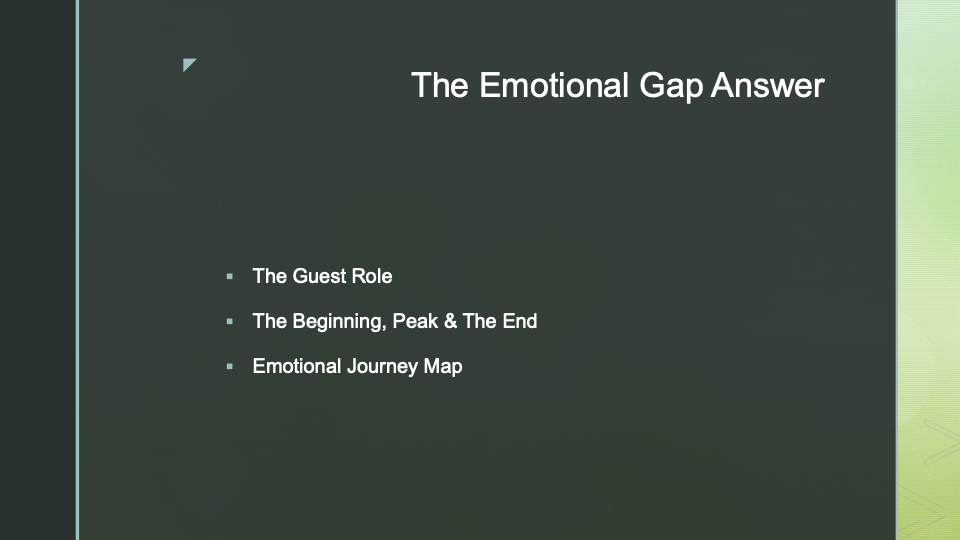
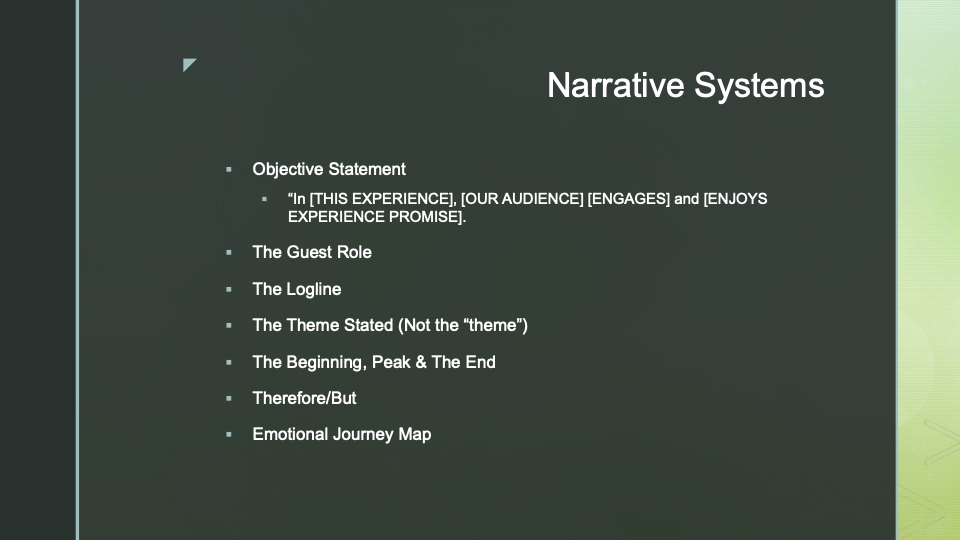
3. Fix Emotion with an emotional journey map
Oliver’s emotional map for experiences can be very simple.
Three to five beats may be enough.
For each stage ask:
- What should the guest feel?
- What supports that?
- What undercuts it?
- Are we rushing past it?
This map gives physical design, dialogue, sound, light, technology and operations the same emotional target.
Do not automatically fix a weak experience by adding more features
This is the commercial value of Oliver’s creative framework.
A disappointing experience often attracts more content.
- Another interaction.
- Another room.
- Another technology.
- Another character.
- Another spectacular moment.
All of these costs money.
But fixing a Purpose Gap may mean reducing ambiguity.
A Cohesion Gap may simply require removing things.
An Emotional Gap may need applying more time – not more content.
Diagnosis comes first.
This is especially important late in development, when built assets and technology may already be locked and every additional fix creates further production cost.
Oliver describes being brought into projects when design decisions have already been made or media is already being rendered, leaving the story to be retrofitted around expensive decisions that cannot move.
The Story Gap framework gives teams an opportunity to find that problem earlier.
Story is a decision-making system
The value of all this is not that an experience becomes more “story-like”.
It is that teams gain shared criteria:
- A writer.
- Producer.
- Operator.
- Architect.
- Designer.
- Marketer.
- Technologist.
Each can now test their work against the same purpose, premise and intended emotion.
“When every single discipline can point back to one of these narrative systems, decisions stop being personal and start being purposeful.”
That may be the most useful definition of story in the whole framework.
It simply makes everything else easier to decide.
What to ask in your next meeting
Start here:
Is the experience we have created actually delivering the experience we promised?
Then diagnose against the three Story Gaps:
- Purpose: Do people understand why they are here and what they can do?
- Cohesion: Is every discipline reinforcing the same experience?
- Emotion: Are guests feeling what we intended, with enough time for it to matter?
Do not discuss the solution until you know which problem you are solving.
Well done. You’re now closing the Story Gap.
Further reading
- Original WXO Campfire listing and Emma Oliver biography.
- Oliver on ‘Tools for Transformative Experiences’ at London Experience Week 2026.
- Emma Oliver: Official website.
For more Experience Briefings, head here.
For more information on how to join the WXO, head here.