Secret Cinema evolved its format for Grease to make large-scale immersive productions easier to enter, operate – and repeat.
Secret Cinema is an immersive entertainment company that turns familiar films and stories into large-scale live worlds.
From Dirty Dancing: The Immersive Experience to Guardians of the Galaxy: The Live Experience, its many IP-driven productions successfully combine screen content, performance, detailed environments and audience participation. The company describes itself as a global production and creative studio specialising in collective theatrical experiences.
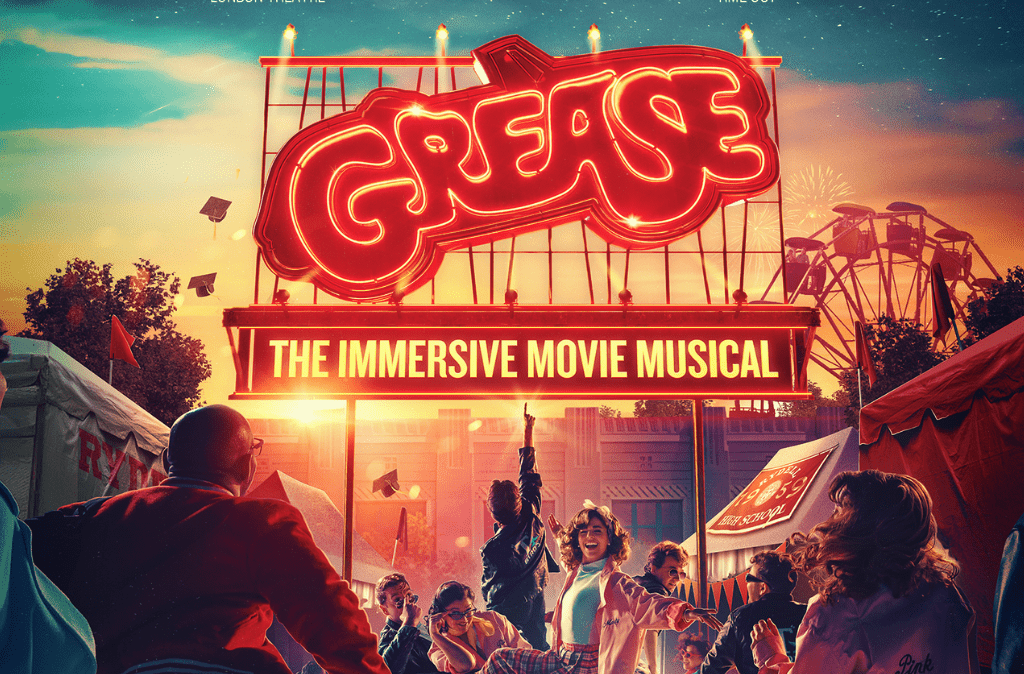
Matt Costain is Secret Cinema’s senior creative director. He directed Grease: The Immersive Movie Musical, which transformed the world of the iconic 1978 film into a live production built around Rydell High, a summer fairground, a classic American diner and multiple screens.
As well as translating the world of Grease to the live arena, the 2025 (and now 2026) project gave Secret Cinema an opportunity to rethink a model that had become increasingly demanding for both audiences and operators.
Secret Cinema’s earlier productions frequently involved a long period of free exploration, followed by the parent film and then an afterparty. Some productions lasted five hours or more.
The worlds slowly became richer, but the required audience investment became harder to communicate and maintain.
People needed to arrive early. They felt the pressure to dress elaborately. They could worry that an important scene was happening somewhere else. A format designed to create discovery could now produce frustration.
For Grease, Secret Cinema gave themselves an additional task alongside translating the film to the live stage: to keep the live spectacle while removing unnecessary barriers.
This Experience Briefing draws on a WXO Campfire with Matt Costain and distils its most useful ideas for experience leaders.
Costain’s role in the briefing is to explain the thinking behind the production through a Creative Director lens. The work itself belonged to Secret Cinema and the huge amount of creative, technical and operational teams that developed and delivered it.
But whoever you speak to, the central lesson is simple:
Large-scale immersion does not always become stronger by adding more. It can become stronger by making its main promise clearer.
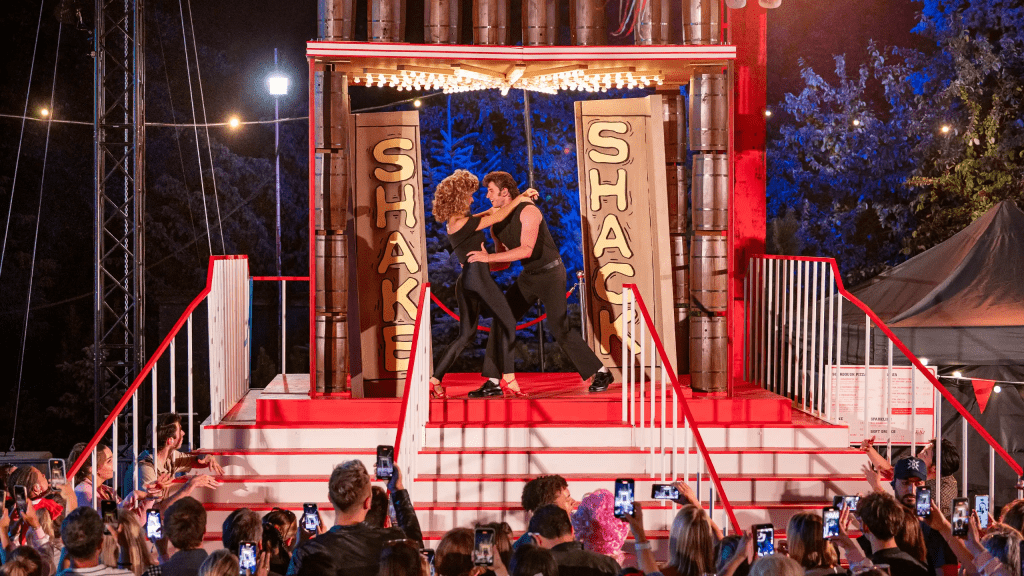
Matt Costain is an Olivier Award-winning creative director, actor and aerialist. His Secret Cinema credits include Dirty Dancing, Bridgerton, Diablo: The Gathering, Stranger Things and Star Wars: The Empire Strikes Back.
Grease: The Immersive Movie Musical opened at Battersea Park in 2025 and returned for a second summer in July 2026, with additional themed Roam and Return seating introduced following the first run.
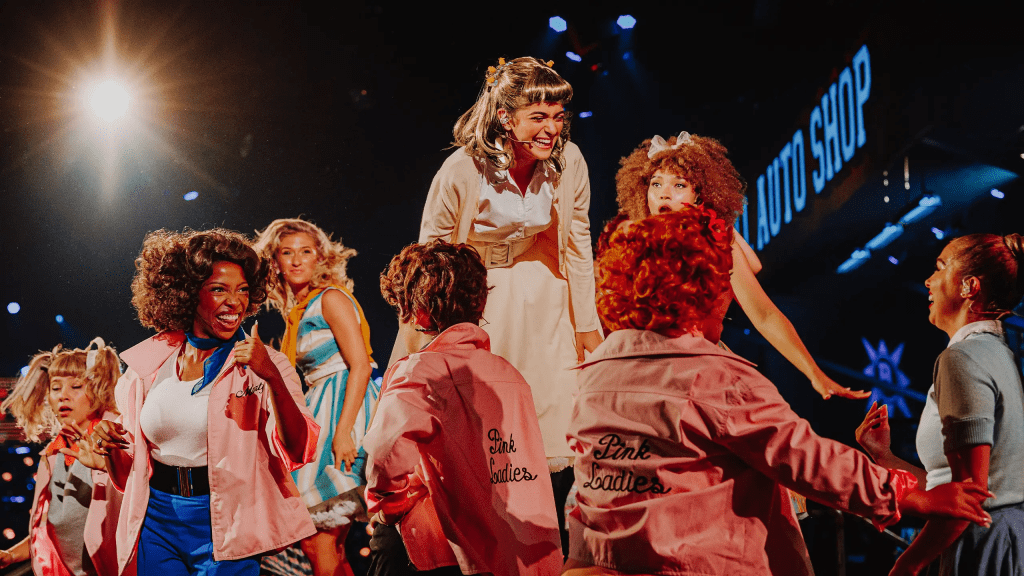
The old format had stopped fitting people’s lives
Secret Cinema’s original model invited audiences into a detailed film world before bringing them together for a screening.
As those worlds became more ambitious, people wanted more time to explore them. Earlier opening times followed. Anyone arriving later could feel they had already missed part of the experience.
Costume requirements created a similar tension.
Committed audiences enjoyed dressing for the world. Newcomers and more casual attendees however could see the preparation as another obstacle between them and the experience.
The same applied to free-roaming stories. The fact that nobody could realistically see everything encouraged discovery – but it also created a fear of making the wrong choice.
Secret Cinema needed a new format that could serve its core audience without assuming that every guest wanted to surrender an entire evening to exploration.
The answer that emerged began to resemble conventional theatre:
- a recognisable start time
- a clear running time
- one main audience environment
- a structure people could understand before buying
“It turned out that we’d accidentally reinvented theatre.”
– Matt Costain
That was not a retreat from immersive work.
Theatre timings exist because they fit around work, travel and daily life. Treating audience time as a useful constraint allowed Secret Cinema to make a large production accessible to more people.
Build one world instead of several competing journeys
Secret Cinema had previously staged Grease through an outdoor festival model in Birmingham, UK.
The title suited the format. It offered music, dancing and a fairground atmosphere. But it also offered considerable operational risk.
The outdoor model exposed the production to weather and thus the potential of late-booking. Equally, a site might be operationally suitable but fail to evoke the world of the film in question.
The London production still needed indoor and outdoor space – that couldn’t be avoided – but it quickly realised it didn’t need several overlapping narratives.
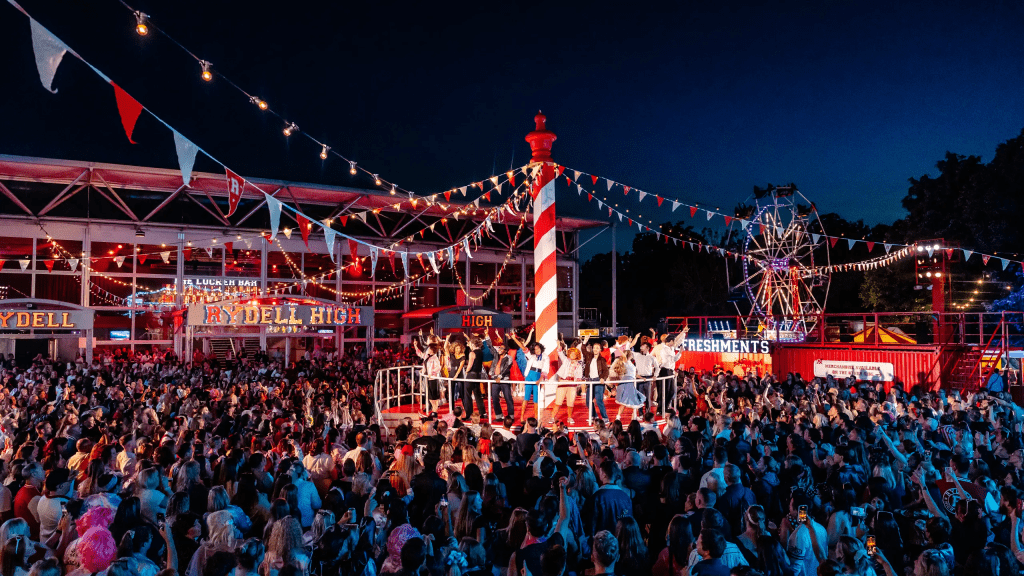
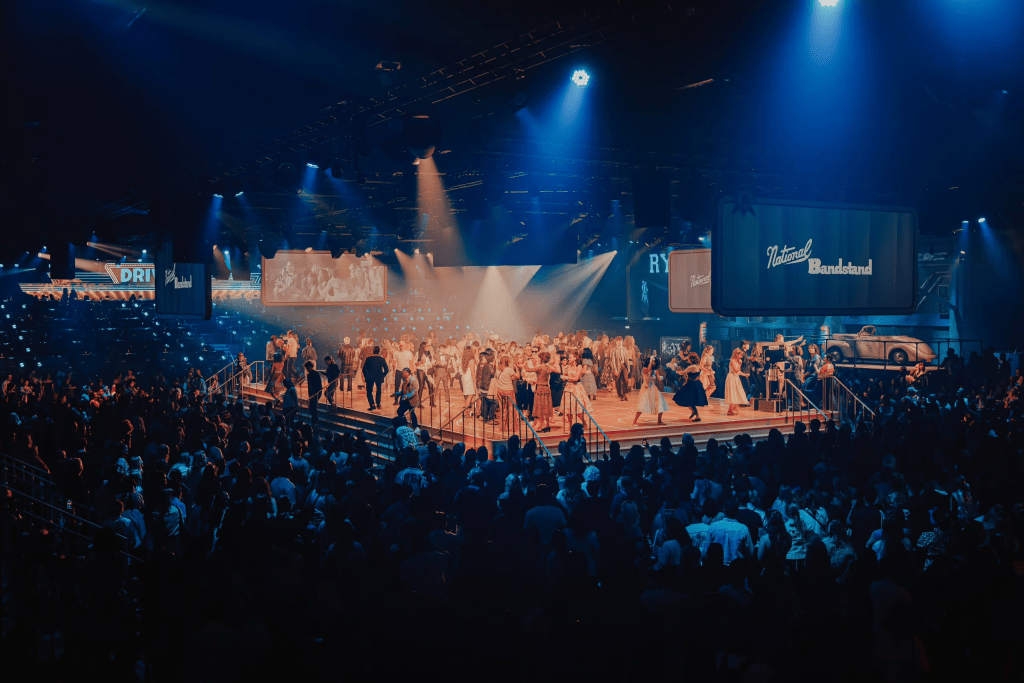
Secret Cinema decided to move the experience into two connected physical areas, with the film now operating as an integrated part of the world.
1. The fairground
The outdoor area allowed guests to arrive, eat, drink and adjust to the environment.
Secret Cinema deliberately avoided turning it into a complicated pre-show with onboarding. Guests did not need to complete a mission or worry that the main story had already started.
The space had a clear function.
2. Rydell High
The audience then moved into Grease‘s famous school environment, where live performers, physical sets and the film now existed together.
The live production could ‘take over’ from the film for major musical numbers. Characters could enter the audience. The world of Rydell High now continued around the screens.
3. The film
The film was now not shown after the immersive section.
It became part of the environment and fully integrated in the experience.
Secret Cinema negotiated permission to lower its soundtrack, perform songs live and pause the screen content while live action took over. This allowed the film and the physical production to work together rather than compete for attention.
The resulting format was less free-roaming than some earlier Secret Cinema work, but it offered a clearer communal experience. Media coverage also noted the production’s greater emphasis on accessibility and collective participation.
Begin with the promise, not the content list
Secret Cinema’s original guiding question to its large-scale productions was:
“What would it feel like if I was living in the movie?”
For Grease, the answer was now not simply to reproduce as many scenes as possible. It was subtler than that.
Yes, audiences wanted to enter Rydell High, encounter the characters and take part in the social energy of the film.
That truth gave the team a way to test each idea.
Would adding another activity deepen the feeling of being at Rydell?
Would it help the audience participate?
Or would it become just one more thing to find, explain and operate?
This distinction matters because ambitious productions easily accumulate content.
A new scene may be entertaining on its own but ultimately it could weaken the complete journey by competing for time or attention.
To add or not to add. Sadly the answer to this and other questions could not come from the paying customers. Audience research can help identify expectations and barriers. It cannot supply the true creative vision. The new.
“The audience don’t know what they don’t know. They can imagine things that they’ve seen before and they know things that they like, but they don’t necessarily have the vision to come up with a new thing. It’s our job to come up with a vision and not let them down.”
The audience can tell a team where the old proposition is confusing.
The creator still has to decide what the new experience should be.
Establish the rights before developing the detail
Film-based live experiences operate inside a complicated rights environment.
For Grease, the film rights and theatrical performance rights were held separately. Secret Cinema needed permission both to show the Paramount film and to perform the material live.
The team established what could be changed before building the production around assumptions.
Paramount permitted Secret Cinema to lower the recorded soundtrack and perform songs live. The film could appear across multiple screens, pause and temporarily give way to live footage or original material.
Inevitably, there were limits with this ‘freedom’.
Any screen showing the film had to display the complete image. The production could not crop different sections of the frame and distribute them around the room.
Much like the constraints of time and commitment, these conditions shaped the design.
They determined how the screens were used, where live numbers could take over and how the film remained visible inside the environment.
The rights agreement was not paperwork attached to a finished idea.
Rightly or wrongly, it was now part of the creative brief.
Make an unfamiliar format visible
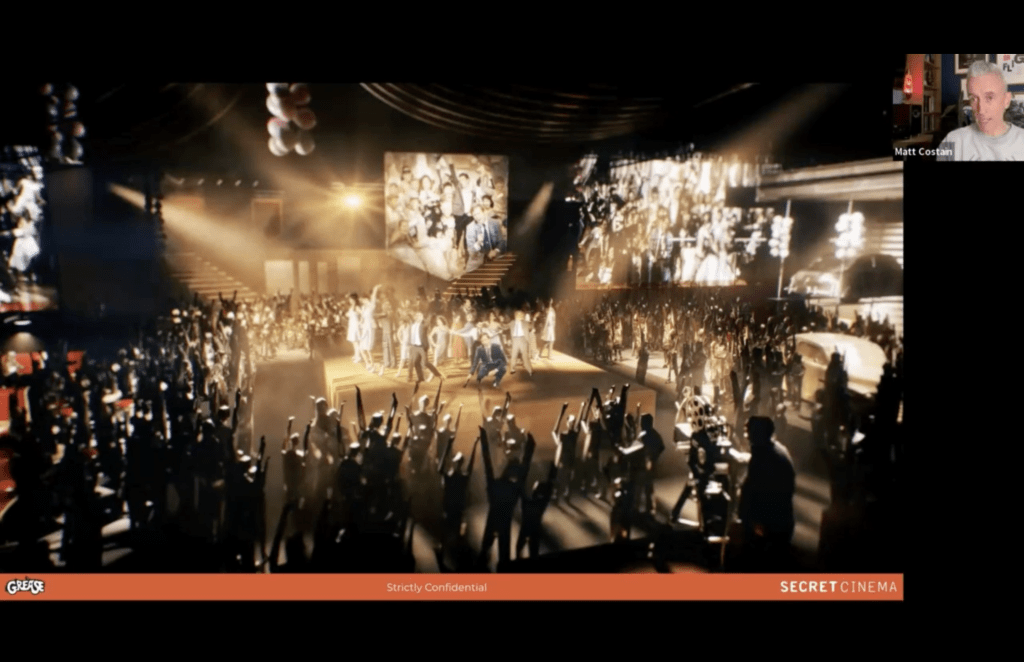
Large-scale immersive ideas are difficult to explain to rights holders through a written treatment (see The Story Codex).
- A school gym suddenly becomes a cinema?
- Live performers occupy the floor?
- The film now surrounds the audience?
- A diner and an autoshop operate inside Rydell High?
Without a shared visual reference, each stakeholder may imagine something different – and thus input a different opinion.
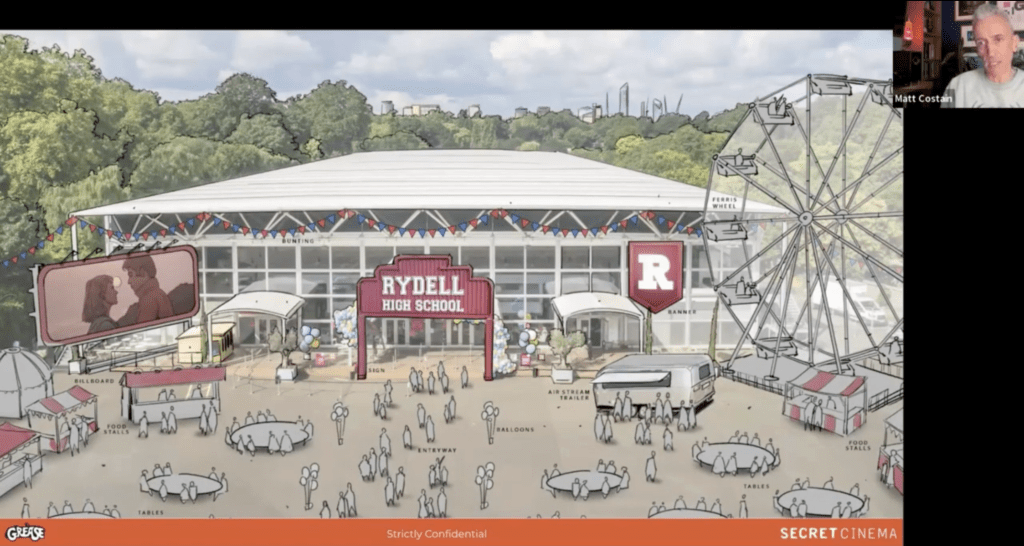
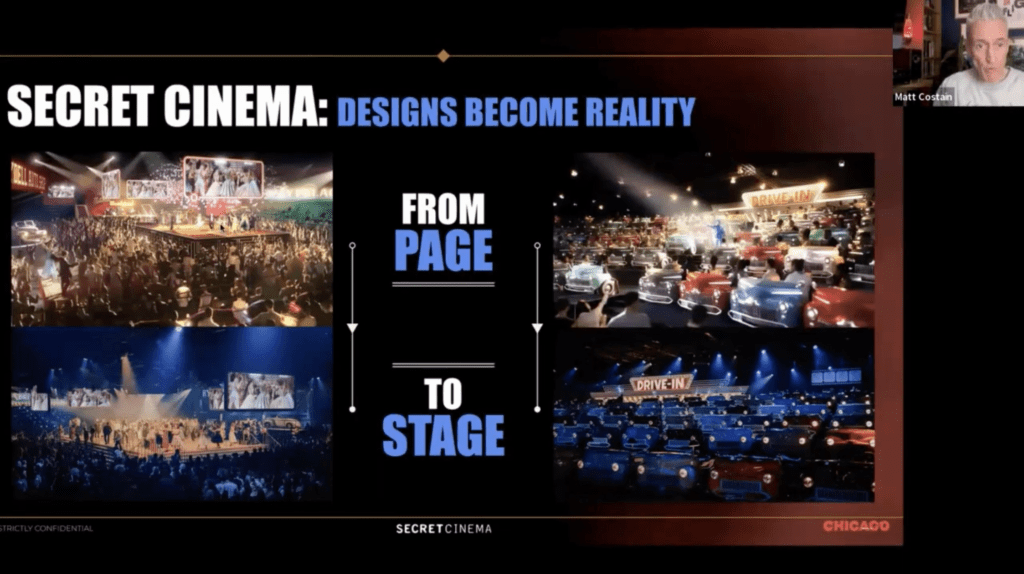
Secret Cinema used detailed renders and three-dimensional plans to give Paramount and the production team something specific to examine.
“As soon as you show them a picture, everyone’s like, ‘Oh, yeah. That makes total sense.’”
The images allowed approval conversations with Paramount to become practical. Questions now became useful to the production as opposed to asking for clarity:
- Could audiences see the screens from each position?
- Where would the live numbers happen?
- How would the film remain legible?
- Would the room hold the required capacity?
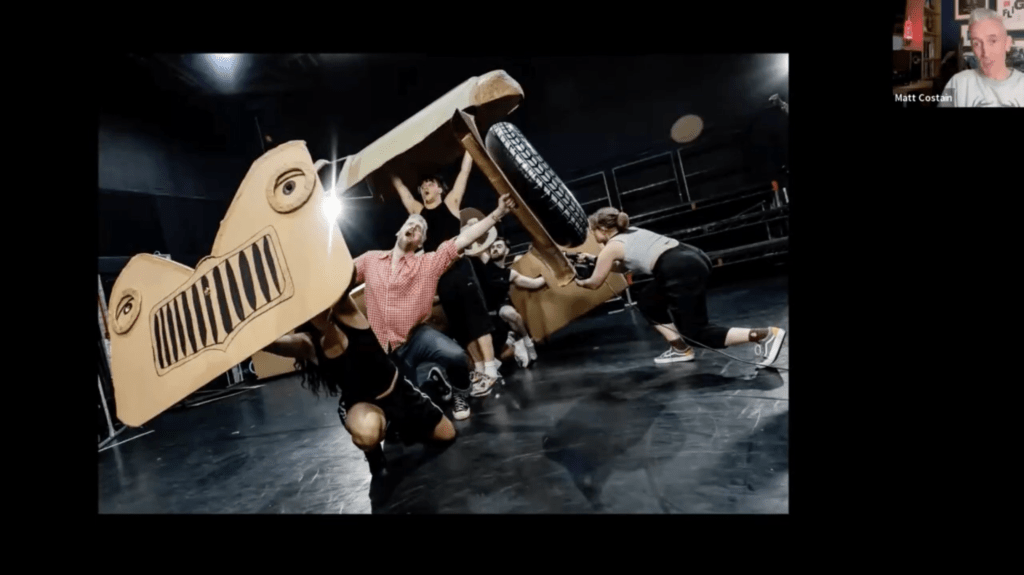
Renders explained the complete proposition while rough prototypes tested individual ideas.
When a proposed puppet car was difficult to communicate, the performers simply made a version from cardboard.
“Sometimes you just have to build a thing out of cardboard so that people understand what you mean.”
The prototype did not need to look finished.
It needed to reveal whether the idea could work.
It could.
Operations writes part of the story
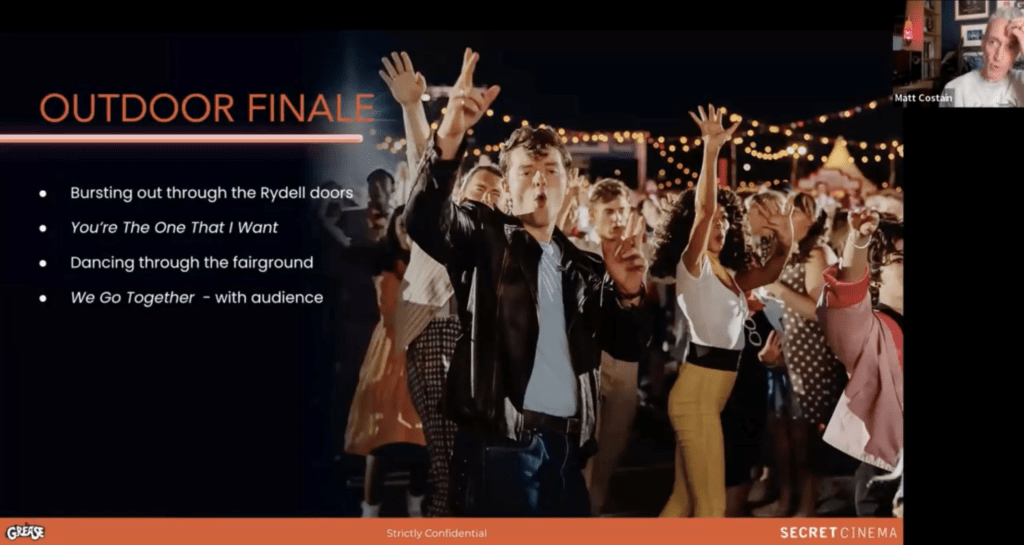
The Grease finale required nearly 2,000 audience members to leave the indoor space and return to the fairground before the film ended.
Secret Cinema could not treat this as a ‘simple’ front-of-house task happening outside the creative work.
The production used the story to prepare for the mass exodus.
The audience had already learned that the film could pause and live action could take over. Near the finale, the Rydell High principal could now simply send everyone outside for the fairground sequence.
The transition therefore felt like part of the story rather than an evacuation.
The team measured the doors and calculated that the movement would take three and a half minutes.
It did.
However what storytelling can fix, operations can break. A much smaller spatial error caused difficulty elsewhere.
Two handrails extended about 20 centimetres further than expected. The difference created a pinch point between the audience and a moving scenic element. Flow through the room never fully recovered.
The audience did not need to understand the cause to feel the effect.
“Operations directly informs the creative content of this sort of work.”
Door widths, licence conditions and audience capacity can all determine what can happen creatively.
The fairground provided another example.
The production ran for more nights than the Ferris wheel’s planning permission allowed. Its location near the Battersea Park Children’s Zoo restricted the number of days it could operate, so the final performances were forced to use a helter-skelter instead.
The replacement worked but the real learn was the reminder that no matter now compelling your idea, it still has to survive planning, weather and the legislation of your venue.
Lower the threshold for participation
Secret Cinema’s audiences help create the visual world. However that help can go two ways…
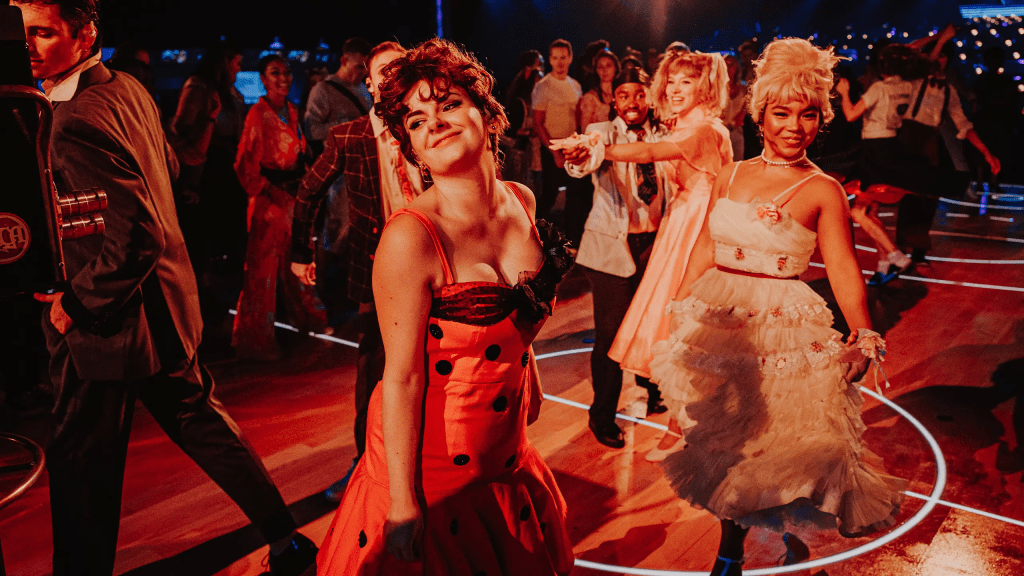
“If you build an amazing school but 2,000 people arrive with their rucksacks and bright yellow anoraks, you don’t have a school any more. You have a place full of tourists…”
Costume needs to serve the whole production – and that means sometimes you need to tell people specifically what to do.
“…however if they all arrive wearing Pink Ladies jackets, you have a spectacle!”
Earlier productions could be highly prescriptive about what guests should wear. But was a 2,000 strong blend of leather jackers and satin jackets truly achievable? And would people want to wear that on the Tube?
For Grease‘s move from Birmingham to London, Secret Cinema chose to lower the minimum requirement.
Most people already owned jeans and a white T-shirt. That was enough to appear at home in Rydell High without the potential for feeling uncomfortable that they were wearing fancy dress on the journey there.
Costain calls this plausible deniability.
Guests who wanted to do more could add a leather jacket, elaborate hairdo or even a full character identity.
But the participation model now had an easy starting point without limiting the enthusiasm of committed fans.
Marketing for Grease became clearer for the same reason.
Secret Cinema had once protected almost every detail of the production as a surprise. That becomes harder when tickets are a significant purchase and nervous newcomers do not know what the format involves.
Showing the world in advance gave audiences enough confidence to buy and participate.
Clarity did not ruin the surprise or weaken the immersion.
Instead it helped people arrive ready to enter it.
Make the first production useful to the next one
The renders helped rights holders understand what Secret Cinema intended to build.
But it was the final production photographs that proved that the company could deliver it.
Placing the approved image beside the finished environment created evidence for future conversations with studios and partners.
The value was not simply promotional.
The comparison showed that an ambitious and unusual proposal could be trusted.
The London production sold out in 2025 and returned to Battersea Park for another season in 2026. The second run also introduced Roam and Return seating, allowing guests to explore the experience before returning to dedicated themed seats.
Ultimately, Grease‘s new format was repeatable because its rules were clearer.
- It had a defined running time.
- Each space had a purpose.
- Participation was easy to begin.
- The film and live production operated within agreed boundaries.
Secret Cinema learning that scaling did not mean filling the venue with more material.
Instead it meant making the core idea strong enough to support more people.
The bigger lesson
Large productions can feel overwhelming because creative and operational decisions are tightly connected.
- Change the venue and the story flow changes.
- Change the rights agreement and the screen design changes.
- Change the arrival time and the audience’s willingness to participate may change with it.
Secret Cinema’s work on Grease shows that the answer is not to separate or vilify these decisions.
It is to treat them as part of the experience design.
Costain’s contribution is a unique view from inside the heart of that process.
His argument is not that every production should copy Grease‘s one-world model.
It is that each production needs a clear promise, an honest understanding of its audience and a structure the operation can support.
The glamour of the IP matters.
So does the handrail that is 20 centimetres too long.
What to ask before staging your next large-scale production
- What is the central experience being promised?
- How much time and preparation can the audience realistically give?
- Which ideas deepen the world, and which simply create more to manage?
- What must the rights holders approve before detailed development begins?
- Can a render or rough prototype make the difficult idea understandable?
- Where could one doorway, licence condition or measurement undermine the plan?
- What is the easiest credible way for a newcomer to participate?
- What evidence will show that the finished production matched the promise?
The question to take into the room is:
Are we making the experience larger – or are we making its central idea clearer?
Costain’s final standard is a useful one for any team adapting popular culture into a live experience:
“Those people deserve excellent art.”
Further reading
- Grease: The Immersive Movie Musical, official Secret Cinema site: the current production page, including the format, creative team and Roam and Return ticket model.
- Grease: The Immersive Movie Musical review, The Guardian: an account of how the live cast, film, sets and audience participation worked together.
- Secret Cinema’s Grease review, WhatsOnStage: detailing the shift from secrecy and free roaming towards accessibility and communal participation.
- Secret Cinema’s Grease review, Time Out: a more critical assessment of Grease‘s new hybrid form and the compromises created by combining film with live performance.
- Grease: The Immersive Movie Musical review, The Stage: coverage of the production’s scale, live musical numbers and more structured approach to immersion.
For more Experience Briefings, head here.
For more information on how to join the WXO, head here.