
A detailed narrative is not enough if the people designing, building and operating the experience cannot use it.
Every experience tells its story through more than a script.
In a museum, the narrative may be spread across objects, labels, sound, spatial design, digital interactions and staff behaviour.
In a theme park, it might continue through the attraction, queue, landscape, food and beverage, merchandise and hotel. Participants move between these elements and piece the story together for themselves.
Abigail Taylor-Sansom, a researcher in immersive storytelling, calls this decentralised storytelling: a story distributed across multiple touchpoints, with the guest, user or player taking some part in assembling it.
This creates a practical problem for experience teams: how do the writers, designers, producers, operators, performers and external partners know which story they are all building?
The conventional answer is often a treatment, design narrative or story bible. These documents can contain enormous detail. Yet a document can contain the correct answer without making that answer easy to find, understand or use.
This Experience Briefing draws on a WXO Campfire with Abigail Taylor-Sansom and distils its most useful ideas for experience leaders.
Taylor-Sansom is Professor of Dramatic Writing at Savannah College of Art and Design (SCAD) and a former Walt Disney Imagineer. She created The Story Codex as an open-access narrative tool for immersive and interactive stories. It is designed for linear, branching and open-world experiences, and for use by writers and non-writers alike.
Its central idea is simple: replace a high-level story written mainly as long prose with a set of clear questions and answers.
“The story is to enable us to make design decisions. That’s what it’s for.”
– Abigail Taylor-Sansom
Those answers become the project’s story rules, guiding decisions throughout design and production.
1. The story must make design decisions easier
Taylor-Sansom’s test for an experience narrative is whether it is actionable.
The story is not only there to describe a fictional world or explain what happened before the participant arrives. It should help people make choices about costumes, environments, lighting, performance, guest experience, operations and every other part of the project.
A narrative statement is useful when it changes a decision.
- If the experience is set in 1999, what does that mean for clothing, technology, language and props?
- If the guest is the most powerful person in the world, how should performers address them?
- If the intended tone is friendly and nostalgic, which visual and behavioural choices support that tone, and which ones contradict it?
Treatments and story bibles can still be valuable. They can preserve backstory, plot detail and reference material. The problem comes when a long prose document is expected to be the everyday working tool for an entire multidisciplinary team.
Taylor-Sansom identifies three particular difficulties.
a. Important answers are hard to find
People working under time and production pressure often need one clear answer. Telling them that “it is somewhere in the treatment” places the burden on them to search through ten, twenty or eighty pages.
The more intimidating the document, the greater the chance that people will skim it, rely on memory or make their own interpretation.
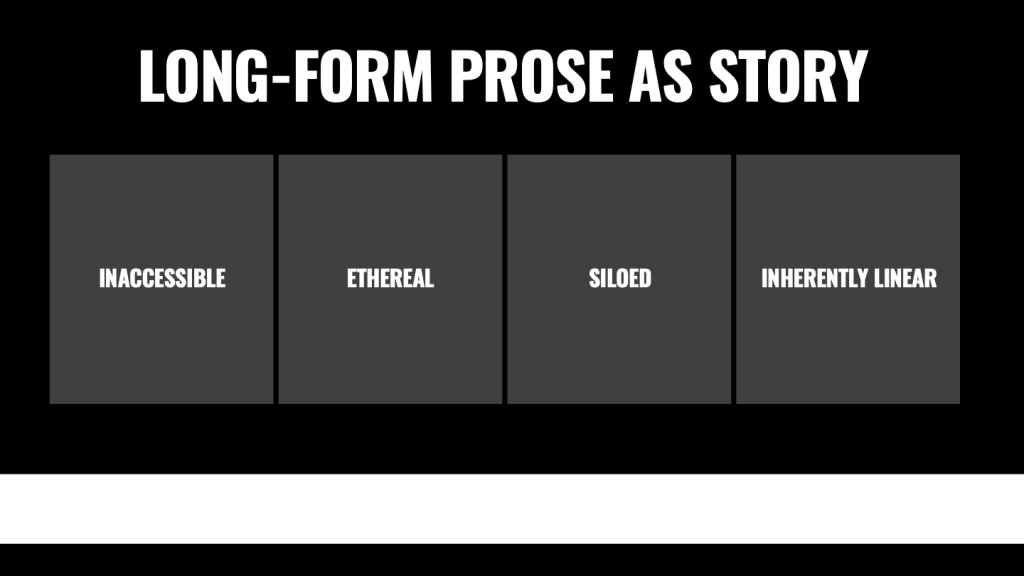
b. Decisions can become siloed
Long prose is usually written by one person. As the writer moves through the document, they may make choices simply because they need an answer to complete the next paragraph.
By the time the rest of the team sees the treatment, numerous creative decisions may already have been made without their input.
This matters because narrative is not the sole responsibility of the writer. A designer may understand how a story rule changes the space. An operator may see that the proposed participant journey will create confusion. A performer may recognise that a character instruction is impossible to sustain in practice.
The story becomes stronger when those perspectives shape it early.
“This is not the domain of the writer or even just the creative director. It’s everybody’s domain.”
– Abigail Taylor-Sansom
c. Linear documents are a poor fit for non-linear experiences
Treatments developed for film and television usually describe events in sequence.
Experiences are less predictable. Participants may move at different speeds, miss information, repeat an interaction, avoid a performer or interpret an instruction differently from the way the team expects.
Even an experience with one fixed route will contain variations in attention, participation and behaviour.
A document that describes one perfect journey can therefore create false confidence. Experience teams still need experimentation, prototyping and playtesting.
The practical lesson is not to stop documenting the story. It is to separate detailed reference material from the clear, high-level rules that everyone needs in order to do their job.
2. Turn the high-level narrative into shared story rules
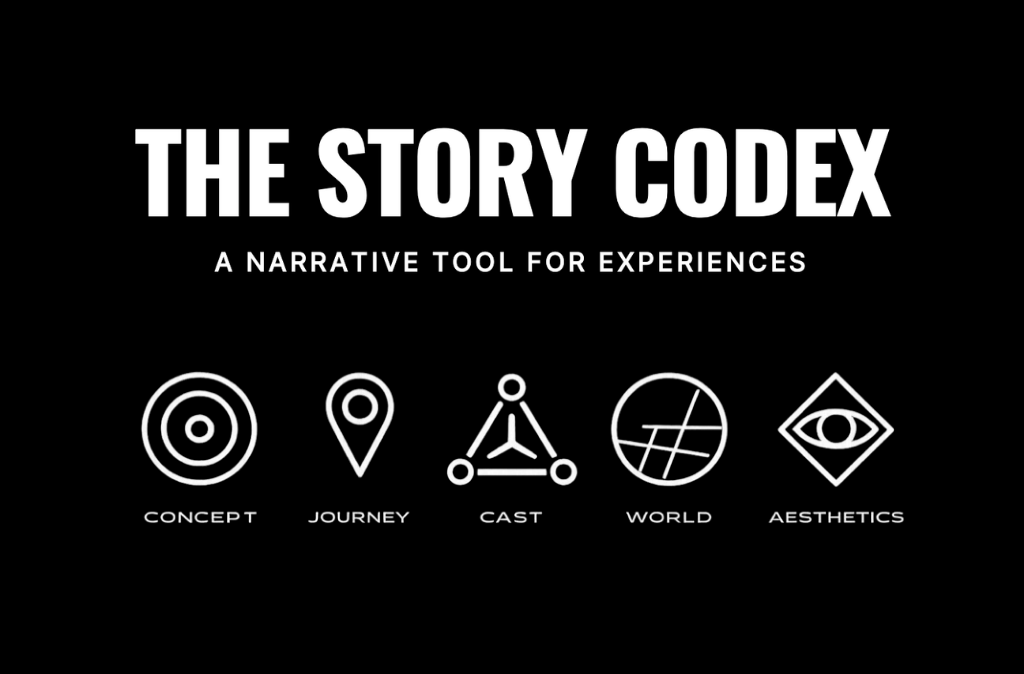
The Story Codex uses 21 canonical questions. The answers to those questions become the story rules for the project.
These are not software-style rules built around rigid “if this, then that” instructions. Each rule is an answer that the team agrees to treat as true.
Every relevant design and production choice should then behave as though that answer is true. If the team constantly needs to break a rule to improve the experience, the rule itself should be reconsidered.
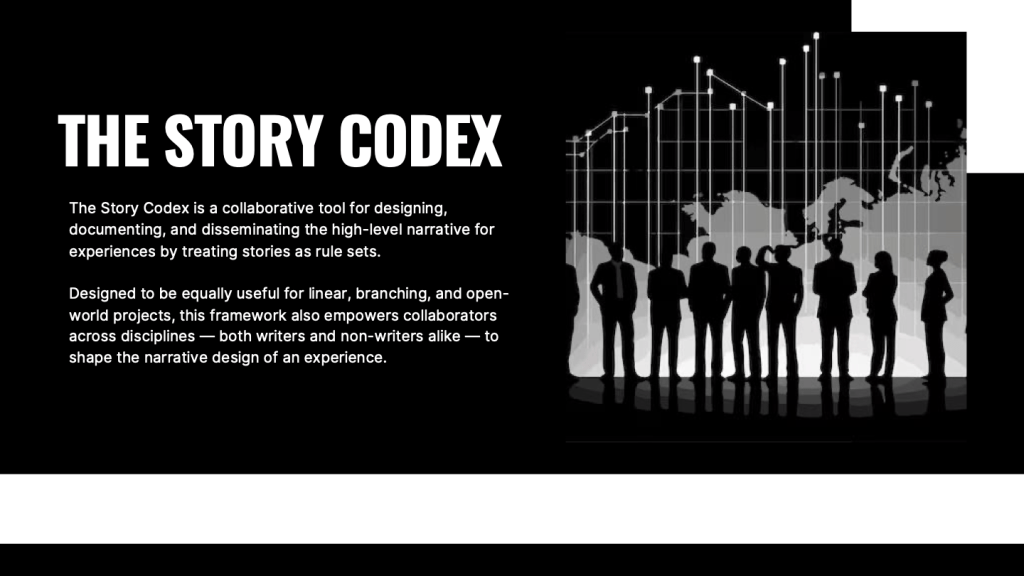
The questions are divided into five areas.
CONCEPT: What is the big idea?
The first questions force the team to express the experience clearly.
- Q. What is the experience in one to two sentences (logline)?
- Q. What is the philosophical or moral argument underpinning the experience?
The second question does not mean that every experience needs to deliver a heavy-handed lesson. It asks what the experience is saying about people, relationships or the world.
An experience might suggest that love is worth the risk, that courage makes difficult action possible or that people can achieve more collectively than alone.
Making that idea explicit gives the team a standard against which to test its choices. It replaces the assumption that everyone will understand the deeper meaning through “vibes” or creative telepathy.
“If you can’t say it in two sentences, you gotta go back to the drawing board because something is missing.”
– Abigail Taylor-Sansom
JOURNEY: What will the participant actually do?
The journey questions focus on the participant’s experience:
- Q. Do users navigate the experience as distinct individuals or as a collective?
- Q. What steps or actions must the user take to complete the story?
- Q. What is the user’s objective, and when is that objective introduced?
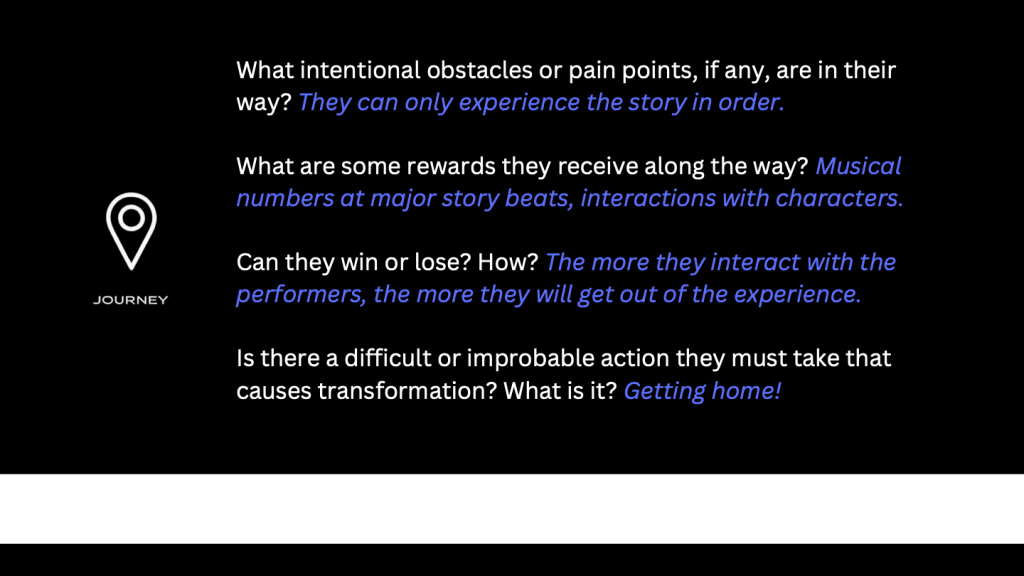
- Q. What intentional obstacles or pain points, if any, do they encounter?
- Q. What are some rewards they receive along the way?
- Q. Can they win or lose? How?
- Q. Is there a difficult or improbable action they must take that causes transformation?
These questions also help teams distinguish between an intentional obstacle and poor operational friction.
Waiting, searching or following a constrained route may be meaningful when it serves the narrative. The same action becomes frustrating when it is caused by unclear instructions, poor capacity planning or an avoidable design failure.
CAST: Who will the participant encounter?
The cast questions ask for concise descriptions of the most important non-participant characters.
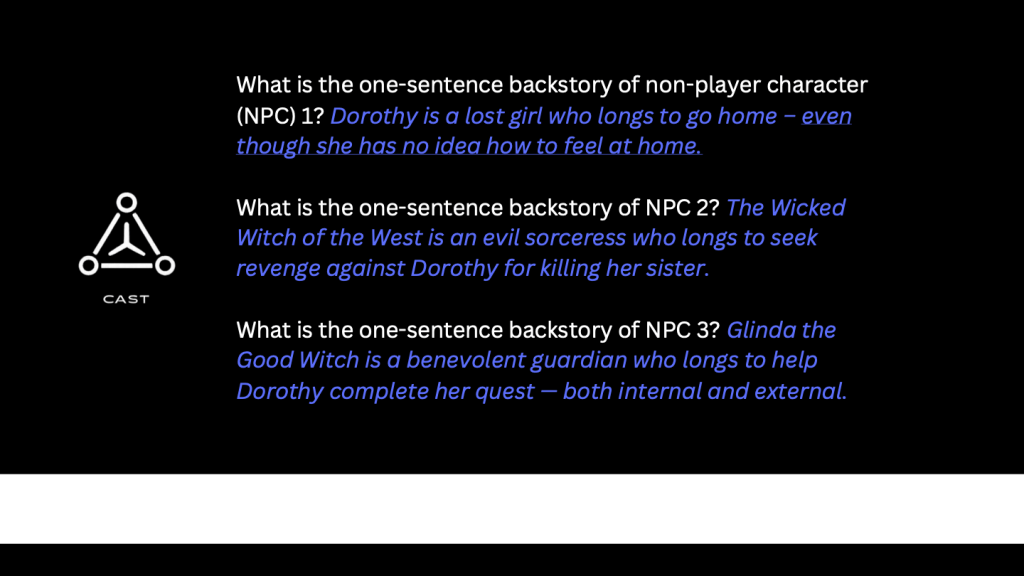
- Q. What is the one-sentence backstory of non-player character (NPC) 1?
- Q. What is the one-sentence backstory of NPC 2?
- Q. What is the one-sentence backstory of NPC 3?
For each character, establish who they are, what they need and what is preventing them from getting it.
The aim is not to capture every biographical detail. It is to give performers, designers and other collaborators enough information to understand the role each character plays in the experience.
WORLD: Who has power here?
The world questions establish the rules of the reality the participant enters.
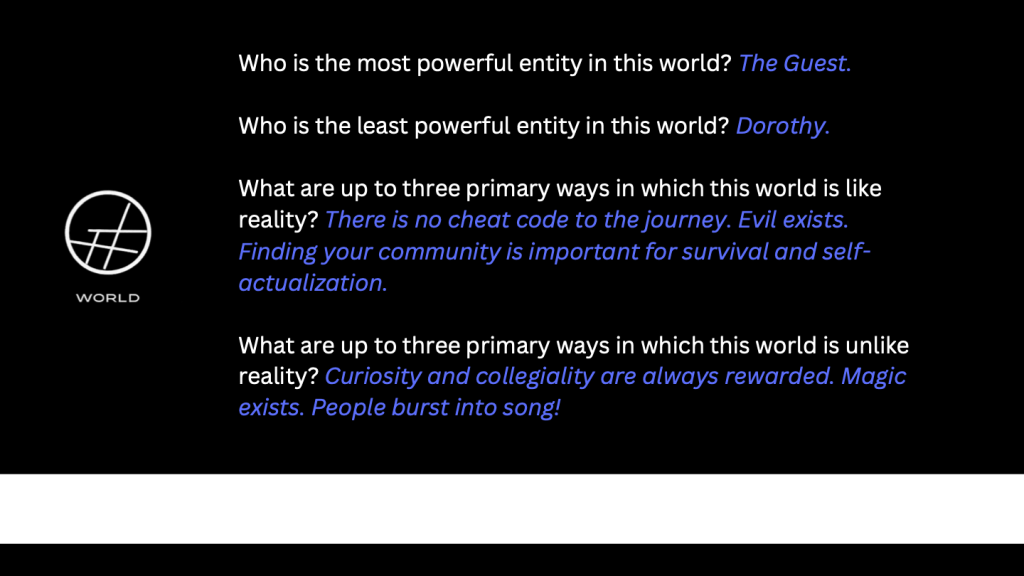
- Q. Who is the most powerful entity in this world?
- Q. Who is the least powerful entity in this world?
- Q. What are up to three primary ways in which this world is like reality?
- Q. What are up to three primary ways in which this world is unlike reality?
These questions can have a direct effect on service design and participant behaviour. A world in which the guest is treated as powerful will feel very different from one in which the guest is a suspect, an intruder, an apprentice or someone asking for help.
AESTHETICS: What does this world look and feel like?
The aesthetic questions cover tone, time period, geography, visual references and visual anti-references:
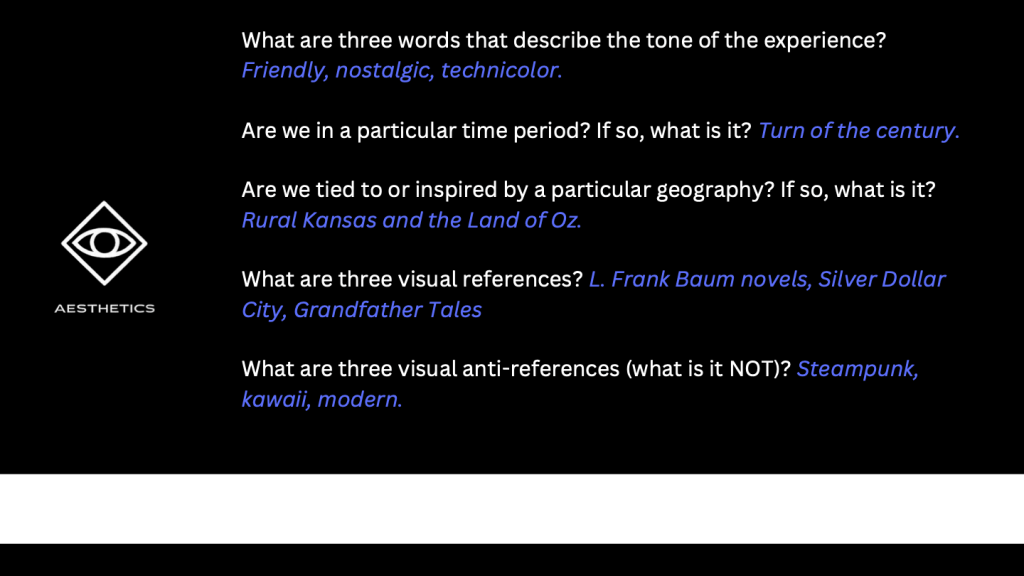
- Q. What are three words that describe the tone of the experience?
- Q. Are we in a particular time period? If so, what is it?
- Q. Are we tied to or inspired by a particular geography? If so, what is it?
- Q. What are three visual references?
- Q. What are three visual anti-references (what is it NOT)?
Anti-references define what the experience must not become. They are especially useful when a team knows that a direction feels wrong but has not yet agreed on the right alternative.
“Not modern”, “not steampunk” or “not polished corporate futurism” can remove unsuitable directions quickly. The team can then discuss what should take their place.
The Story Codex is a collaborative tool for designing, documenting and communicating the high-level narrative. Its purpose is not to give a writer a shorter form to complete alone. The questions should be answered with the people whose work will be guided by the results.
A practical test for every answer is: “What does this mean for my part of the experience?”
If a designer, operator or production partner cannot answer that question, the story rule may still be too vague.
3. Use story rules to catch ambiguity before it becomes expensive
One alternate reality game involving found footage set around Y2K shows how ambiguity can become expensive.
The project had extensive documentation establishing that the footage belonged to 1999. An external production company was brought in to film a robbery scene in 2021. The script described “masked men”.
The production interpreted this as men wearing surgical masks associated with the COVID period, rather than ski masks appropriate to the robbery and its 1999 setting. The footage had to be reshot.
The time period was not missing from the project.
It was present in the documentation, but it did not reach the person making the decision in a clear enough form.
A simple story rule such as “All found footage takes place in 1999” would have made the constraint unmistakable. It could have guided wardrobe, props, set dressing and performance without asking each collaborator to search a large story bible.
The distinction is important:
Information that exists is not necessarily information that can be used.
The Story Codex can also help teams understand why an existing experience works.
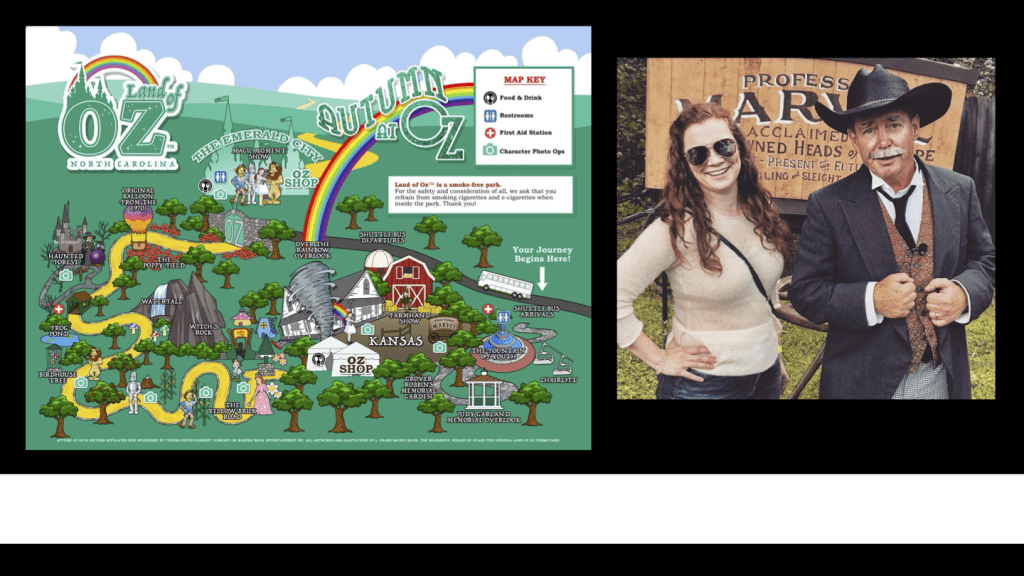
Applied to Land of Oz, a seasonal theme park in North Carolina, the Codex reveals both the experience’s coherence and a possible weakness.
The basic proposition can be stated in one sentence: join Dorothy as she travels home from the Land of Oz.
Participants begin in Kansas, experience a tornado and follow the Yellow Brick Road towards the Emerald City. They meet characters and encounter live musical moments along the way.
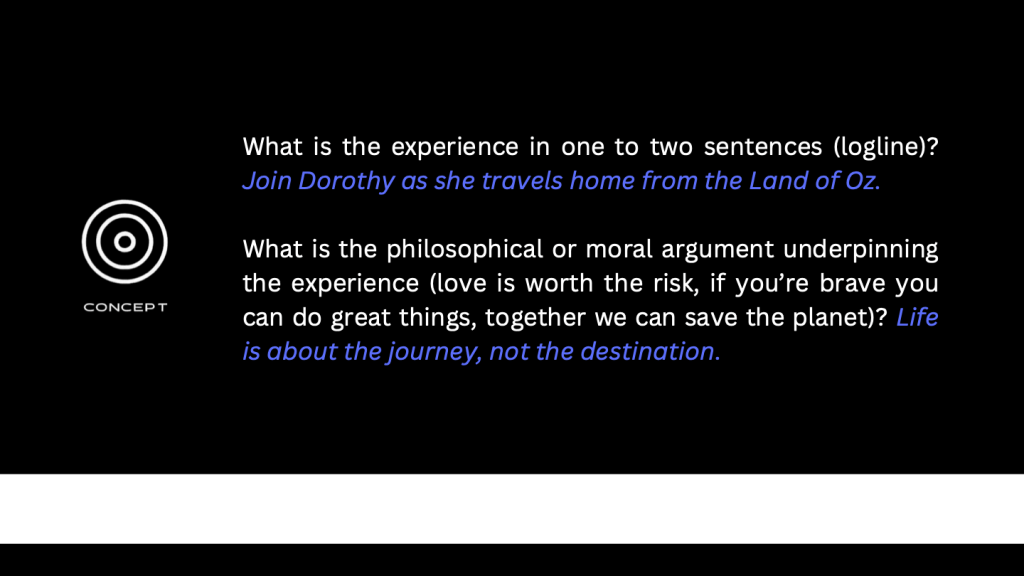
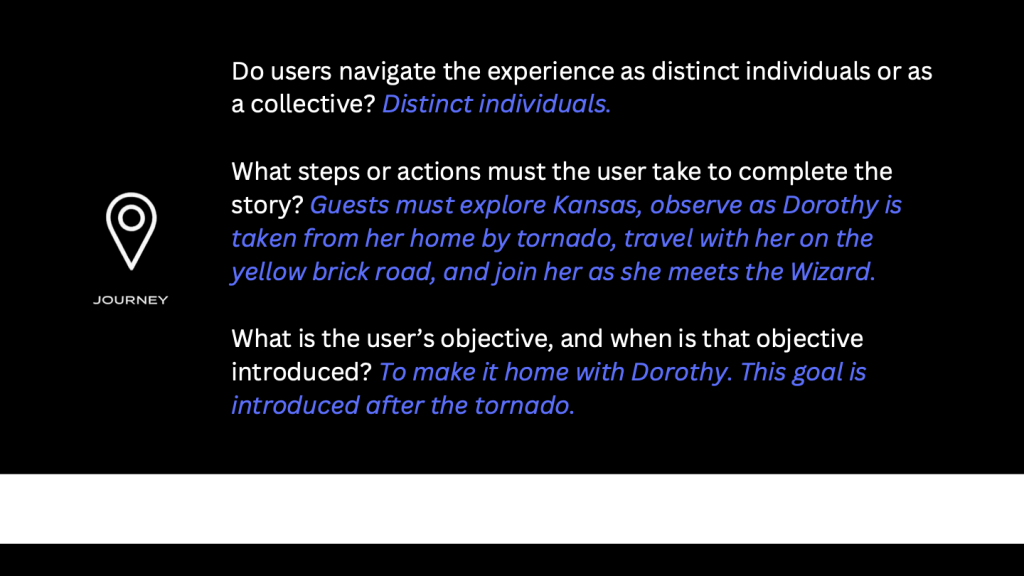
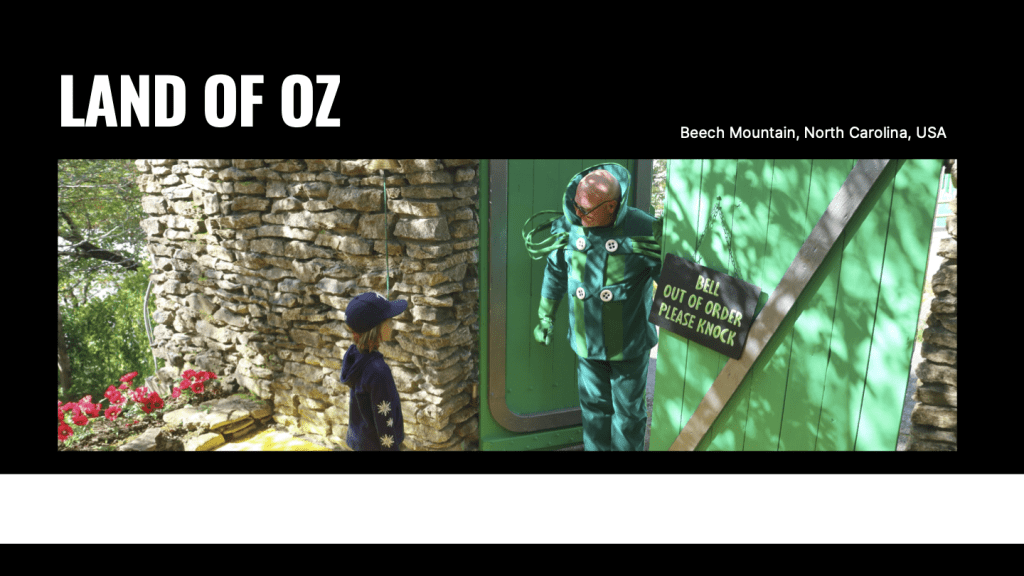
For Taylor-Sansom, the experience’s underlying argument is that life is about the journey, not the destination.
That argument explains why its meet-and-greets feel like part of a story rather than a collection of separate photo opportunities. Participants cannot skip freely between attractions. They follow the same route, but they travel at their own pace and decide how deeply to interact.
The constrained sequence becomes an intentional obstacle. Character interactions, songs and major story moments become rewards.
“It really is about the journey, and everybody goes through it in their own way, but they all go through the same path on the Yellow Brick Road.”
– Abigail Taylor-Sansom
The Story Codex also exposes a point of weakness. The participant’s objective, getting home with Dorothy, may not be made explicit enough within the experience. It appears to rely partly on people already knowing the film.
Asking “What is the participant’s objective, and when is it introduced?” turns a general feeling of confusion into a specific design problem. The team can then consider whether a performer, pre-show, environmental cue or other story moment needs to communicate that objective more clearly.
The Land of Oz example also shows that narrative coherence does not depend entirely on expensive technology or large-scale scenic investment.
Its route, performers, songs, character encounters and visual tone support the same central idea. The Codex makes those connections visible and helps identify which elements are doing meaningful narrative work.
The bigger lesson
Experience narrative is not simply a piece of content created by a writer.
It is a system of choices that shapes what participants see, hear, do, understand and feel.
That system crosses departmental boundaries. The story affects the space, service model, participant instructions, operational flow, performance style, food, merchandise, technology and commercial offer.
A shared set of story rules gives those different disciplines a common language.
It also allows teams to discuss narrative quality more precisely. Instead of saying that something “doesn’t feel right”, they can ask whether it supports the agreed tone, participant objective, power structure or underlying argument.
This is important for the professionalisation of the Experience Economy. Museums, attractions, games, branded experiences and cultural projects may use different production methods, but they face many of the same questions:
- What is the participant being asked to do?
- What makes the journey meaningful?
- What rules define the world?
- What should every touchpoint communicate?
- Which decisions must remain consistent as the project moves between teams and partners?
The Story Codex does not remove the need for creative instinct, detailed writing or testing with participants. It gives teams a clearer place to begin and a practical way to identify where alignment is missing.
“This is a great place to start when you’re at the beginning of a project and you want to make sure that nobody is going off on a tangent.”
– Abigail Taylor-Sansom
It is particularly useful at the start of a project, when a team is moving in different directions or struggling with a fundamental creative question.
The most useful shift is this: the story is not ready simply because someone has written it down.
It is ready to guide the project when the people making the experience understand what it requires of them.
What to ask in your next meeting
- Can everyone explain the experience in one or two sentences?
- What is the participant trying to achieve, and when will they understand that objective?
- Which story rules should guide the decision currently in front of us?
- Which answer could still be interpreted differently by a designer, operator or external partner?
- Are we asking people to search a long document for something that should be stated as a one-line rule?
For more Experience Briefings, head here.
For more information on how to join the WXO, head here.