
Four rules for building interactive experiences faster, changing them later – and learning from what people actually do…
Interactive technology can help create experiences that would otherwise be impossible.
- A physical object can affect a digital world.
- A room can respond when somebody moves through it.
- An audience can influence a live performance without leaving their seats.
But the same technology can also make an experience harder to create.
Once sensors, hardware, software and networking become fixed, a simple creative change can turn into an engineering problem. Now constrained by the technology that helped create it, a production team becomes less willing to experiment at the exact time when it most needs to learn how an audience actually behaves.
There is another way to approach the problem.
Treat technology as something you design with, not something you install after the design is finished.

Lance Chantiles and Isaac Shelanski are co-founders of Indistinguishable From Magic, or IF Magic, a venture-backed physical-computing company. Its flexible platform combines modular hardware, no-code logic and connections to other creative tools so interactions can be prototyped, altered and scaled without rebuilding the underlying technical system each time.

This Experience Briefing draws on a WXO Campfire with Lance Chantiles and Isaac Shelanski and distils its most useful ideas for experience leaders.
IF Magic’s platform has already been used across projects including the Museum of Ice Cream, the Getty, interactive installations in New York and the WXO’s own World Experience Summit.
The practical lesson from that work is simple:
Do not optimise technology only for launch. Optimise it for learning and change.
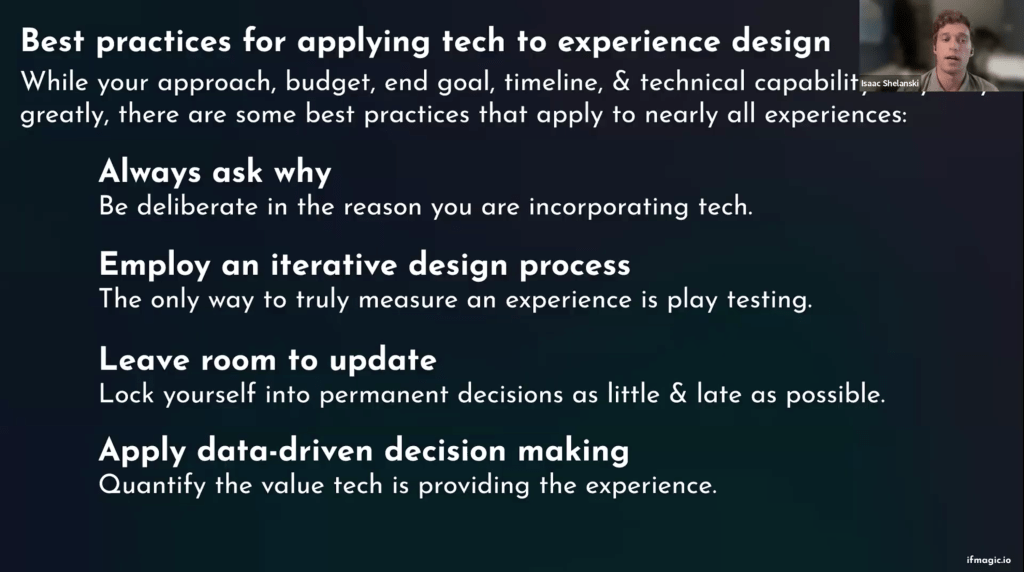
1. Give the technology a job
Technology is tempting because it can do impressive things.
As Katrina Lat detailed in her recent Campfire, that is not a sufficient reason to use it.
It can enable wish fulfilment. Make an environment interactive. Introduce game mechanics. Personalise what somebody experiences. Automate a response. Collect useful information.
But before deciding how the technology works, a designer needs to decide why it exists.
“Tech is really just like any other tool in your experience design toolbox.”
This changes the opening conversation.
Instead of:
Which sensor should we use?
or:
Should this run in Unity?
start with:
What should this allow the guest to do or feel that we cannot achieve as well without it?
That answer might be very specific:
- A visitor waves an object and feels capable of magic.
- A room responds to their movement.
- A game recognises what they have done without somebody manually triggering it.
- An audience receives a personalised response.
In these instances, the technology has an obvious role. But if the technology has no clear job, leaving it out may be the better design decision.
2. Prototype the interaction before you scale the system
The hardest thing to predict is not necessarily the technology.
It is the person using it.
“The only way to know how people are going to interact with something is to put them in a room with it – and watch.”
That makes early playtesting part of technology design rather than a final quality-control exercise.
A prototype does not need the complete system.
Start with the smallest useful question:
- Should the guest press something?
- Wave over it?
- Stand somewhere?
- Pull something back?
- Throw it?
- Move quickly?
- Move slowly?
Which action feels natural becomes much easier to answer when somebody can physically try it.
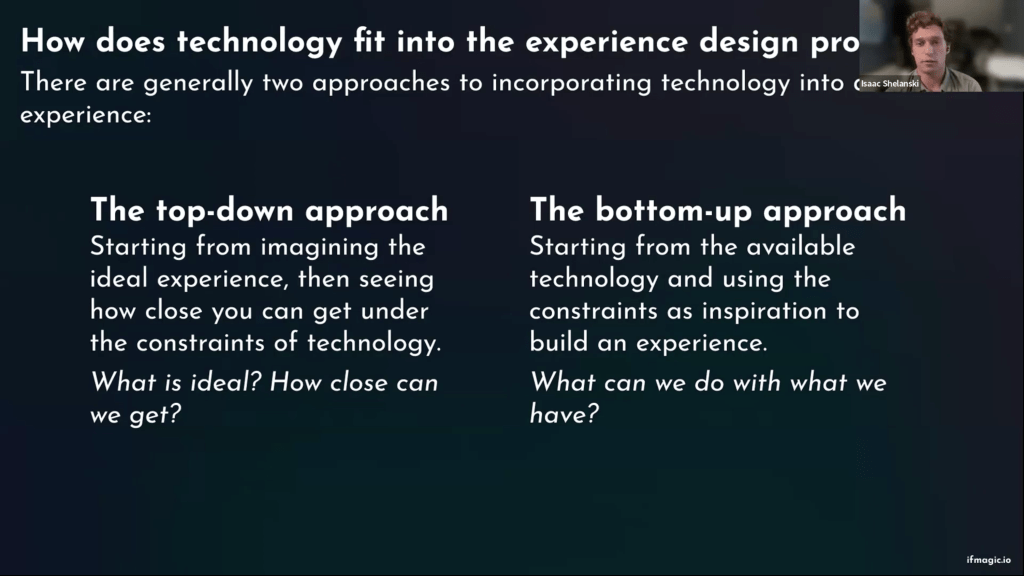
Start from the dream or start from the constraint?
Chantiles and Shelanski identify two useful starting points.
- A top-down process begins with the ideal interaction and asks how technology can make it possible.
- A bottom-up process begins with the space, hardware or other constraints already available and asks what interesting experience can be created from them.
Neither is inherently better.
What matters is knowing which problem you are solving.
The Museum of Ice Cream in Chicago is a good example of the top-down approach.
In one installation, visitors interact with large physical cherry sculptures, swinging them to launch virtual cherries at a fixed screen. It’s a life-sized videogame.
In this instance, the creative idea came first.
The technical problem was then reduced to something more manageable: what physical information does the system need in order to understand what the visitor is doing?
The answer included orientation and acceleration.
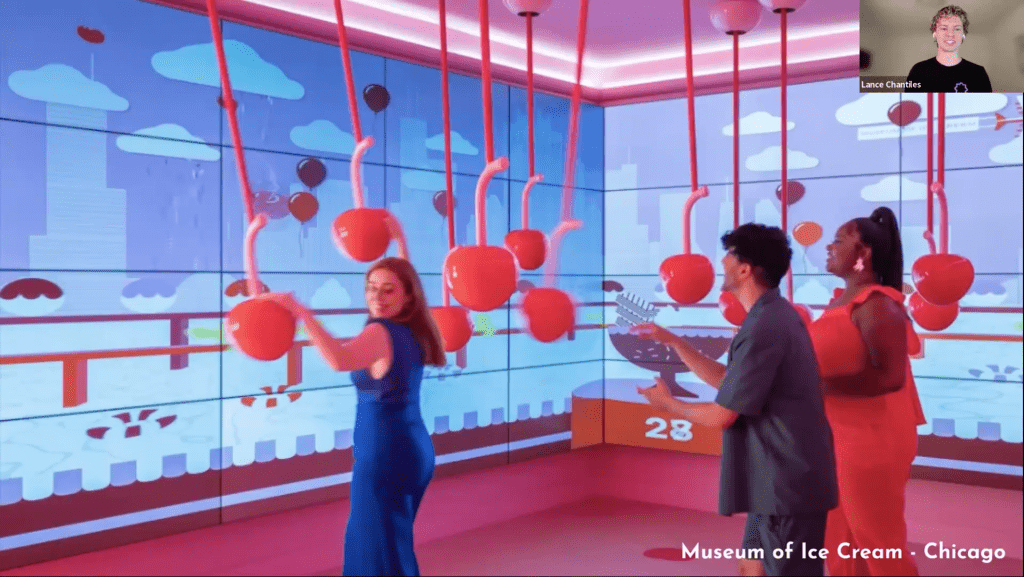
Once those inputs were established, the physical cherries could be fabricated while the game behaviour continued to change during playtesting. The team could test whether launching should feel like pushing, swinging or pulling back like a catapult without redesigning the prop every time.
That separation is useful.
Fix only what needs to be fixed. Keep everything else available for experimentation.
Give creative and technical teams a simpler shared language
Designers do not need to start by discussing protocols, microcontrollers or network architecture.
A more useful starting point is:
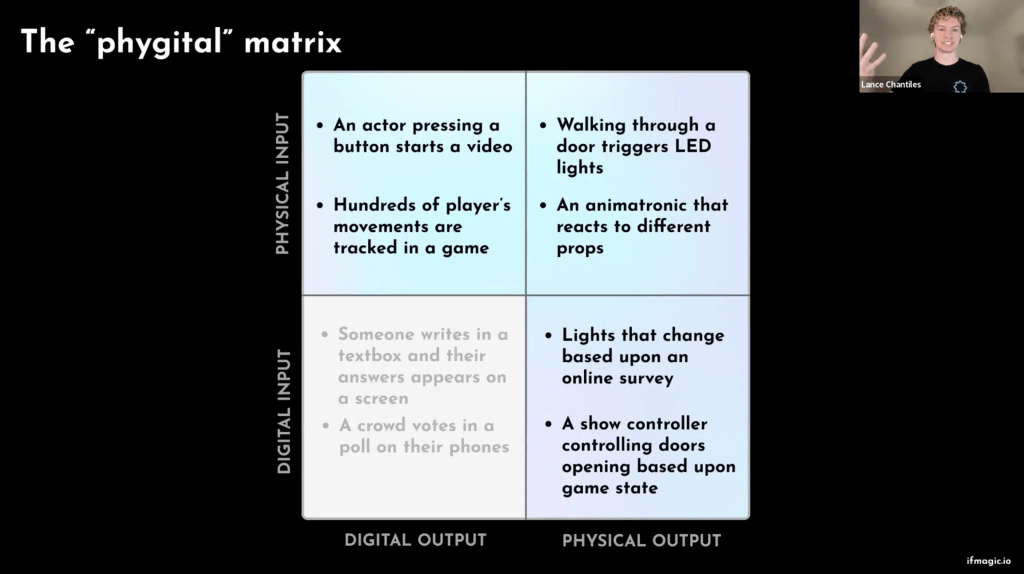
- What is the input?
- What is the output?
A person walks through an arch. Lights respond.
Someone presses a physical button. A video starts.
A digital game reaches a particular state. A physical door opens.
Once the interaction is clear, the technical team can work backwards into sensors, logic, hardware and networks.
IF Magic describes this through a simple physical/digital matrix covering physical and digital inputs and outputs.
For a non-technical creative team, the practical version can be even simpler:
Guest does X → experience does Y.
That is often enough to begin prototyping.
3. Keep important decisions reversible
Technology becomes expensive when every component depends on every other component.
- One change produces six more.
- A new sensor requires new code.
- The new code changes the hardware.
- The hardware changes the enclosure.
- The change now requires the engineer who built the original system.
An adaptable technology system tries to reduce those dependencies.
Shelanski’s advice is to lock yourself into permanent decisions “as little and as late as possible”.
The Flatiron Plaza installation Interwoven in New York shows why.
Interactive arches used sensors to detect people walking through them, with sound and lighting changing in response.
During development, the system used a light-based distance sensor.
It worked indoors.
Then it reached the actual site.
Sunlight interfered with the readings.
In a tightly integrated system that discovery could have forced a substantial redesign. Instead, the team replaced the light-based sensor with an ultrasound sensor while leaving the rest of the interaction intact.
That is the creative benefit of modular technology.
It is not simply easier maintenance.
It allows the experience to respond to information the designers could not have had when they began.
The above principle also applies when nothing ‘physical’ has gone wrong.
An interaction may need seasonal content.
A venue may introduce new IP.
Guest behaviour may reveal that one mechanic works better than another.
Programming may need to change to encourage repeat visits.
IF Magic’s own platform is designed around this idea, allowing teams to swap inputs and outputs, alter logic and update experiences after deployment rather than treating the finished installation as fixed.
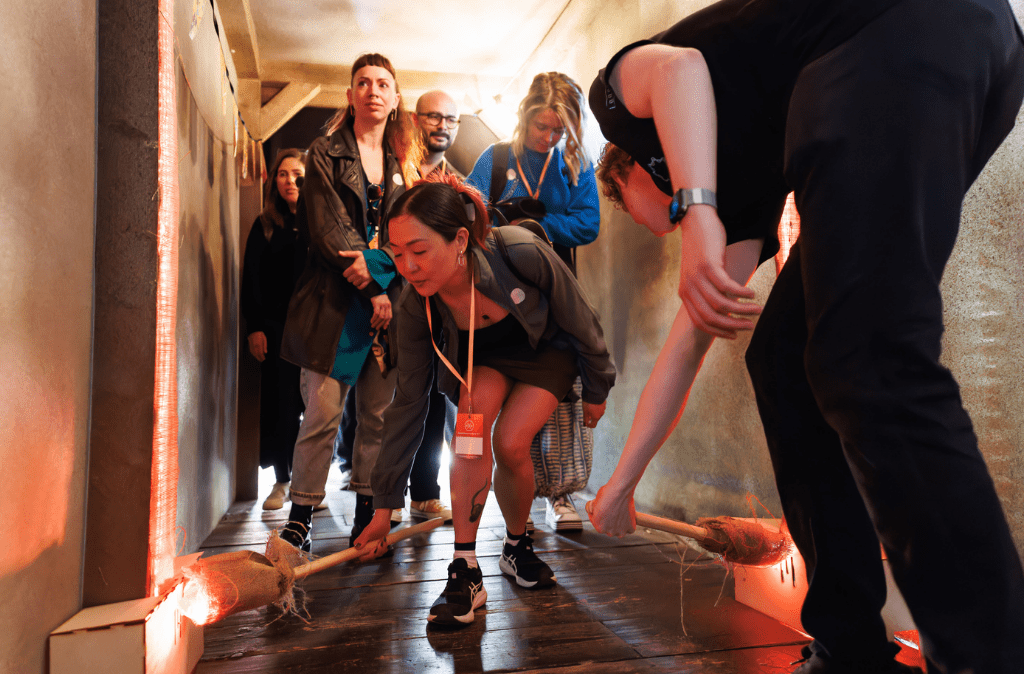
At the 2025 World Experience Summit, for example, the interactive welcome tunnel used the same underlying infrastructure while interactions and props changed across the three-day event.
This is where responsive technology starts to resemble software.
The expensive physical layer can stay.
The behaviour can evolve.

4. Use technology to learn, not just perform
There is another benefit to making an experience responsive.
The system can tell you what happened.
Teams usually understand the cost of technology very precisely.
Shelanski argues that they are often much less precise about its value.
“Everybody has a very, very clear idea of the cost of tech – but not its value”
So measure what it contributes.
- How long did people interact?
- Did they repeat the action?
- Which part did they skip?
- Where did they stop?
- Did a new version increase engagement?
- Did one trigger work better than another?
The answers can improve more than the technology itself.
They can influence flow, creative decisions, operations and future investment.
This creates a different relationship with launch.
Instead of:
We designed it. We installed it. We hope people respond as expected.
the process now becomes:
Design → prototype → observe → change → launch → measure → change again.
Technology becomes part of the feedback loop.
The trade-offs have not disappeared
Flexible tools do not remove the normal constraints of production.
Teams still have to make choices between:
- Cost
- Quality or fidelity
- Ease and speed
Chantiles and Shelanski’s point is that different technical approaches move those three variables differently. Chasing the final increment of fidelity, for example, can become disproportionately expensive, while a simpler solution may achieve the guest outcome perfectly well.
The purpose of a more adaptable system is therefore not to eliminate compromise.
It is to make better compromises after you have learned more.
That may be the most important change for experience creative teams.
Technology can now stay in the room while you create
Traditional physical computing can create a break in creative momentum:
- A designer has an idea.
- The idea goes to somebody technical.
- Hardware gets specified.
- Code gets written.
- The team waits.
- The prototype arrives.
By then, testing another idea may mean beginning the process again.
Tools such as IF Magic do not remove the need for experienced technologists on complex projects. Nor do they make every interaction easy.
But they do reduce the engineering required to answer many of the smaller creative questions.
That makes technology available earlier, when decisions are still cheap.
And later, when evidence starts arriving.
The result is not necessarily a more technological experience.
It can simply be a better-tested one.
What to ask in your next meeting
The question to ask is clear:
“Are we using technology in the creative process, or only installing it after the creative decisions have been made?“
Then ask:
- What specific guest behaviour or outcome does the technology enable?
- What is the smallest version we can physically test?
- Which decisions can remain changeable until we learn more?
- What will the system tell us about how people actually use the experience?
- Where are we deliberately trading cost, fidelity or speed?
The useful shift is from asking what technology should we buy?
to asking:
What will technology allow us to learn and change?
For more Experience Briefings, head here.
For more information on how to join the WXO, head here.