

Technology improves an experience – but only when it helps participants feel, do or discover something they could not otherwise.
Technology has become one of the default ways to signal innovation.
Clients ask for AI.
Boards ask for XR.
Creative teams look for the latest tools.
But does more technology actually create a better experience?
This Experience Briefing draws on a WXO Campfire with Katrina Lat and distils its most useful ideas for experience leaders.
Katrina Lat is an experience researcher and designer whose analysis covers 996 immersive experiences across theatre, escape rooms, installations, exhibitions, museums and attractions.
Her findings challenge one of the industry’s most persistent assumptions: that more technology means a better experience.
1. Technology does not predict quality
The common assumption is simple:
More technology = better experience.
Lat tests that assumption by plotting the technological sophistication of 996 immersive experiences against her quality ratings.
The relationship is almost non-existent.
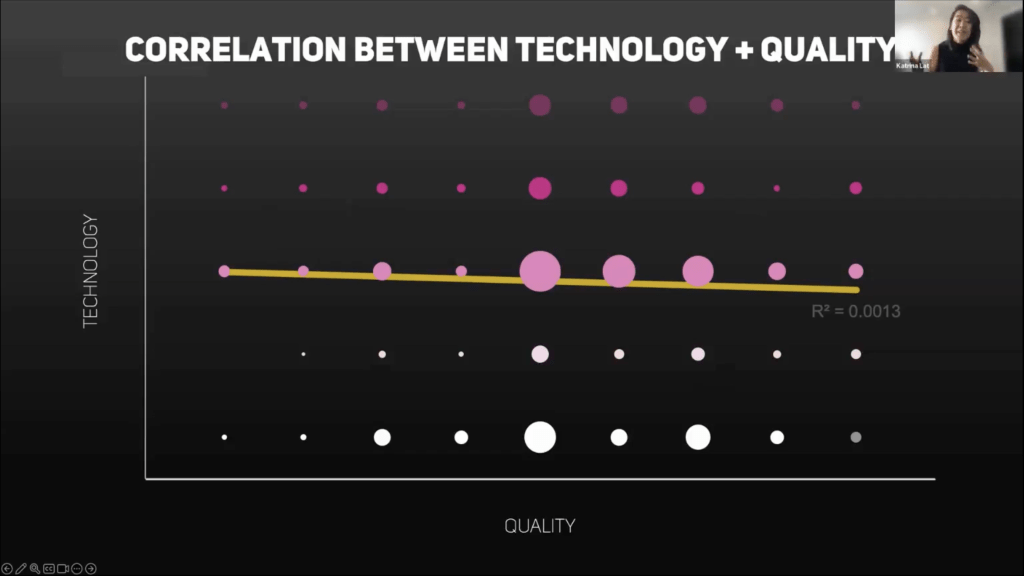
The trend line produces an R-squared value of 0.0013. In practical terms, technological sophistication explains virtually none of the difference in quality across the experiences analysed.
Some of the highest-rated experiences rely on VR, artificial intelligence or complex digital systems.
Others rely almost entirely on performers, physical space, practical effects and clever design.
Technology is not the common factor.
Quality is.
Technology tells you how an experience is delivered. It does not tell you whether the experience is good.
Examples
Technology-heavy
Minimal technology
- Dolores Meta Maze in the Netherlands
- The Forbidden Corner in the UK.
These experiences take very different approaches, yet all sit among Lat’s highest-rated work.
The lesson is not that technology does not matter.
It is that technology alone tells experience leaders very little about whether an experience will succeed.
2. Judge technology by the job it does
If technology does not predict quality, what should experience leaders evaluate instead?
Start with what the technology contributes to the participant experience.
- Does it create a world that could not otherwise exist?
- Does it increase participant agency?
- Does it deepen emotional engagement?
- Does it reveal something participants could not otherwise see?
- Or does it replace an effective analogue interaction with a more expensive digital one?
Technology should not be the reason an experience exists.
It should be the best way to deliver the experience the team is trying to create.
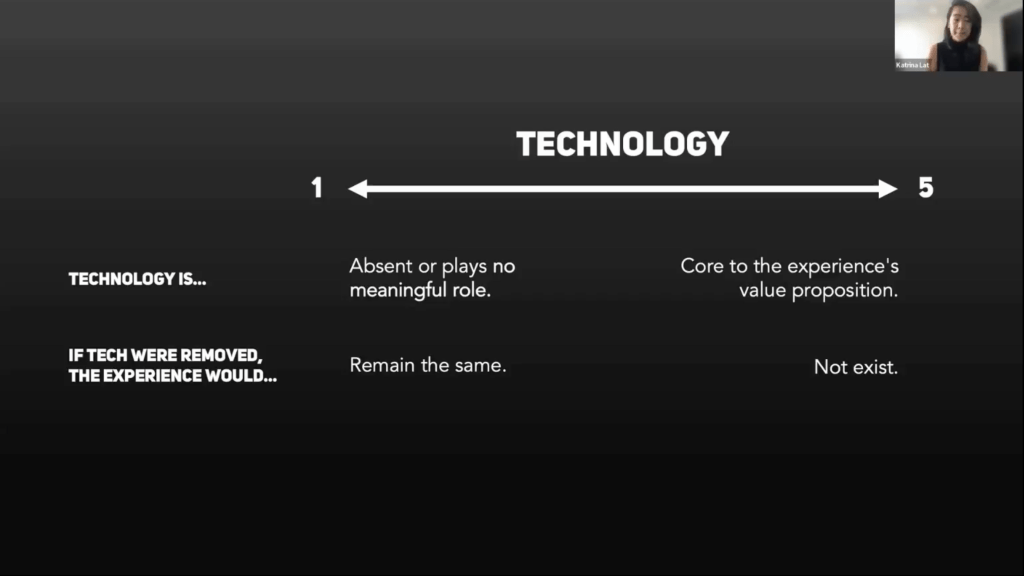
A technology-led experience may be entirely justified when removing the technology would destroy its central proposition.
At the same time, a low-tech experience can achieve equally strong results through story, performance, spatial design and participant interaction.
Technology is not valuable simply because it is impressive.
It is valuable when it performs an essential job.
The test is not whether the technology is impressive. It is whether the experience would lose something essential without it.
3. Evaluate the experience
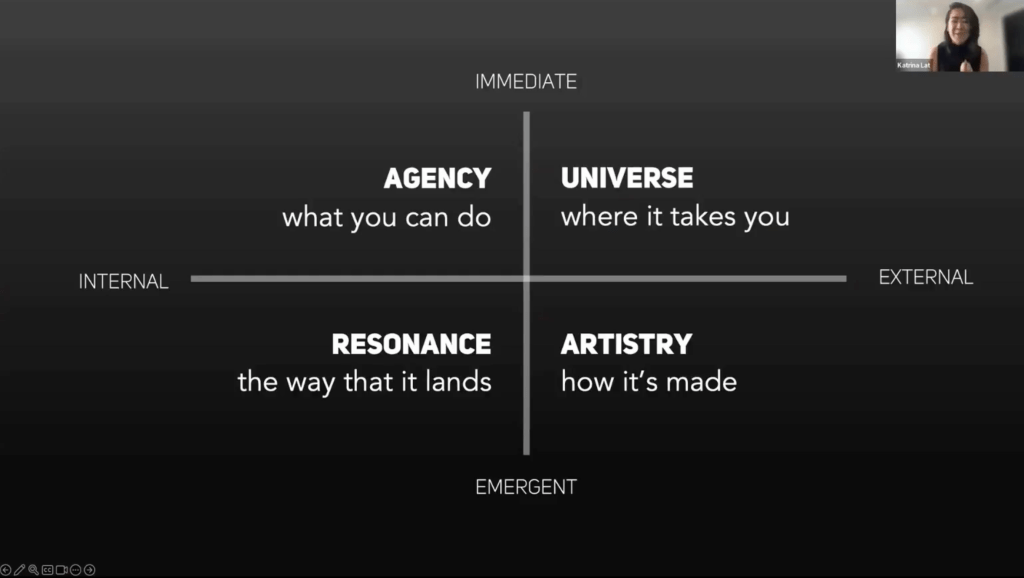
Technological sophistication is only one characteristic of an experience. Lat’s AURA framework offers a broader way to assess quality.
AURA considers four dimensions:
AGENCY | What can the participant do?
>> Agency covers the choices, actions and influence available to the participant. It asks whether people can affect their journey or are simply moved through a predetermined sequence.
UNIVERSE | Where does the experience take them?
>> Universe covers the coherence, depth and credibility of the world. It includes the physical, fictional and social environment the participant enters.
RESONANCE | How does the experience land?
>> Resonance examines emotional impact, meaning and what remains with the participant after the experience ends.
ARTISTRY | How well is it made?
>> Artistry considers the quality and intention behind the writing, performance, design, technology, sound, scenography and other creative choices.
Technological sophistication is only one characteristic of an experience. Lat’s AURA framework offers a broader way to assess quality.
The framework places these dimensions across two axes:
- internal versus external
- immediate versus emergent
This is how AURA’s dimensions translate for the experience.
- Agency concerns the participant’s immediate ability to act.
- Universe concerns the external world they enter.
- Resonance may emerge internally as the experience develops or after it ends.
- Artistry concerns the external craft through which the experience is created.
AURA thus shifts the conversation away from “How much technology does this use?” and towards more useful questions:
- What can participants do?
- How coherent is the world?
- What emotional or intellectual trace does it leave?
- How well do the creative elements work together?
Technology may support any of these dimensions but it is not a substitute for them.
4. Every technology choice creates trade-offs
Technology should be evaluated like any other design choice.
Every new layer creates opportunities and costs.
Technology can enable:
- richer interaction
- new forms of participation
- responsive environments
- impossible worlds
- personalised journeys
- new ways to reveal information
But it can also introduce:
- operational complexity
- maintenance requirements
- accessibility challenges
- staff training needs
- additional points of failure
- faster obsolescence
- dependence on specialist suppliers
Those trade-offs deserve as much attention as the creative possibilities.
This is particularly important because technology often looks attractive in a pitch long before the team has considered what it will cost to operate reliably.
The question is not simply:
“What can this technology do?”
It is:
“What will this technology require?”
A technically ambitious design may be entirely appropriate. But its value has to justify the additional maintenance, staffing, accessibility and reliability demands it introduces.
5. Innovation is not the same as technical sophistication
The appeal of technology is understandable.
It is visible.
It photographs well.
It can make a proposal feel contemporary and make investment easier to justify.
But technical sophistication is not the same as innovation.
A low-tech experience can be highly innovative when it gives participants a new role, creates an unusual social dynamic or uses a familiar environment in an unexpected way.
A high-tech experience can feel conventional when the technology adds spectacle without changing what the participant thinks, feels or does.
Innovation lies in the experience created, not in the equipment used to create it.
This distinction matters for commissioners, investors and clients as much as it does for designers.
When a brief asks for AI, XR or interactivity before defining the participant need, technology has become the objective rather than the tool.
A stronger brief begins with the intended experience:
- What should participants feel?
- What should they be able to do?
- What should they understand or discover?
- What should remain with them afterwards?
Only then should the team decide whether technology is the best way to achieve it.
The bigger lesson
Lat’s research does not argue against technology.
It argues against using technology as a proxy for quality or innovation.
Across almost 1,000 immersive experiences, the strongest work is not defined by how much technology it uses.
It is defined by how deliberately each design choice serves the participant.
That creates a useful shift for anyone commissioning, funding, operating or designing experiences.
The question is not:
“How can we add more technology?”
It is:
“What experience are we trying to create, and is technology the best way to achieve it?”
This also points to a wider need within the Experience Economy.
Experience teams need shared ways to assess quality that work across sectors and formats. A theatre production, museum, escape room, attraction and XR experience may use radically different tools, but each can still be evaluated through participant agency, the strength of its world, its emotional resonance and the quality of its execution.
Technology is one design material among many.
Treating it that way allows teams to make better creative decisions, set more realistic operating expectations and invest where the technology creates genuine participant value.
What to ask in your next meeting
- What participant need is this technology solving?
- What becomes possible with it that would not be possible without it?
- Would removing it fundamentally weaken the experience?What operational, accessibility and maintenance demands does it introduce?
- Are we investing in participant value, or signalling innovation?
- How does this choice strengthen agency, universe, resonance or artistry?
For more Experience Briefings, head here.
For more information on how to join the WXO, head here.