

Changting Lu on heritage-at-scale, game IP, fast tech adoption and the new rules for international collaboration.
Speaker: Changting Lu
Campfire: Inspiration to Innovation: How China’s Immersive Entertainment is Finding Its Own Voice
Date: 18 March 2026
Format: Case study
Core question: How is China’s immersive entertainment market turning local culture, game behaviour and fast tech adoption into formats of its own?

Back in March 2026, WXO members gathered together for Changting Lu’s Campfire, Inspiration To Innovation: How China’s Immersive Entertainment Is Finding Its Own Voice. The session was billed as a guide to a market that many international creators still misunderstand: China’s fast-moving immersive entertainment sector.
What could’ve been a simple market tour, turned into something far more useful: a warning against lazy assumptions.
The listing promised “three game-changing trends”:
- Heritage-at-scale
- Virtual-to-physical IPs
- Bold tech adoption.
It also promised cautionary tales about cross-cultural collaboration, including why some international projects thrive while others fail badly.
Changting Lu was well placed to explain the shift. She began her career in Los Angeles at Walt Disney Imagineering, worked as a bilingual show writer on Zootopia at Shanghai Disneyland, returned to China during Covid, and has since worked across immersive theatre, AR, VR, AI-led experiences and her own Shanghai-based company, Get Dreams Done Co.
This matters because her argument was not made from a distance. Lu has worked across both sides of the market: Western-originated themed entertainment and China’s evolving immersive scene. Her point was not that China is simply catching up. It was that the market is starting to behave by its own rules.
Or, in the language of the Campfire title, it is moving from inspiration to innovation.
The market is shaped by what people cannot do
Lu began with a point that would make many Western experience designers uncomfortable, but it was one of the most practical insights of the session.
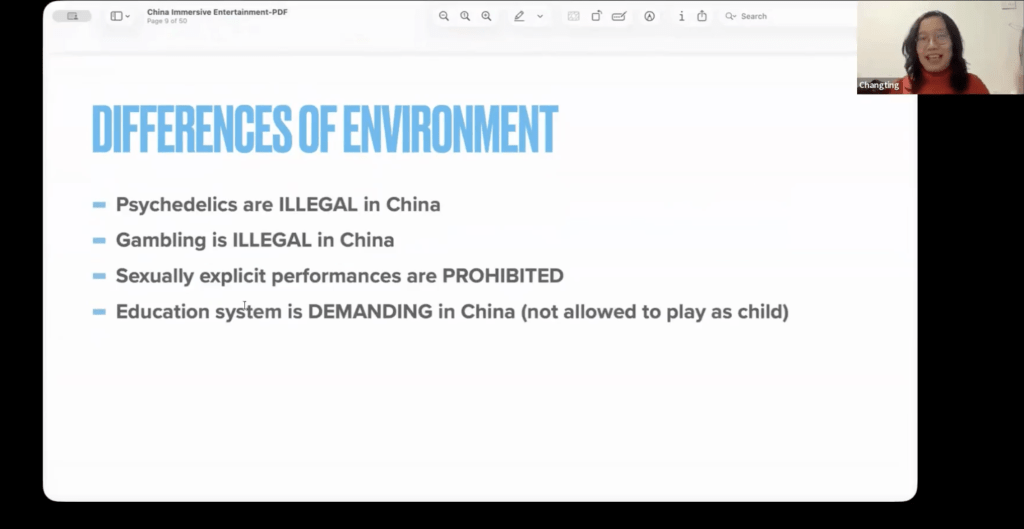
The legal and social environment shapes what audiences crave.
“Some things that might be legal in the US or a lot of European countries are illegal in China,” she revealed. “For example, psychedelics are illegal, gambling is illegal.”
Then she offered what she called a “secret” for making an experience a business success:
“If you can allow the audience to feel like they are doing something illegal legally, then they are going to be willing to pay a lot of money for that.”
It sounds provocative, but the point is bigger than China. People pay for experiences that safely stage forbidden feelings. They want danger without real danger, transgression without consequences, risk without ruin, altered states without illegality.
In China, Lu argued, this plays out clearly. Because gambling is illegal, shows and attractions that include gambling-like mechanics without real gambling can be commercially powerful. Because psychedelics are illegal, experiences that create an altered-state feeling through music, light, sound or scenography can also attract attention.
“What are the things that people crave for but they can’t get from their real life?” she asked.
That is a strong question for any experience creator. The most valuable experience is not always the most technically advanced or the most spectacular. It may be the one that gives legal, social or emotional permission for something otherwise unavailable.

This is also a useful counter to the generic language often used around “immersive”. Lu was not talking about immersion as a broad atmospheric quality. She was talking about specific forms of desire: the chance to be a gambler, criminal, warrior, lover, explorer, avatar or time traveller without becoming one in real life.
That is experience design as social pressure valve.
Trend #1: heritage-at-scale
Lu’s first major trend was heritage-at-scale.
She used Kaifeng, in Henan province, as her example. Kaifeng is a city with thousands of years of history. That creates a different condition from a conventional greenfield theme park.
“When we think about theme parks like Disneyland,” Lu said, “we need to remember that the land that they build the park on itself does not really have a ‘theme’. But now when we look at a lot of theme parks in China, we need to consider that the land itself already has a theme because the city has a long history.”
That is an important distinction. In many Western themed entertainment models, the theme is imported onto the site. In this case, the theme is already in the ground. The creator’s job is not to invent meaning from scratch, but instead to activate inherited meaning at visitor scale.

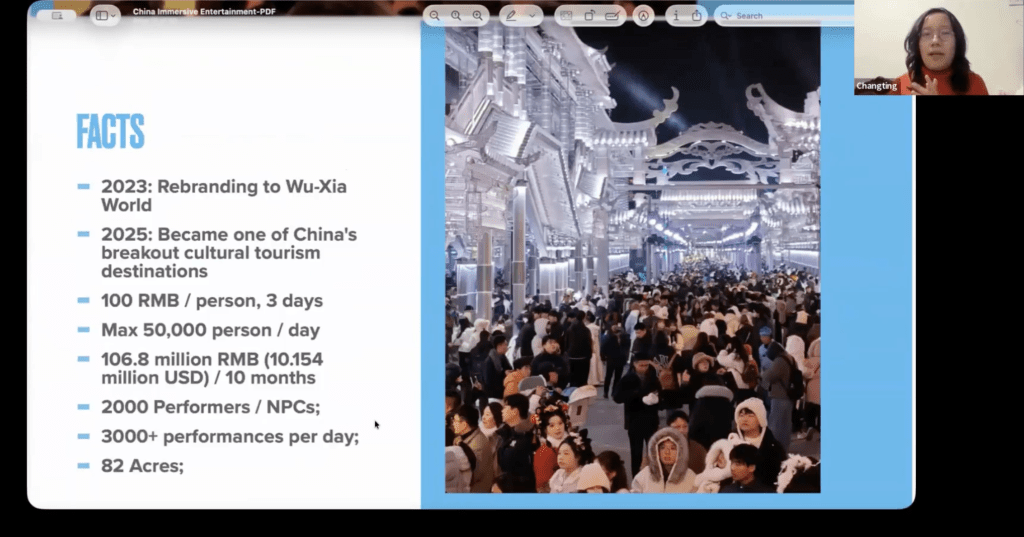
The case study was a Kaifeng attraction that rebranded in 2023 as a ‘wuxia world‘ experience. Lu explained wuxia as something like “a Jedi story, but in an ancient Chinese setting”: a genre familiar through Chinese film, novels and games, built around martial heroes, honour, skill, wandering, combat and moral codes.
That rebrand changed the guest proposition. Visitors were no longer simply attending an attraction in a historical city. They could enter an ancient martial world.
The results, according to Lu, were striking. Last year, it became one of China’s most successful and most visited tourist attractions. What makes it especially interesting is that the park is mostly performance-based. Lu said there are no conventional rides or rollercoasters. Instead, there are around 2,000 performers and 3,000 performances per day.
“It is basically a park with just tons of performances,” she said.
This is an important model. It treats live performance not as entertainment layered onto a ride park, but as the operating system of the park itself.
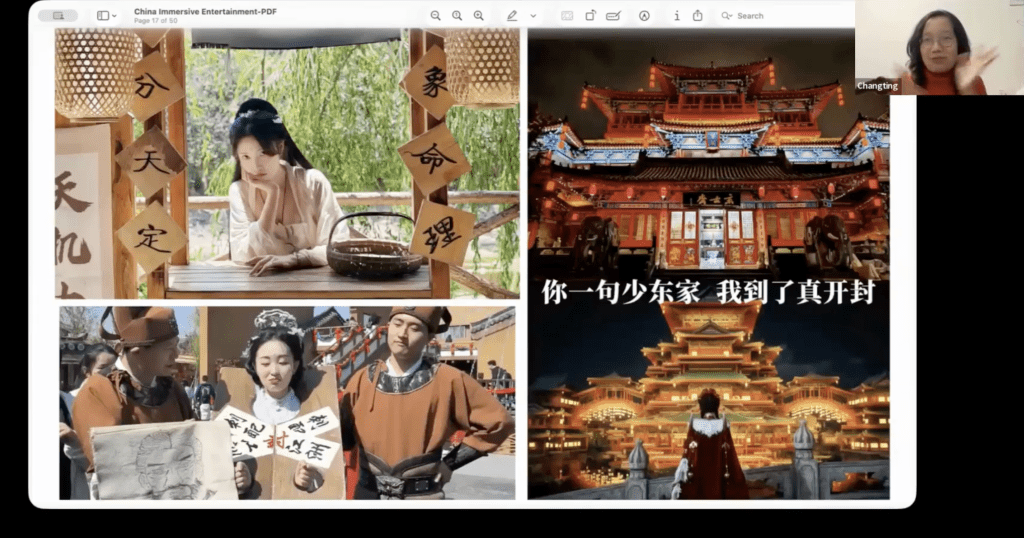
Visitors walk through what feels like an ancient movie set or war zone. Around them, vignettes of wuxia stories unfold. The attraction also uses a game system. On entry, guests receive paper money designed to look like currency from the Song dynasty, roughly a thousand years ago. This functions as a token economy. Guests can use it to play games, trade with actors and exchange it for souvenirs.
Here the earlier point about “illegal legally” returns. Some of the games include gambling-like elements. But because visitors are not using real money, they can experience the thrill of gambling without breaking the law.

“So these mini-games make it a lot more interactive,” Lu said, “and people really loved it.”
The practical lesson is clear. Heritage does not have to mean static interpretation. It can become a playable system. A historical city can be turned into a ruleset, a performance field and a social game.
When games teach people how to behave in physical worlds
The Kaifeng attraction also connects to gaming.
Lu explained that the attraction collaborated with a game company whose wuxia-themed open-world game had made Kaifeng an important setting. Some park scenes resemble scenes in the game. Some visitors are players who come to the park looking for a feeling they have already experienced digitally.
This is more than IP extension. It is behavioural training.
Games teach audiences how to read worlds. They teach people to look for quests, trade, talk to NPCs, test rules, accept side missions, commit harmless crimes and expect the environment to respond. When those behaviours are carried into a physical attraction, the visitor does not arrive as a blank slate. They already know how to play.
Lu gave a telling example:
“Some of these interactions are also interactions you might get in the game. For example, you can be a criminal. You can be put into a jail. People love it because while it’s not real jail, audiences get the sense of doing something illegal…”
That sentence contains much of the future of location-based entertainment. Visitors want roles, not just views. They want systems, not just sets. They want consequences that feel meaningful but remain safe.
For experience leaders, the implication is that game literacy is becoming experience literacy. If audiences spend hundreds of hours in open worlds, they may expect physical spaces to offer some of the same affordances: tasks, choice, status, currency, hidden encounters, social proof and playful rule-breaking.
The challenge is to translate those behaviours without simply copying game mechanics. A physical environment has bodies, queues, safety limits, staffing costs, weather, families, food, fatigue and social embarrassment. It cannot behave like a console game. But it can learn from one.
Trend #2: from digital to physical
Lu’s second trend was from digital to physical.
China’s game industry is enormous. The listing described the country as “the world’s largest consumer market”, and Lu’s Campfire session made clear that game culture is now feeding directly into immersive entertainment.
“In recent years,” she said, “a lot of these game companies are thinking of how to bring the digital world into the physical world.”
She traced this through several stages.
First, cosplay parties: fans dressing as characters and gathering around shared IP.
Then “only events”, where cosplayers of the same IP, or fans of the same character, gather in smaller venues to take photos and share fandom.
Then cosplay commissions, one of the most striking examples in the talk.
Lu discussed Love and Deepspace, a popular love simulation game with a large fan base in China. Because players love the characters, some commission cosplayers to perform as their favourite character and spend time with them on a date.
“Think of it as like a one-day long, one-on-one immersive performance,” Lu said. “So you can see why this attracts people.”
There is also a practical social insight here. Lu noted that many cosplayers playing male characters are women, because female fans may feel safer going on a date with a female performer than with a random male performer.
This is not a minor detail. It shows how market forms adapt to emotional and social conditions. The product is not only fantasy. It is controlled intimacy, role-play, safety and fandom in one package.

Game companies have noticed. Lu described an immersive activation in Shanghai for Love and Deepspace. In the game, players can have five husbands or boyfriends. The activation built a pop-up luxurious house beneath one of Shanghai’s famous landmarks, the Oriental Pearl Tower. Fans queued to enter the house and take photos with official cosplayers of their favourite characters.
Other game companies are doing similar work. Lu mentioned Honkai: Star Rail and Reverse: 1999 as examples of companies using immersive concerts, activations and themed buildings that match the game world.
The result is a market where the line between player, fan, visitor, customer and participant is blurred.
This is why Arcane could happen.
Lu cited the Arcane immersive musical performance in Shanghai, a collaboration between Tencent, Riot Games, Punchdrunk and SMG Live. She described it as a huge production and said it had become popular in Shanghai.
The important point is not simply that a big Western game/animation IP was adapted into a physical production. It is that the Chinese market already had habits that made the move legible: cosplay, fan gatherings, commissions, game-world activations, concerts, role-play and high-intensity IP fandom.
An international producer looking at China only through the lens of theatre or theme parks would miss this. The better lens is convergence. Games are not just content. They are social infrastructure.
Trend #3: tech at speed
Lu’s third trend was tech at speed.
Her main case study was Three Body Problem: Beyond Gravity, an immersive experience based on the famous Chinese science fiction novel that she worked on as creative director. The WXO listing notes that Lu was creative director for the project, which brings guests into the world of Three Body Problem with performance, interactive media and AI.
The most surprising thing, Lu said, was not only the technology inside the show. It was who produced it.
“Looking back at it,” she said, “I think the most surprising thing is actually it was an AI company who produced and invested and produced the show. It was not an entertainment company.”
This is one of the sharpest business insights in the talk.
In China, Lu argued, tech companies often want to create immersive experiences not only to showcase technology, but as part of brand-building. They want to present a compelling future in which their technology makes life easier, better or more exciting. The immersive experience becomes a vision of the future with the company placed inside it.
“(These tech companies) want to paint a brilliant future where technology can make people’s life easier or better,” Lu said, “Their brand and the technology they’re building is part of it.”

This creates a different funding and development environment from markets where entertainment companies dominate. Lu also noted that in China it can sometimes be easier for tech companies to access government funding or support than entertainment companies, and that tech companies may have stronger government relationships.
That affects what gets built.
It also affects risk tolerance. Lu said Chinese companies and audiences can be more open to using new technologies even before they are fully mature.
“I don’t think the technology is necessarily more advanced,” she said, “but I do think people are generally more open to use new technologies, even technologies that are not that well developed.”
That distinction is important. Innovation is not always about having better technology. Sometimes it is about adopting imperfect technology faster and finding the right narrative container for it.
Lu gave an example from Three Body Problem: Beyond Gravity. When the show was designed around three years ago, large language models were not as advanced as they are now. Conversations with AI could quickly reveal that something was off. But the team found a way to integrate the AI model into the show: the scene involved characters talking to a four-dimensional creature, an alien civilisation. Because the being was meant to be alien, it did not need to sound perfectly human.
“So because the character is kind of alien,” Lu said, “it actually makes sense if it doesn’t sound that human.”
This is a very smart design principle. Do not force immature technology to imitate mature human behaviour. Cast it in a role where its limitations become part of the fiction.
- If an AI cannot convincingly be a human receptionist, maybe it can be a ghost, oracle, alien, machine intelligence, bureaucratic system, dream fragment or unreliable narrator
- If a robot moves awkwardly, perhaps the awkwardness belongs to the world
- If a voice model has latency, perhaps the delay becomes ritual
Technology often fails when the creative frame demands naturalism from tools that cannot deliver it. Lu’s example shows the opposite: put the technology where its strangeness is useful.
The creative opportunity: Chinese formats are becoming less derivative
The title of the Campfire included the phrase ‘Inspiration to Innovation‘. That matters. The listing described a market evolving “from copying the Sleep No More model to creating entirely new formats”.
Lu’s examples support that shift.
The Kaifeng wuxia park is not simply a Chinese version of a Western theme park. It is a performance-heavy, game-inflected heritage world built on a real city’s historical meaning.
The Love and Deepspace economy is not simply a pop-up. It grows out of fandom, cosplay, parasocial intimacy, safety and one-on-one performance.
Three Body Problem: Beyond Gravity is not simply a sci-fi show with gadgets. It is an immersive experience financed by an AI company, partly shaped by the desire to present technological futures.
The through-line is not “China does immersive bigger”. Sometimes it does. The stronger point is that Chinese creators are combining cultural heritage, game behaviours, fandom intimacy, tech investment and physical entertainment in market-specific ways.
This is where international observers need to be careful. If they only look for familiar Western categories – theme park, theatre, escape room, activation, exhibition – they will miss the hybrid logic underneath. Many of the most interesting forms sit between categories.
And in China, category boundaries can move quickly.
International collaboration: the old advantage is weakening
After describing the three trends, Lu turned to international collaboration.
She used a Chinese saying: “foreign monks chant better.” The meaning is close to “the outsider is assumed to have special authority”. For years, this helped international creators. If a team came from overseas, it could be seen as bringing something new, rare or premium.
Lu’s point was that this still creates opportunities, but it is no longer enough.
“Recent years, some of the collaborations are successful,” she said, “but other collaborations? Not so much.”
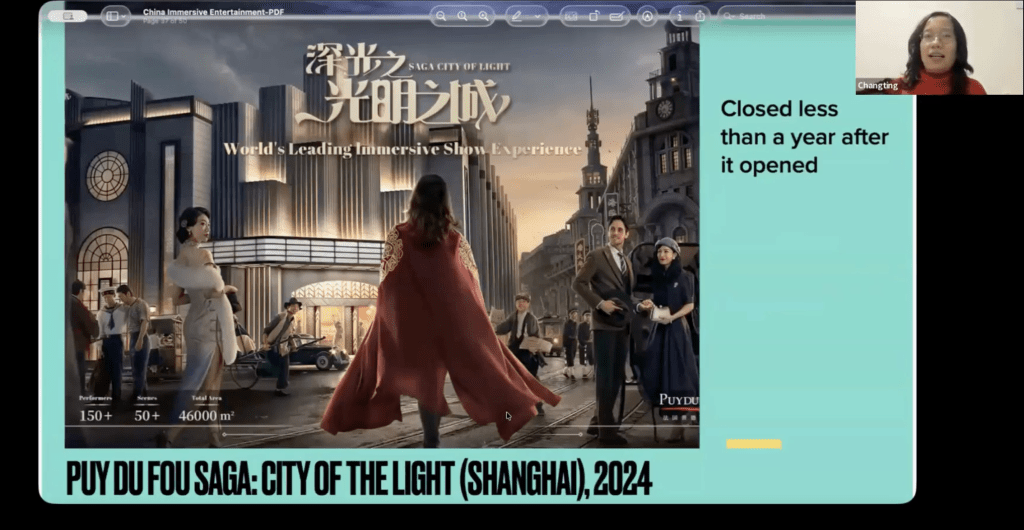
Her central cautionary tale was a major French-originated project that opened in Shanghai in 2024. Lu had heard of the brand while in Los Angeles and had looked forward to it. She knew people on the project and acknowledged the effort and production quality. The set was beautifully built. There were interesting experience design elements, including a shaking train and boat.
But the audience response was poor. According to Lu, it was so bad that the show had to close during previews, attempt fixes and reopen. Some visitors asked for refunds. The situation became chaotic enough that police were called.

Lu’s diagnosis was direct: the biggest problem was the story.
The show was set in Second World War Shanghai during the conflict between Japanese and Chinese forces. But it also brought in magic elements involving an ancient Chinese emperor and an object that could protect the city. To explain why this was jarring for Chinese audiences, Lu offered an analogy: imagine a Second World War story about German forces in Paris, only for the main character to discover a Roman Empire treasure under the Louvre with magical power to protect the city.
“So they bring some very unrelated things together,” she said. “The Chinese audience just feel like, well, this is not right.”
The phrase “not right” is understated. It captures something that is often missed in cross-cultural work. A story can be expensively made and still feel fundamentally wrong if the cultural logic does not hold.
Lu added that the story was apparently not written by a Chinese writer. That led to her main lesson:
“If you are doing something trying to connect with the local history and culture, then you really, really need to involve creators from this culture to write this.”
This should not be controversial. Yet the global experience industry still gets it wrong. Local culture is not a surface treatment. It is not enough to add a local setting, a local costume, a local myth or a local landmark. The deeper question is whether the story makes sense to the people whose history is being used.
There was also a more positive version of the lesson. Lu said that if the French company had told a French story, in a French style, based on French history, Chinese audiences may well have paid for it.
Why? Because it would have offered something genuinely different – something Chinese audiences could not easily access in daily life, and something cheaper than travelling to France.
This is a useful distinction for international creators.
You do not always need to localise the subject. But if you do localise it, you need local authorship.
There are two viable routes: bring the best of your own culture with confidence, or collaborate deeply enough that local culture is handled from the inside. The dangerous middle is importing a foreign structure and dressing it in local history without local narrative authority.
What experience professionals should take from this
Lu’s Campfire offered four practical lessons.
- First, design around unmet desire. The question “what do people crave but cannot get in real life?” is a powerful starting point. It may point to transgression, intimacy, risk, altered states, status, identity, nostalgia or social belonging.
- Second, treat heritage as an active system. In China, many places already carry strong historical meaning. The opportunity is not just to represent that heritage, but to let people play, trade, perform and inhabit it.
- Third, recognise that digital fandom is now a physical market. Game audiences do not only want merchandise or screen-based extensions. They may want dates with characters, concerts, pop-up houses, world activations and immersive productions.
- Fourth, match technology to story maturity. New tools do not need to be perfect if their limitations are creatively framed. An imperfect AI can be a weak human, but a compelling alien.
- Fifth, do not mistake international prestige for cultural permission. Foreign expertise may still be valued, but the market is more mature. Audiences can tell when a local story has not been properly understood.
The broader lesson is that China’s immersive market is not simply a destination for exported formats. It is a laboratory for new hybrids: historical performance parks with game economies, fan-service activations with one-on-one role-play, tech-funded sci-fi worlds, and collaborations that succeed or fail depending on cultural intelligence.
That is why the “finding its own voice” phrase matters. The market is not only growing. It is developing grammar.
Conclusion: The next opportunity is not copying China either
There is a risk in reading any market case study too literally. International creators should not come away thinking the answer is to copy Kaifeng, commission cosplay dates, add AI aliens or build gambling-lite mechanics into every experience.
That would miss the point.
The value of Lu’s talk was not a menu of Chinese tactics. It was a way of seeing how entertainment forms emerge from local conditions.
China’s immersive entertainment is shaped by law, history, fandom, technology investment, government relationships, city identity, game culture and social need. Other markets will have their own equivalents. The task is to understand those forces before deciding the form.
The most useful question from the Campfire is therefore not “what is China doing?” It is “what is this market making possible that another market would not?”
In China, one answer is heritage at performance scale. Another is digital IP becoming physical behaviour. Another is tech companies acting as immersive producers. Another is a new confidence in domestic voice.
For WXO members, that should be the provocation. The Experience Economy is not converging into one global format. It is splintering into local grammars, each shaped by different audiences, permissions and infrastructures.
That makes international collaboration harder. It also makes it more interesting.
For more on this topic
WXO Campfires are member-only sessions, with members also unlocking access to the organisation’s full on-demand library of Campfire recordings.
The recording, transcript and presentation from this Campfire are available to WXO members inside the membership hub.
You can check out listings for forthcoming Campfires here.
For more information on how to join the WXO, head here.