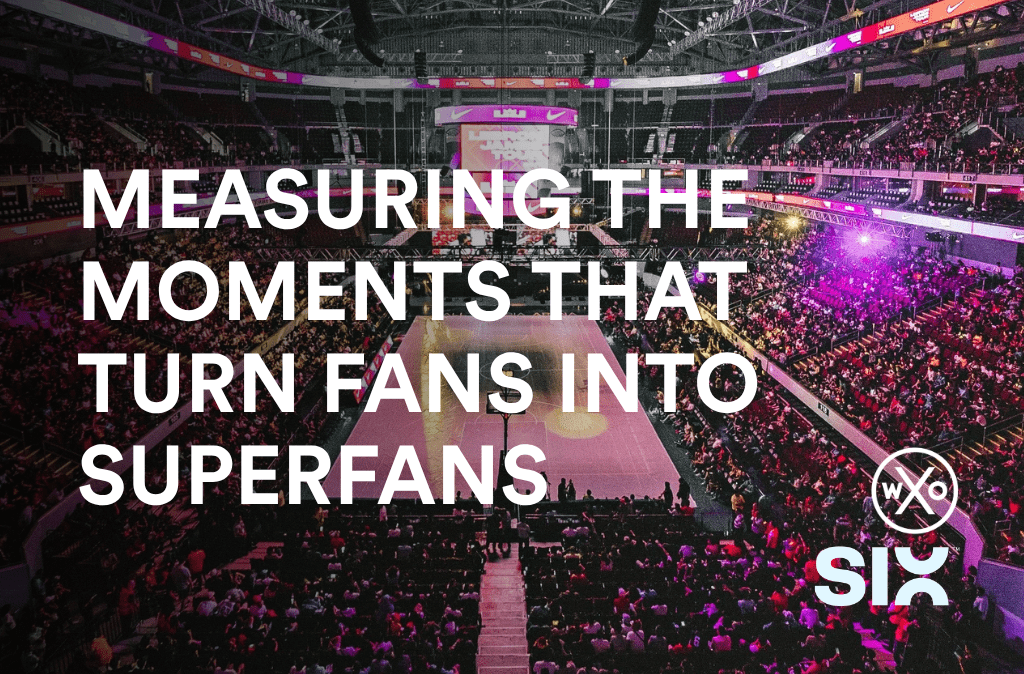

Immersion used wearable data to show the Cleveland Cavaliers where an NBA game day created value, friction and commercial opportunity.
Immersion is a neuroscience and biometric measurement company that helps organisations understand how people respond to content, events and experiences in real time.
Rather than relying solely on what participants remember afterwards, the company uses passive biometric data to identify changes in emotional value across the experience itself.
The Cleveland Cavaliers are a professional basketball team competing in the NBA, North America’s leading basketball league.
Like other major sports franchises, the Cavaliers control much of the entertainment, hospitality and service surrounding a game. They cannot control the result on the court.
It’s that distinction – the desire to improve audience experience and the desire for control – that shaped the brief.
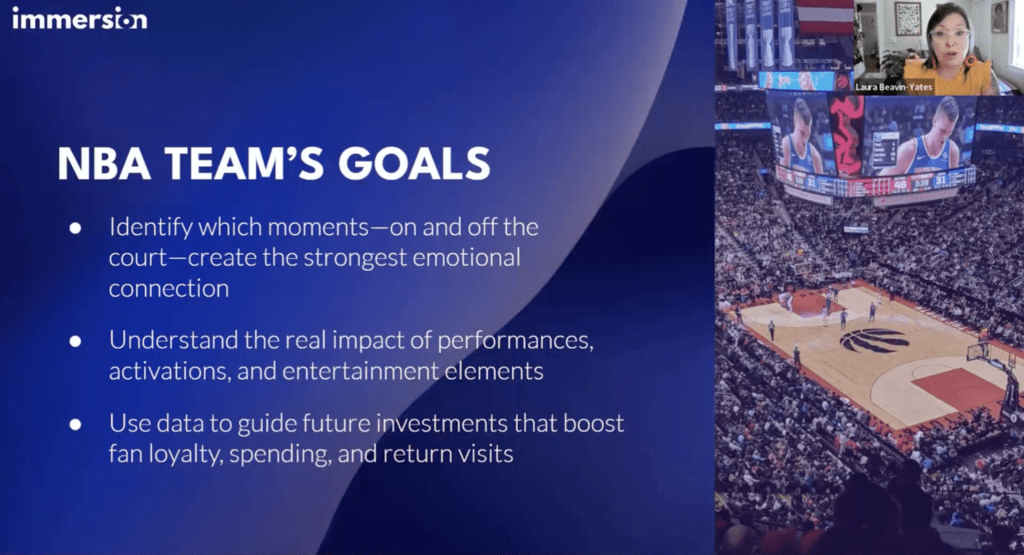
The Cavaliers wanted Immersion to identify which controllable parts of game day created genuine value for fans, where the journey caused friction and when engagement might support further spending or loyalty. The ensuing case study presented here is testament to the desire of that brief and the strength of Immersion’s strategy and technology.
This Experience Briefing draws on a WXO Campfire with Laura Beavin-Yates and distils its most useful ideas for experience leaders.
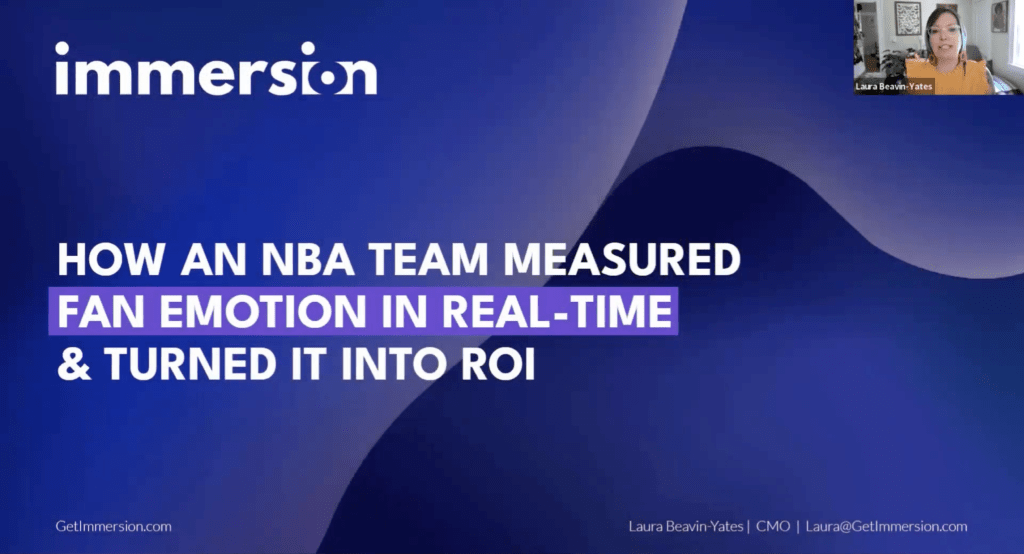
Laura Beavin-Yates works at the intersection of cognitive psychology, behavioural neuroscience and audience measurement. As CMO at Immersion, she helps organisations turn passive biometric data into practical evidence about how people experience live events and content.
She argues that real-time measurement earns its place when it helps an operator make a better decision.
The Cavaliers project gives that argument practical force. Immersion designed and ran a two-game proof of concept that connected biometric data with specific game-day moments, audience groups and operational choices.
The work addressed questions the scoreline could not:
- Which controllable moments created value?
- Which entertainment investments justified their cost?
- Where did the fan journey create friction?
- Which groups had the strongest emotional connection?
- When might engagement support another commercial action?
Measure the experience people have, not only the one they remember
Traditional audience research usually happens after the experience.
That creates a timing problem.
People remember peaks, endings and unusual moments more readily than the full journey. Their answers may also be affected by the result of the game, the journey home or what happened after leaving the venue – it’s commonly known as the Mandela Effect.
The suggestion is not that surveys are useless.
They provide important context. A fan may explain that poor lighting, confusing signage or congestion weakened the experience.
But a survey starts with the remembering self.
Real-time measurement starts with the experiencing self.
The distinction matters when a client needs to identify exactly when engagement rises or falls.
Beavin-Yates also questions intrusive real-time methods such as dial testing, where participants continually report whether they like what they are seeing:
“If I’m paying attention to turning a dial up and down, what am I not paying attention to? The thing in front of me.”
Measurement should not change the experience it is trying to understand.
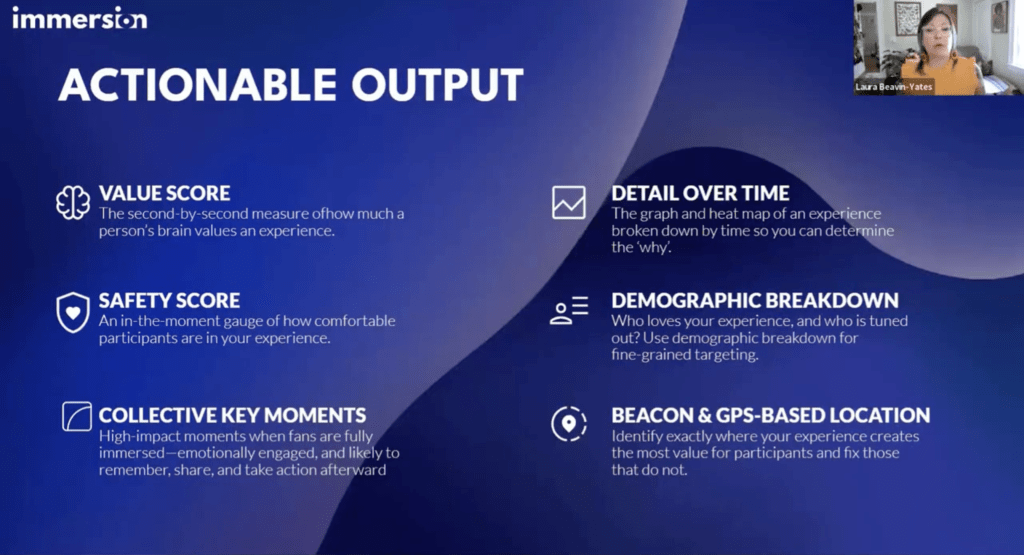
What Immersion measures
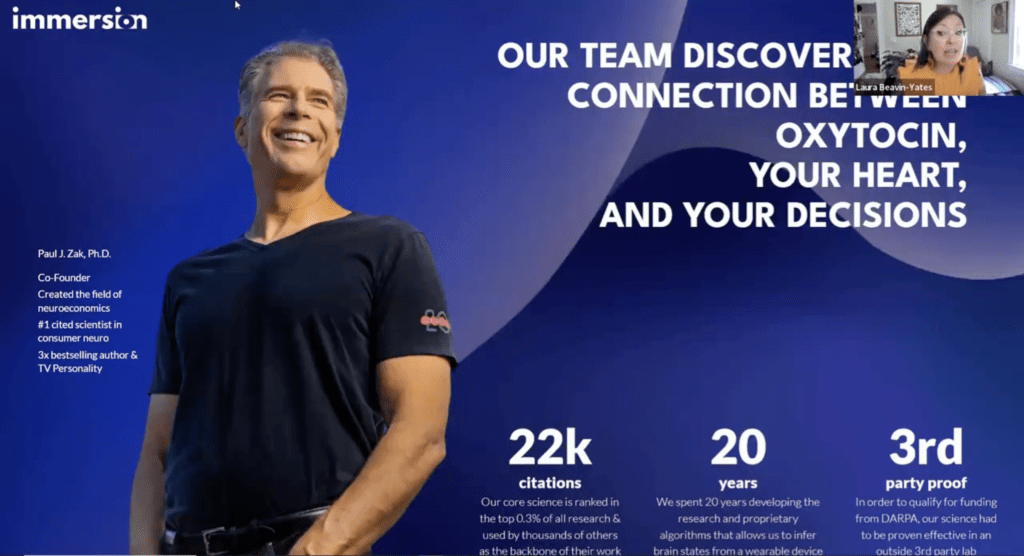
Immersion’s method uses heart-rhythm data collected through smartwatches, fitness trackers or sensors supplied at the venue.
Its proprietary algorithms convert those signals into three outputs.
1. Value
A moment-by-moment measure of how strongly an experience registers as worthwhile and meaningful.
Immersion links high Value with later outcomes including recall, sharing, purchasing and return behaviour.
2. Safety
A measure of comfort and confidence compared with anxiety or stress.
This is not workplace psychological safety. Here, it helps identify whether somebody feels at ease inside the physical and emotional environment.
3. Collective Key Moments
Points where a group records a simultaneous rise in Value.
These show where a shared experience may be creating a common memory or increasing the likelihood of later action.
Immersion bases its model on research into oxytocin, dopamine and cardiac rhythms. The company reports that its measures can forecast outcomes such as recall, sales and subsequent action with at least 85% accuracy.
These are company-reported results from a proprietary system. A client considering the approach should ask for validation relevant to its own audience and intended decision.
The practical principle is clear:
Collect the data without asking people to leave the experience in order to describe it.
How Immersion ran the Cavaliers study
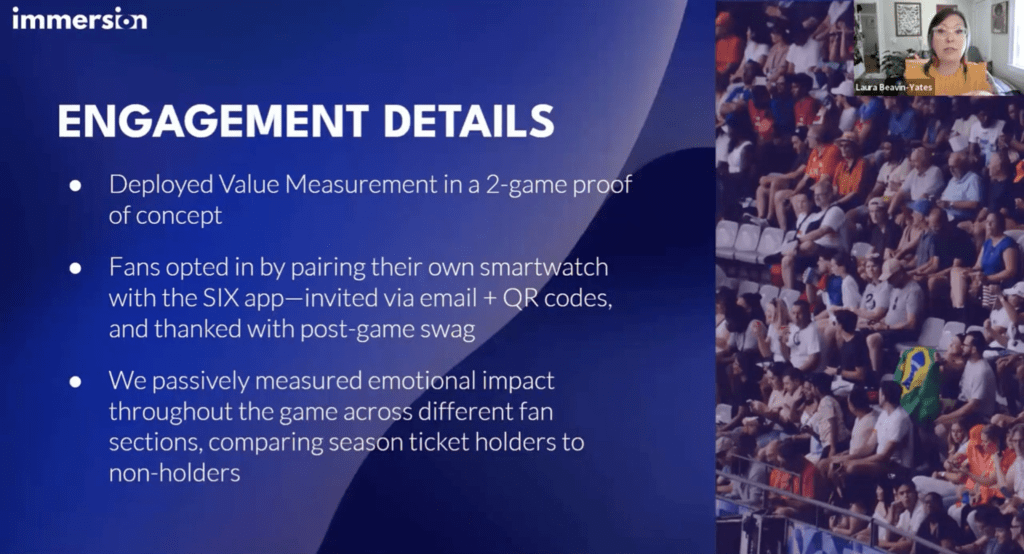
Immersion measured fan responses during two Cavaliers home games, against the New York Knicks and Memphis Grizzlies.
A total of 118 fans took part across different seating tiers. The sample included members and non-members.
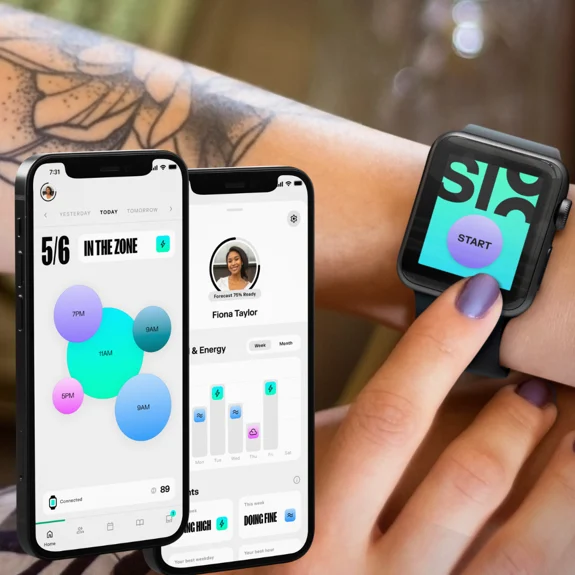
Participants opted in, connected a supported smartwatch or used a Bluetooth sensor provided at the Cleveland’s Rocket Arena. Immersion’s SIX app collected the data anonymously while they watched the game.
Each fixture generated around 1.5 million individual data points.
Using two separate games created a useful comparison:
- One game was close.
- The other had a wider points margin.
This allowed Immersion to examine which parts of the game-day experience retained value regardless of the contest on the court.
The Cavaliers wanted the study to support practical decisions around entertainment, loyalty and the wider fan journey.
As the client put it:
“We know we have no control over the score of the game. However, we do know that we can control the entertainment elements.”
That is the business reason for the study.
The Cavaliers could not guarantee fans a close game or a home win.
However they could improve almost everything surrounding them.
What Immersion’s analysis revealed
The project directly affected not just the audience experience but the commercials surrounding it. They mapped directly to the three outputs detailed above – Value, Safety and Collective Key Moments:
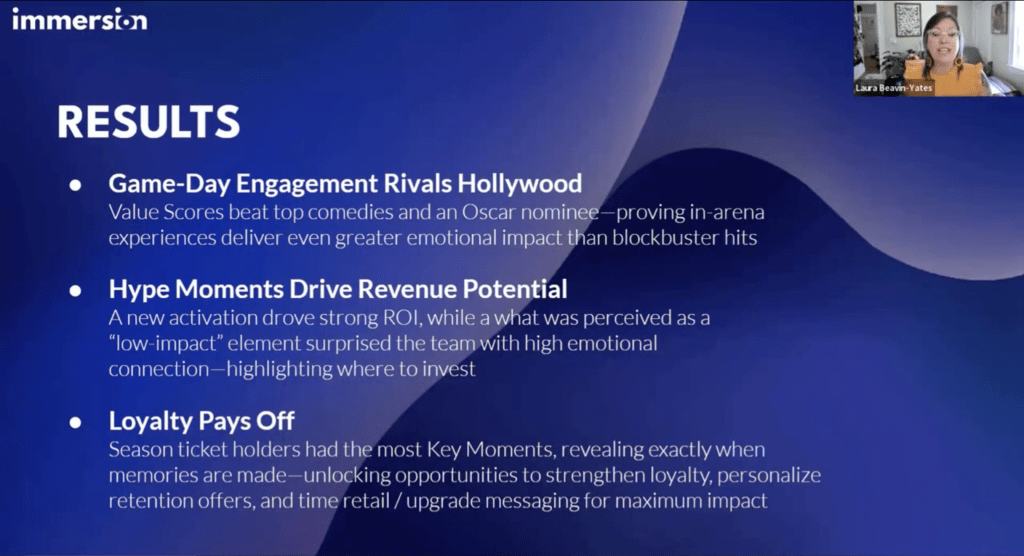
1. The live experience justified serious investment
Immersion found that fan Value across the games matched the emotional impact recorded for successful family films and exceeded the response to an Oscar-nominated film used as a benchmark.
This gave the Cavaliers a way to understand the strength of the live game-day experience beyond attendance or satisfaction.
More importantly, the analysis distinguished between individual game-day elements.
A costly new entertainment activation produced clear Collective Key Moments. The evidence suggested that the investment was performing its intended role.
The Honorary Ball Kids programme produced a different surprise.
Members of the Cavaliers’ marketing team had regarded the pre-game activity as relatively uneventful. Immersion’s data showed that fans connected with seeing a child enter the court and interact with the players.
One result supported a substantial investment.
The other protected a smaller moment that might otherwise have been underestimated.
The learning? Production cost and audience value are not the same thing.
2. Membership changed the emotional response
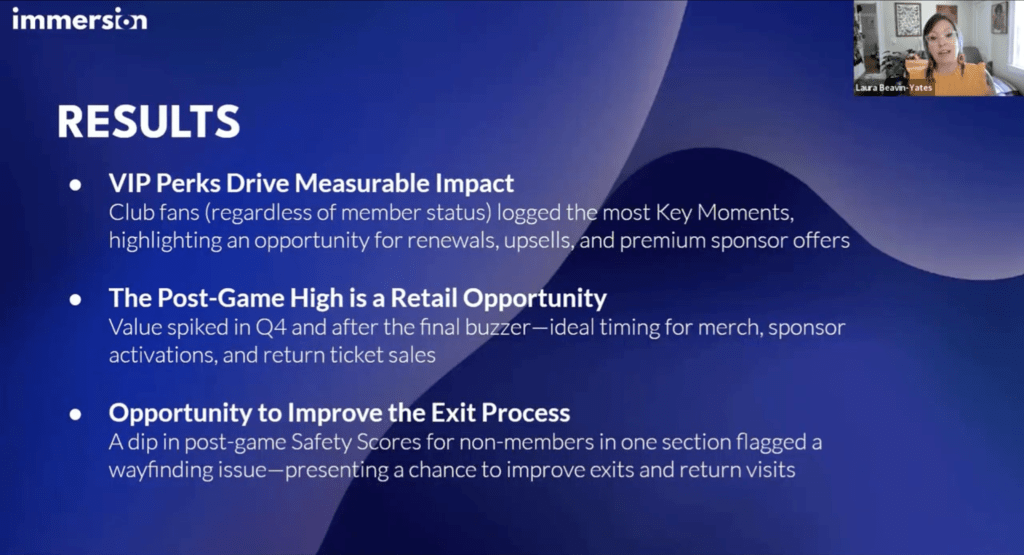
Immersion found that members of the Cavs United Membership scheme experienced more meaningful moments than non-members.
During the game with the wider points margin, members showed 6% higher Value and 4% higher Safety. During the tighter game, their Value was 3% higher, with similar Safety scores.
Invited guests recorded the strongest response across seating groups. Their Value was 16% higher and their Safety was 10% higher than for fans elsewhere in the arena. No surprise given the premium level of their game-day experience.
Irrespective of membership level, fans aged 16 to 35 also showed the strongest emotional connection.
These results do not mean loyalty can be reduced to a biometric score.
They give the Cavaliers stronger questions to investigate.
- Why does the club environment perform so well?
- Which aspects could be extended to other sections?
- What experiences help turn a first-time visitor into a full-time member?
Immersion identified the groups and moments worth examining. The Cavaliers could then decide how to respond.
3. The commercial window continued after the final buzzer
Immersion recorded a rise in Value during the fourth quarter, with engagement remaining high after both games.
This happened despite the different scorelines.
The result suggested that the Cavaliers might be closing shops, ending sponsor activity or withdrawing ticket offers while fans were still strongly engaged.
The post-game period was not simply an operational exit.
It was part of the experience and a possible commercial window.
That does not prove that every offer presented during a Value peak will convert.
It gives the Cavaliers an evidence-based opportunity to test merchandise, membership or future-ticket offers at a more relevant moment – and one they had not previously considered utilising.
4. Falling Safety highlighted possible friction
One specific group of non-member club guests recorded a decline in Safety after the game.
Immersion’s analysis directed attention towards that stage of the journey. The Cavaliers could then connect the finding with an exit area affected by weak signage and low lighting.
The data did not diagnose the operational problem by itself.
It showed the client where to investigate.
Biometric measurement can flag that the audience response has changed. Observation, interviews and operational knowledge may still be needed to explain why.

Turn measurement into a client decision
The work conducted by Immersion suggests a practical loop for any experience teams and their measurement partners.
1. Begin with what the operator can control
Do not collect data simply because it is available.
Agree which decisions the evidence needs to inform. These may concern entertainment, service, retail timing, signage or membership benefits.
2. Measure the whole journey passively
Include arrival, pre-event activity, the core experience and departure.
Participants should not have to stop engaging in order to report how engaged they are.
3. Synchronise the data with the experience timeline
A rise or fall means little until the analyst knows what happened at that moment and where the participant was.
4. Compare meaningful audience groups
Average results can hide differences between members and non-members, premium and general seating, or younger and older fans.
5. Give the client a decision, not only a chart
- Protect the activation that works.
- Investigate the unexpected success.
- Test an offer during a stronger moment.
- Fix the exit and measure again.
The value lies in what the operator can do differently because the evidence exists.
Where the method could go next
The proof of concept focused mainly on what happened inside the Cavaliers’ Rocket Arena on a game-day.
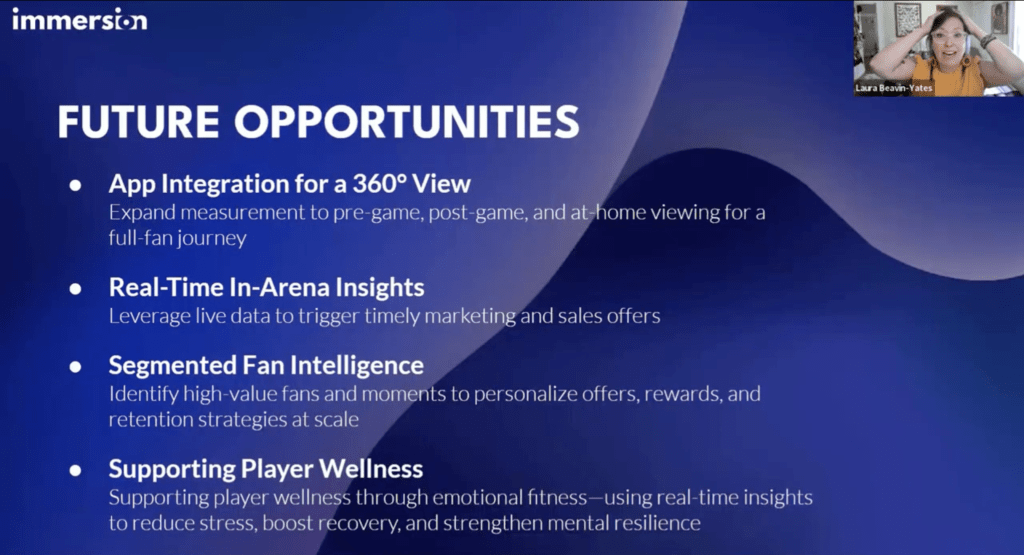
Integrating the system into an existing team smartphone app could extend measurement across travel, at-home viewing, watch parties and the period both before and after the game.
A live dashboard could also help an operator respond while the experience is happening.
Example: If one section records lower Value, entertainment, hosting or offers could be redirected towards it.
While these future applications are potentially more valuable than dwelling on the two-game study, they also introduce equally important questions around consent, privacy and the acceptable use of real-time biometric insight.
- Participation should be clearly opt-in.
- The data should be protected.
- Fans should understand what is being collected and how it may be used.
Immersion’s proprietary technology is also moving into other live-event settings.
At ArcTanGent, a UK heavy music festival, visitors were invited to connect smartwatches to SIX and see which moments produced their strongest responses. Again, only anonymised insights were shared with the event team.
It shows this type of study can easily migrate across sectors, benefitting operators, creative and audiences alike. Again, only anonymised insights were shared with the event team.
What Immersion’s work proves, and what it does not
The Cleveland Cavaliers project was a two-game proof of concept.
- It shows that passive measurement can produce a detailed map of audience response and direct a client towards practical decisions.
- It does not prove that every Value peak causes a purchase.
- It does not make surveys redundant.
- It does not mean that the patterns found in Cleveland will automatically apply to another sport, venue or audience.
Real-time data helps show when something changes.
Qualitative research and operational knowledge often remain necessary to explain why.
The strongest system combines them.
The bigger lesson
Most experience operators already collect activity data.
They know how many people attended, how long they stayed and what they bought.
Immersion added another question for the Cavaliers:
Where did the experience become valuable to fans?
The answers appeared everywhere
- in expensive entertainment
- a child retrieving a basketball
- premium hospitality
- the closing stages of the game
- the journey out of the building
Those moments did not carry equal production weight or commercial investment. They did not affect every audience group in the same way.
That is why Immersion’s work mattered.
The aim was not to replace creative or operational judgement with a dashboard. It was to show the Cavaliers where that judgement could have the greatest effect.
Beavin-Yates’ broader point is that measurement becomes valuable when it changes what happens next. For the Cavaliers, the evidence raised practical questions about activation spend, membership, retail timing and the exit journey.
The useful output was not the biometric data itself.
It was a clearer set of decisions.
What to ask in your next meeting
- Which parts of the experience can the operator control?
- Which investments are currently supported mainly by opinion?
- Can a measurement partner capture the full journey without interrupting it?
- Which audience groups need to be compared?
- Where might high Value create a useful commercial window?
- Where could falling Safety reveal friction?
- What additional research will explain the pattern?
- What will the client do differently when the findings arrive?
The question to take into the room is:
Which moments are creating value, for whom, and what decision should that evidence change?
Further reading
- How the Cleveland Cavaliers Used Neuroscience to Measure Fan Experience
- The Science of Value Measurement
- Original WXO Campfire listing
- ArcTanGent’s invitation to measure the festival experience with SIX
For more Experience Briefings, head here.
For more information on how to join the WXO, head here.