
A strong experience launch proves people are curious. It does not prove they will come back.
The first year of an experience business can sometimes disguise its weaknesses.
Newness creates demand. Early adopters arrive. Opening marketing is at full strength. Social media gives people another reason to try it.
Everything’s great.
That is until the market becomes familiar with the idea.
Now that experience business faces a harder test:
Why should somebody come again?
As a key sector in the experience economy, competitive socialising makes this problem unusually visible. Venues can cost millions to build, the visit is discretionary and ‘mainstream’ customers (this is no ‘hardcore’ launch for experience early adopters) have plenty of alternative ways to spend their evening.

TJ Schier has spent decades operating inside that challenge. He is founder and CEO of multiplayer golf concept SmashSwing, spent 18 years at Chuck E. Cheese and has worked extensively across competitive socialising, hospitality and guest experience.
This Experience Briefing draws on a WXO Campfire with TJ Schier and distils its most useful ideas for experience leaders.

Year One is not the business model
Financial plans often treat the opening year as a baseline.
- Year One succeeds.
- Year Two grows another 5%.
- Year Three grows again.
Schier argues that experience operators should stress-test exactly the opposite.
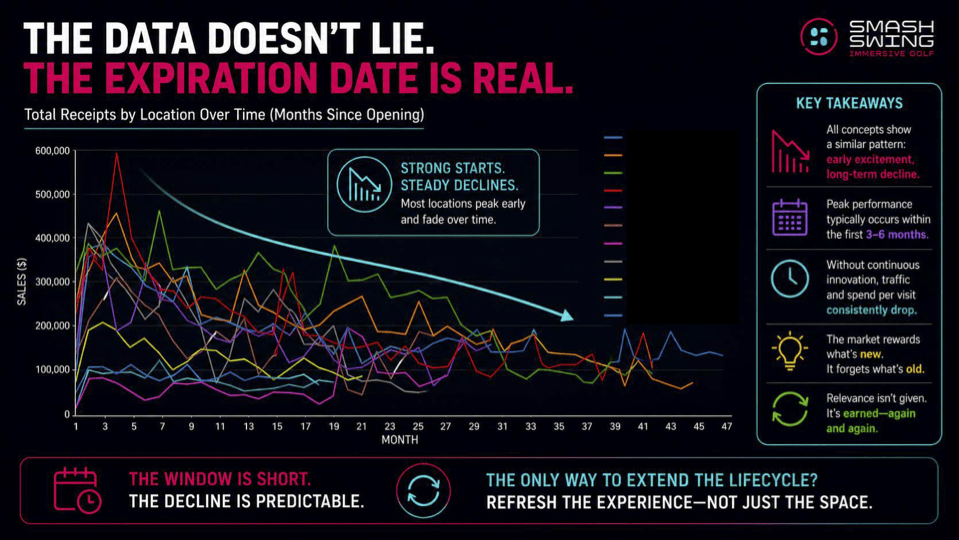
He uses an illustrative example of an $8 million opening year becoming $6 million and then $5.5 million as demand normalises. Those figures are not a universal forecast. The point is to model what happens if novelty disappears while rent, wages and other costs remain.
His analysis of public Texas alcohol receipts provides another warning (see screenshot). Across several competitive-socialising venues, sales commonly peak in the first few months before trending down. Note: These are alcohol receipts rather than full venue revenues, so they should be treated as a directional indicator rather than a complete P&L.
Schier also makes an important exception for high-tourism markets such as Las Vegas, Dubai and Orlando, where a constantly changing visitor population can keep replenishing first-time demand.
For most repeat-visit businesses, however, the strategic question is straightforward:
What does this business look like after everybody nearby who wanted to try it once has tried it?
Schier’s experience produces seven practical principles for designing beyond the honeymoon period.
Principle #1: Design for everyone who determines the return visit
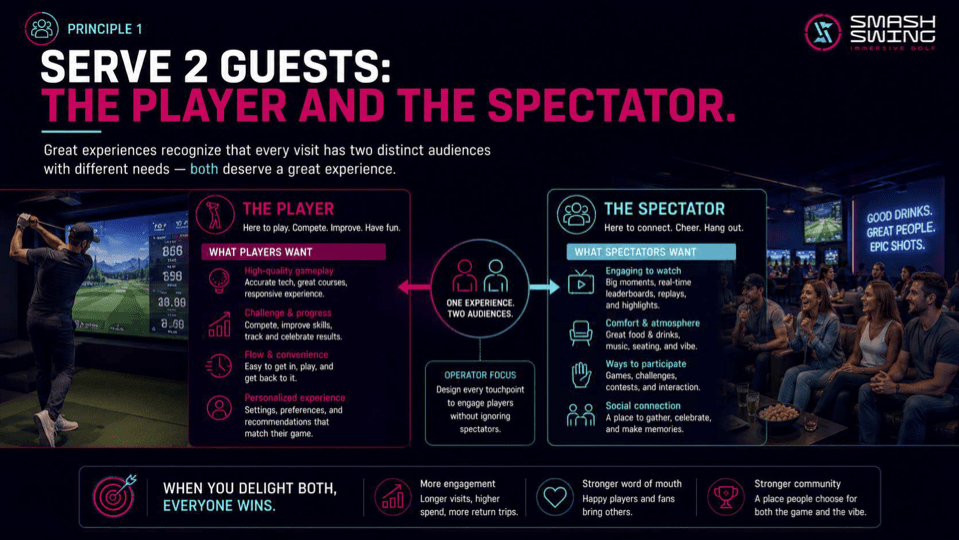
Schier calls this serve two guests.
In competitive socialising, there is usually an obvious participant and a less obvious audience.
- One person swings.
- One person throws.
- One person takes the turn.
Everyone else watches.
“You have the player and the spectator.”
The spectator may actually have more influence over the return decision.
A child may love the attraction, but the parent decides whether the family returns. A golfer may enjoy taking their shots, but the other five people in the group need a good evening too.
This changes the design brief.
- Can spectators follow the action?
- Can they interact?
- Are they comfortable?
- Does the game produce moments worth watching?
- Can they eat, drink, talk and participate without interrupting play?
The transferable principle is broader:
Design for everybody whose experience influences whether the group comes back.
Principle #2: Give people a reason to return
Falling demand often produces a predictable response.
- Free this.
- Discount that.
- Bring a friend.
- Reduced-price food.
Schier’s objection is not that promotions never work. It is that discounting cannot compensate for an experience that has given people no new reason to visit.
The more useful question is:
Why this week rather than six months from now?
Leagues can create habit.
Seasonal programming creates temporary urgency.
New games create something genuinely new to experience.
Memberships can turn an occasional decision into an ongoing relationship.
“This kind of thing shouts value to the member, not discount.”
The distinction is useful across sectors.
Discounting says: experience the same thing for less.
Programming says: there is something different worth returning for.
Principle #3: Understand what the complete outing feels worth
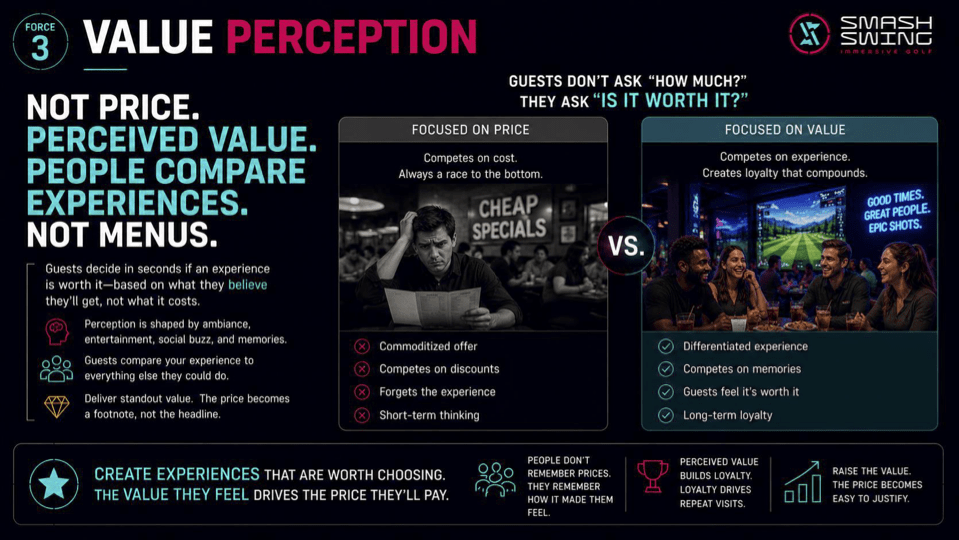
Operators calculate price through costs and margins.
Customers do not necessarily do the same.
Schier illustrates this with two separate offers based around golf gaming.
A per-person price sounded inexpensive to his family even when the combined group cost was higher than an alternative sold as one relatively expensive bay hire.
The lesson is not that one pricing structure is inherently better.
It is that value is perceived, compared and contextual.
The customer may compare the complete outing with:
- a restaurant
- cinema tickets
- drinks with friends
- another attraction
- a sporting event
- staying at home
They are not necessarily comparing your menu with another menu or your golf bay with another golf bay.
This means value is shaped by the complete use of money, effort and time.
The strategic question becomes:
What does this evening feel worth from the guest’s side of the counter?
Principle #4: Build change into the product
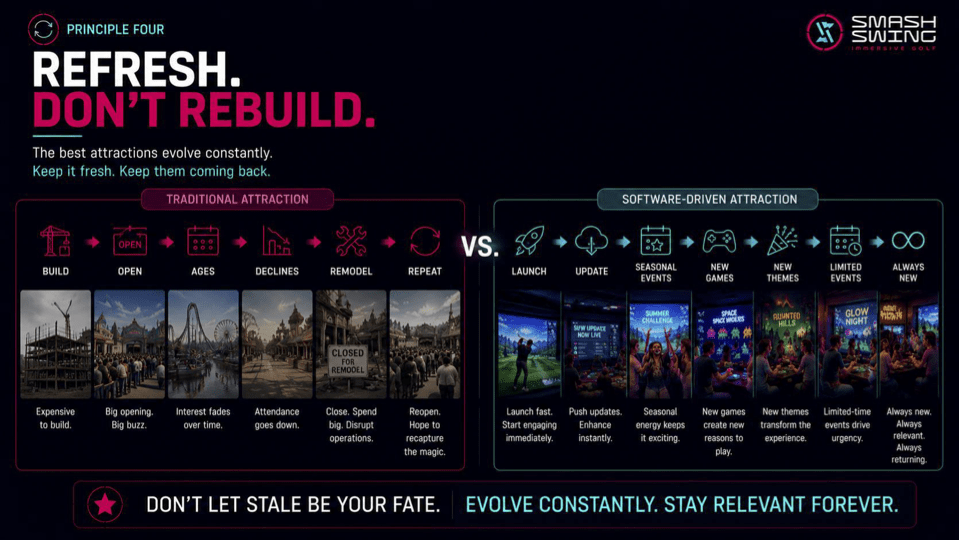
An experience that cannot evolve has a built-in problem.
Once people have seen it, they have seen it.
Schier’s long-term reference point is Chuck E. Cheese, which repeatedly reinvested in its estate rather than treating the opening build as ‘finished forever’.
The important detail is how.
Small isolated upgrades can cost money without creating any meaningful sense of change. Schier describes bundling several noticeable improvements so guests walk back in and recognise that something is genuinely different.
Schier’s own SmashSwing Immersive proposition takes the same idea into software.
The expensive hardware remains, while different games, seasonal content and licensed IP can be introduced around it.
That suggests a useful design principle for any experience business:
Separate what needs to last from what needs to change.
- A venue might retain its physical infrastructure while changing programming.
- An immersive production can change stories or missions.
- A museum can change interpretation and events.
- A resort can rotate rituals and seasonal experiences.
- A digital layer can change while the capital-intensive physical layer remains.
Refreshability should therefore be considered during the original design, not after the experience becomes stale.
Principle #5: Do not overbuild the supporting experience
Competitive-socialising venues often build ambitious kitchens and large menus.
Schier argues that customers frequently respond by ordering the safest, most familiar items anyway.
As a franchisee of Which Wich (an American fast casual restaurant chain specializing in crafted, custom sandwiches and salads), he operated a menu offering 51 sandwiches and around 50 toppings.
He says more than half his sandwich sales came from turkey.
Across competitive-socialising concepts, he similarly sees a small number of items producing the majority of food sales.
His advice is memorable:
“Don’t build a Lamborghini kitchen or a Lamborghini menu.”
The cross-sector lesson is more important than the menu itself.
Every experience contains supporting components:
- Retail.
- Technology.
- F&B.
- Registration.
- Merchandise.
- Ancillary content.
Some deserve major investment. Others simply need to do their job reliably and well.
Ask:
Where are we creating expensive complexity that customers do not value enough?
Principle #6: Plan Year Two while building Year One
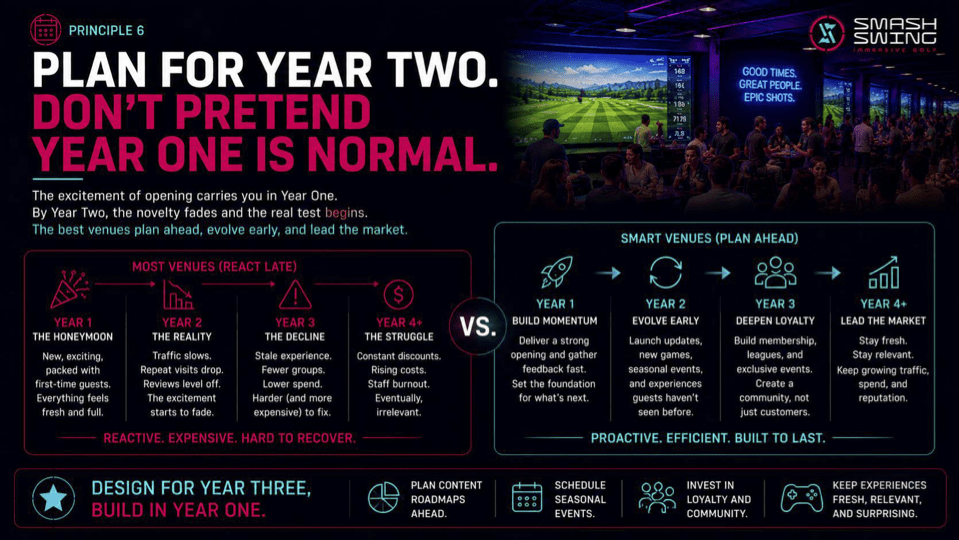
This is the financial expression of the whole argument.
Do not wait until traffic falls to decide how the venue will evolve.
Before opening, determine:
- what changes in Year Two
- what programming is already planned
- which memberships or loyalty mechanisms exist
- how repeat behaviour will be measured
- what capital has been reserved for refresh
- whether the economics survive lower volumes
Schier’s presentation captures the point neatly:
Design for Year Three. Build in Year One.
The Year Two plan is not a recovery programme.
It is part of the original product.
Principle #7: Give the team a standard they can use
The final safeguard is human.
Schier recommends giving employees a simple line that helps them make decisions without waiting for a manager.
At Chuck E. Cheese it was:
“Every guest leaves happy.”
The wording is not the important part.
Its usefulness is.
An employee facing a small service problem has a decision rule.
Schier also recommends letting new staff experience the venue as a guest before teaching them how to operate it.
“Make them be a guest for 90 minutes, deliver the exact experience that you want delivered, done perfectly.”
First show people the standard.
Then train them to reproduce it.
The Year Two Test applies beyond competitive socialising
Schier’s Year Two test applies to all sectors in the experience economy/
- A museum exhibition can become familiar.
- An immersive production can exhaust its first audience.
- A resort can lose novelty.
- A hospitality concept can stop feeling distinctive.
- A technology-led attraction can stop feeling technological.
Competitive socialising simply exposes the problem quickly.
The transferable lesson is not to copy golf venues or Chuck E. Cheese.
It is to design the mature version of the experience business at the same time as the exciting new version.
Creativity gets attention.
Repeatability turns attention into a business.
What to ask in your next meeting
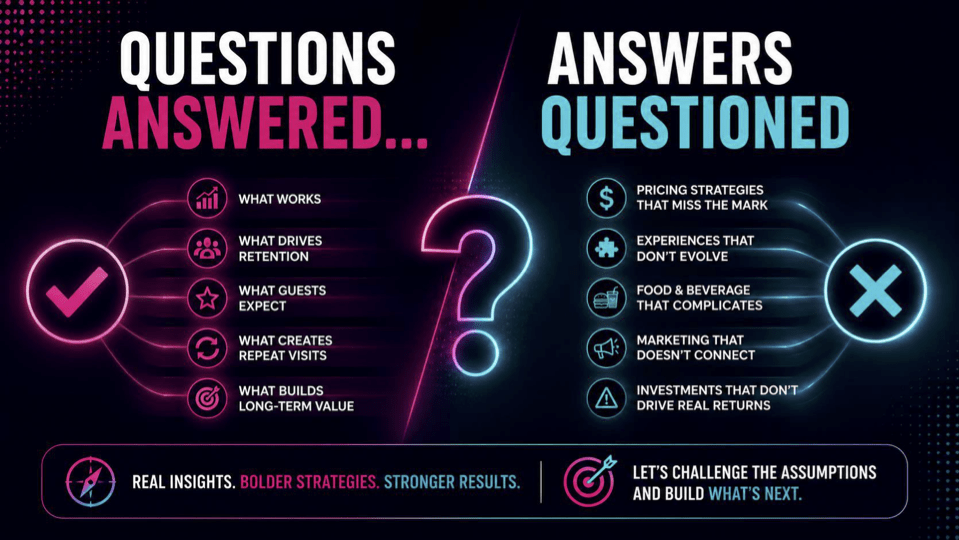
What will make somebody choose us for the third time?
Then ask:
- What will be meaningfully different in Year Two?
- Does our financial model still work if launch demand falls?
- Which parts can change without a major rebuild?
- Are we investing most heavily in what guests genuinely value?
The mistake is treating launch as the finish line.
It is the beginning of the operating challenge – but one you can attack before you even open your doors.
Further reading
- TJ Schier, What Topgolf’s Struggles, and a Mouse (No, Not that One) Can Teach Us, FSR Magazine
- Original WXO listing and TJ Schier biography
- SmashSwing Immersive: A Case Study
- Learn more about SmashSwing Immersive: Golf Business TechCon 25
For more Experience Briefings, head here.
For more information on how to join the WXO, head here.