
Research creates the most value when it helps teams make better decisions throughout development, rather than approving ideas at the beginning or evaluating them after launch.
Experience teams can have an uneasy relationship with research.
Creative teams may worry that audiences will be asked to approve unfinished ideas. Commissioners may expect a survey to predict success. Research may be introduced late, when the important decisions have already been made.
In each case, insight becomes a verdict.
The more useful approach is to treat it as an ongoing source of evidence. Different methods answer different questions. The findings reach teams while they can still improve the proposition, journey, positioning, communications or experience itself.
This Experience Briefing draws on a WXO Campfire with Sonia Joao and distils its most useful ideas for experience leaders.
Sonia Joao is Research Director at Oxy Insight. Her work helps organisations use audience and consumer insight to develop products, brands, content and experiences.
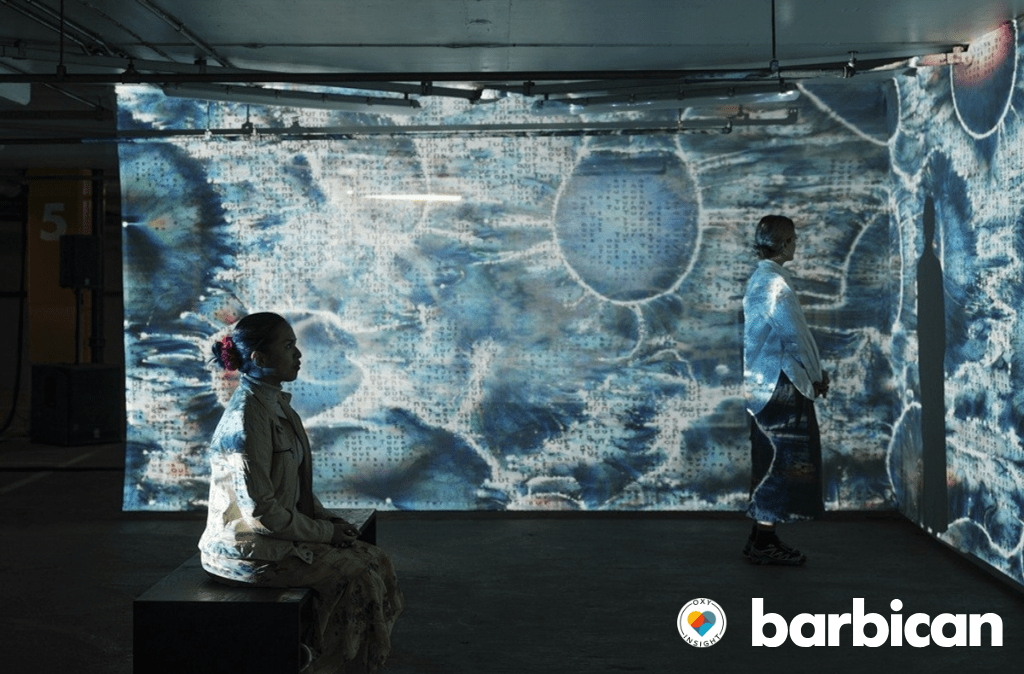
For Barbican Immersive, Oxy Insight created a research programme spanning audience strategy, brand positioning and the development of exhibitions including Feel the Sound and In Other Worlds.
The case study shows how audience insight can support ambitious creative work without turning the audience into the creative director.
“Audience insight is just one part of what makes amazing experiences.”
– Sonia Joao
1. Begin with the decision, not the method
Joao and her colleague Sam Rogers were careful to place the work in context. Oxy Insight had worked with the Barbican for around three Research should not begin with “Should we run a survey?”
It should begin with a decision.
What does the organisation need to understand? What choice will the answer affect? When does the team need that answer?
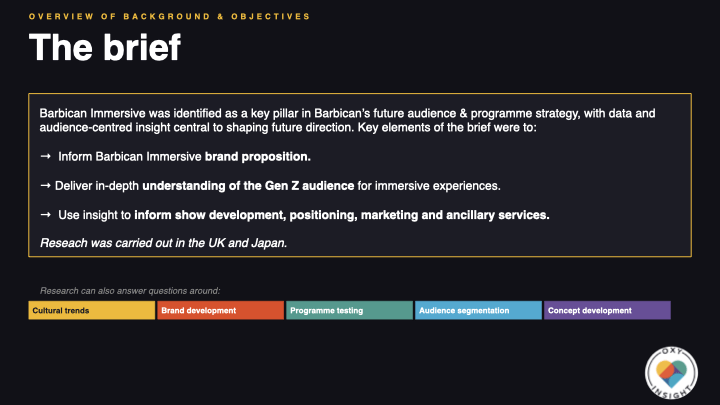
The Barbican Immersive brief covered three connected challenges:
- define the Barbican Immersive brand proposition
- understand the existing and potential Gen Z audience
- use insight to inform show development, positioning, marketing and ancillary services
This breadth matters. The research was not commissioned to answer one isolated question. It was designed to support decisions across the experience, from strategic positioning to the language used to introduce a show.
The first principle is therefore simple:
Do not choose a research method until the team understands what decision the research must improve.
Semiotics can reveal the cultural meaning carried by an image, sound or phrase. It cannot size the commercial opportunity.
Focus groups can expose motivations and anxieties in detail. They cannot tell a team how common those attitudes are across the population.
A nationally representative survey can estimate audience potential. It may not explain why a threshold feels confusing or why an experience loses emotional momentum.
Each method has a job.
Problems arise when a team asks one method to do another method’s work.
“Sometimes there’s a worry that audience insight comes along to green light or red light something, or to say if something’s going to work or not. And it really isn’t that.”
– Sonia Joao
Audience insight is not there to decide whether a creative idea is allowed to exist.
It brings the audience’s voice into the development process so that creative, production, marketing, programming and operational teams can make better-informed judgements.
2. Build a learning system, not a collection of studies
The Barbican Immersive programme combines six methods:
- Semiotic mapping
- Accompanied immersions
- Qualitative focus groups
- An omnibus survey
- A targeted quantitative survey
- A longitudinal audience panel
The value lies not simply in the number of methods. It lies in how they work together.
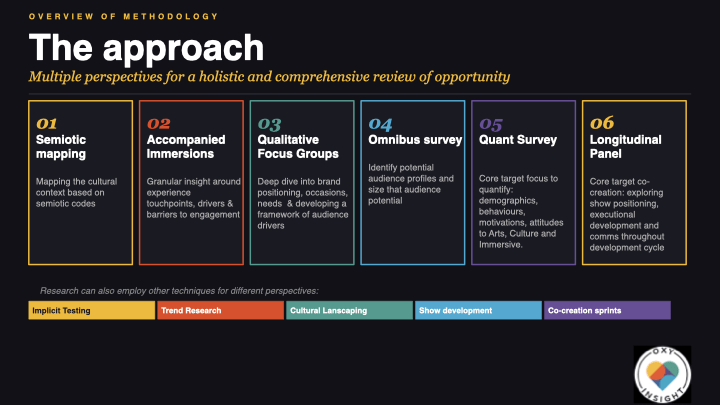
Semiotic mapping establishes the cultural context.
Accompanied immersions reveal what participants do across the journey.
Focus groups explore motivations, barriers and possible positioning in depth.
An omnibus survey sizes the market and identifies potential audience profiles.
A targeted survey tests priorities across the core audience.
A longitudinal panel keeps selected audience members involved as concepts, names, communications and experiences develop.
The methods build on one another. Early exploratory work helps the team decide what later surveys need to measure. Quantitative findings show which qualitative themes are widespread enough to prioritise. Longitudinal work then brings those findings into live development decisions.
“Each stage built on those that came before, and then informed the subsequent stages.”
– Sonia Joao
There is a practical This cumulative approach prevents three common research failures:
- measuring something before the team understands it
- prioritising a finding without knowing how widely it applies
- delivering insight as a final report rather than using it during development
The precise mix will vary by project. Few organisations need every method every time.
The principle remains the same: combine methods when the decision requires different kinds of evidence.
Semiotics reveals the meaning audiences already bring
Semiotics examines the cultural meaning carried by signs, symbols, sounds, language and imagery.
Red can signal danger in one market and fortune in another. A rose can signify romance. Two alternating musical notes can produce a sense of dread because audiences associate them with Jaws.
For Barbican Immersive, semiotic mapping explores codes within immersive entertainment and adjacent fields including gaming and wellbeing. This broader view matters because audience expectations do not remain inside sector boundaries.
The research identifies dominant, emergent and new codes that can shape proposition, visual identity, communications and tone of voice.
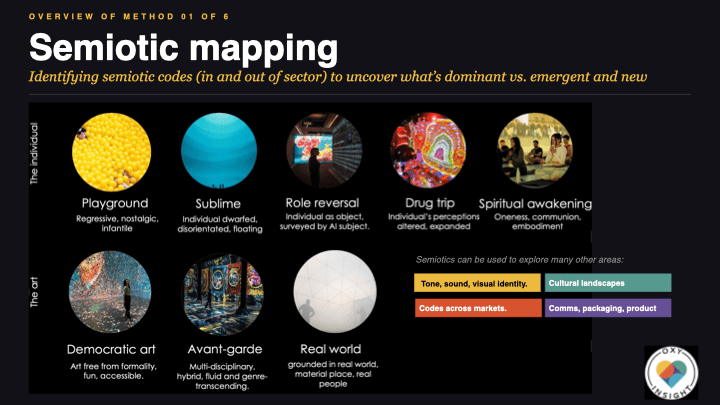
One territory is the sublime: individuals placed against vast landscapes, communicating awe, infinity and human smallness. The code resonates in both the UK and Japan and appears in work by organisations such as teamLab.
Yet the research also exposes a limitation. The sublime can create awe without necessarily inviting participation. For audiences expecting something to do, visual scale alone may not be enough.
Other codes travel less successfully. Drug culture and psychedelia have different associations in the UK and Japan.
The practical lesson is not that one code is right and another is wrong.
It is that formats may travel more easily than meanings.
An experience entering a new market must understand how its imagery, language, tone and references will be interpreted locally.
3. Observe the experience people receive, not only the one the team intends
Audience interviews reveal what people can remember and articulate.
Observation reveals what they actually do.
Oxy Insight recruited immersive-event attendees aged 16 to 34 and accompanied them on four-hour visits to two experiences. Researchers observed the journey from pre-visit behaviour through the experience and into its aftermath.
This produces granular evidence about moments that are easily overlooked:
- how people approach the venue
- whether they understand the entrance
- what they read or ignore
- where they hesitate
- how they follow companions
- when their attention becomes overloaded
- which cues they miss
- what creates delight or confusion
A particularly useful finding concerns the transition from everyday life into the experience.
“That moment of going in is really important, and actually needs to signal that there’s a transformation happening.”
– Sonia Joao
The first threshold is not merely an operational detail.
It is part of the experience’s dramaturgy.
It tells participants that the rules are changing. It prepares them to enter a different physical, emotional or imaginative state.
Jeff Wayne’s The War of the Worlds: The Immersive Experience used large doors and an ominous reveal to create a transition aligned with the story’s mood.
By contrast, an abrupt arrival into a large amount of wall text can ask visitors to process information before they have entered the experience emotionally.
The problem is not the existence of information. It is its timing.
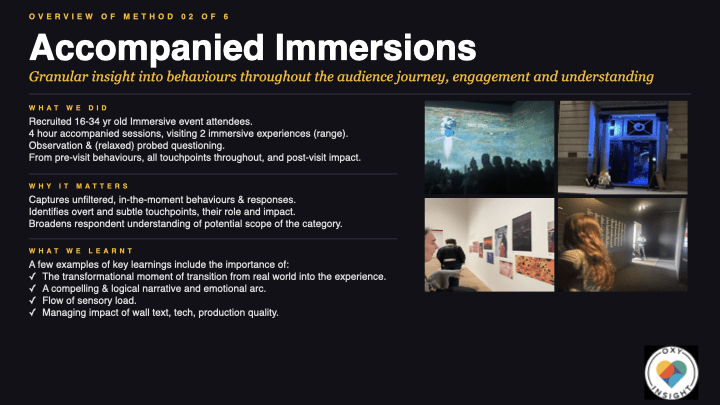
The research highlights four recurring design considerations:
- the transformational moment between the outside world and the experience
- a compelling and logical narrative and emotional arc
- the flow of sensory load
- the effect of wall text, technology and production quality
These are not minor details.
They determine whether participants understand what is happening, feel comfortable taking part and remain emotionally connected to the experience.
They are also difficult for internal teams to judge. Creators already know the story, the space and the intended behaviour. Participants do not.
Observation exposes the gap between what a team believes it has communicated and what the audience actually receives.
4. Translate human needs into a shared design language
Focus groups allow teams to explore why people seek immersive experiences, what prevents participation and which propositions feel motivating.
For Barbican Immersive, this work produces a framework organised around four audience drivers:
Physical and sensory
The desire to engage through sight, touch, sound, movement, vibration, spatial awareness and bodily sensation.
Communal
The social experience of attending alone or together, exploring identity, relationships, belonging and connection.
Cognitive
The desire to learn, encounter new ideas, challenge assumptions and reconsider attitudes.
Emotional
The desire to feel something about ourselves, other people or the wider world.
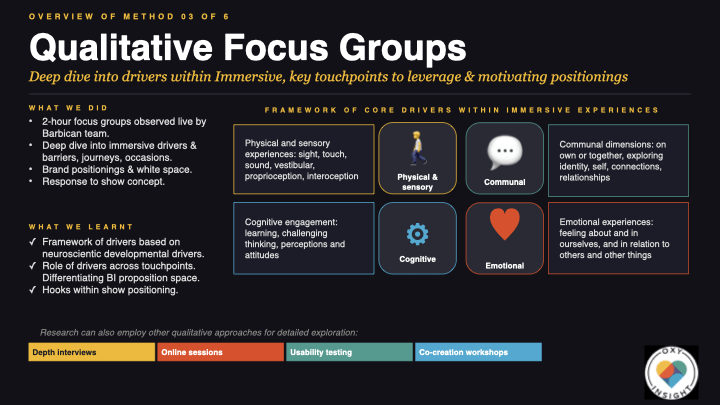
The framework turns broad audience needs into something different teams can use.
Programmers can assess whether a show supports the intended proposition.
Creative teams can consider which drivers the experience prioritises.
Marketing teams can identify the strongest promises.
Venue and operational teams can examine how the wider journey supports or undermines them.
The value is not only a better audience profile.
It is a common vocabulary for making decisions.
5. Define the audience around the opportunity
Audience sizing is useful only when the audience definition fits the organisation’s real opportunity.
An omnibus survey of more than 2,000 UK adults identifies the existing and potential immersive audience. But “immersive” covers an enormous range of activities, from museums and installations to theatre, games and attractions.
A definition that includes everything risks producing a large but strategically useless market.
The research therefore creates what the team calls a “Barbican-shaped” audience: people who attend, or would consider attending, immersive experiences in venues and cultural contexts that the Barbican could credibly offer.
“We want to speak to people whose expectations fit with what the Barbican could realistically put on.”
– Sonia Joao
This is a useful principle for any audience study.
The relevant audience is not always everyone who participates in the wider category.
It is the group whose needs, behaviours and expectations match the decision the organisation needs to make.
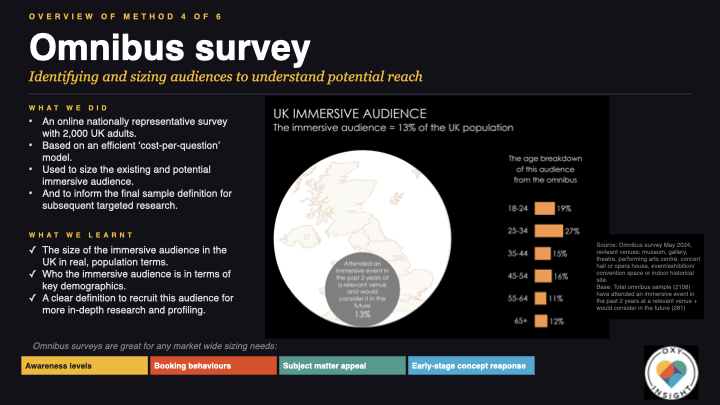
A targeted survey with approximately 500 people from the core audience then goes deeper into behaviours, motivations, attitudes and the relative importance of different experience drivers.
- Qualitative work explains what might matter.
- Quantitative work helps teams decide what matters most widely.
Neither replaces the other.
6. Keep the audience present while the work develops
A longitudinal panel turns research from a snapshot into a feedback loop.
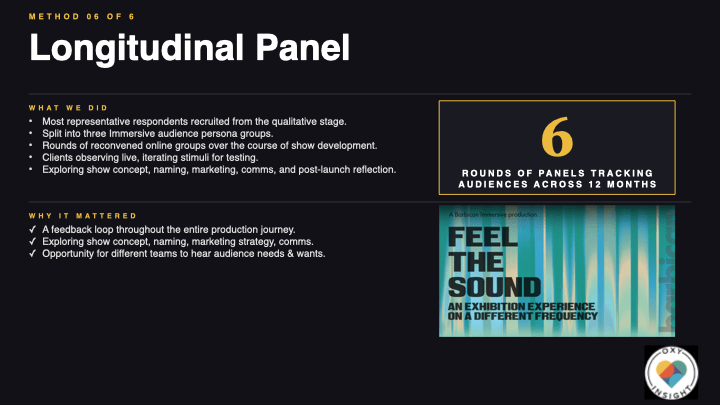
Representative participants from the qualitative stage reconvene across six rounds over 12 months. Different rounds explore:
- show concepts
- naming
- introductory website copy
- marketing strategy
- communications
- exhibition layout
- sensory load
- post-launch response
This allows the team to use audience insight when it has a direct role in a live decision.
“The team could select to use and put into action exactly when it would have the best impact and fit with their development process.”
– Sonia Joao
Timing is crucial.
Research conducted too early may be too abstract.
Research conducted too late may explain a problem that can no longer be fixed.
Research becomes most useful when it reaches the right people while choices remain open.
The panel also creates organisational value.
Creative, programming, marketing and operational teams hear the same audience needs and responses. They can interpret the evidence together rather than receiving separate summaries through departmental filters.
This turns audience insight into shared organisational knowledge.
The bigger lesson
The central distinction is between being audience-centred and being audience-led.
Audience-centred work understands the people it hopes to reach. It observes behaviour, challenges assumptions and uses evidence to improve the proposition, journey, messaging and development process.
Audience-led work can become timid when it treats stated preferences as instructions, removes creative risk or expects participants to design unfamiliar experiences in advance.
Good research does not ask audiences to become creative directors.
It helps creative directors understand the conditions in which ambitious work can connect.
The Barbican Immersive case study also shows that the value of research is not confined to a final set of findings.
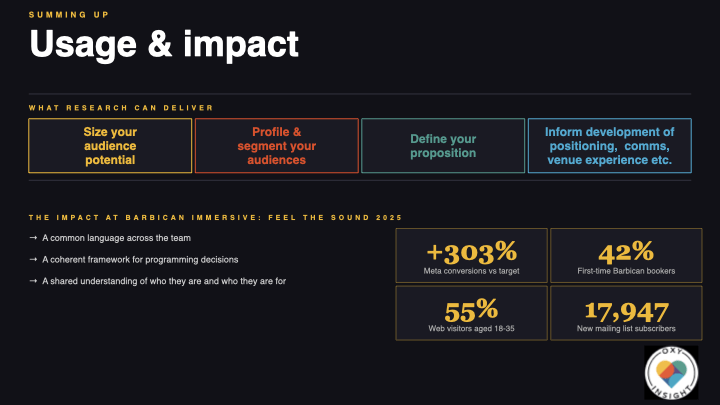
For Feel the Sound in 2025, the programme is associated in the Oxy Insight deck with:
- Meta conversions at 303% of target
- 42% first-time Barbican bookers
- 55% of web visitors aged 18 to 35
- 17,947 new mailing-list subscribers
These figures matter, but the organisational effects may be more durable.
The work gives the team:
- a common audience-centred language
- a coherent framework for programming decisions
- a shared understanding of who Barbican Immersive is for
- a way to connect programming, marketing, venue experience and audience expectations
“It gave them a really important shared understanding of who they’re here for, why they’re here, and what they’re here to give their audiences.”
– Sonia Joao
Research fails when it becomes a document that few people use.
It creates value when it becomes a living part of decision-making: a shared language, a framework, a feedback loop and a way of keeping the audience present when the audience is not in the room.
The best experiences are not designed by committee.
But they are rarely designed well in a vacuum.
What to ask in your next meeting
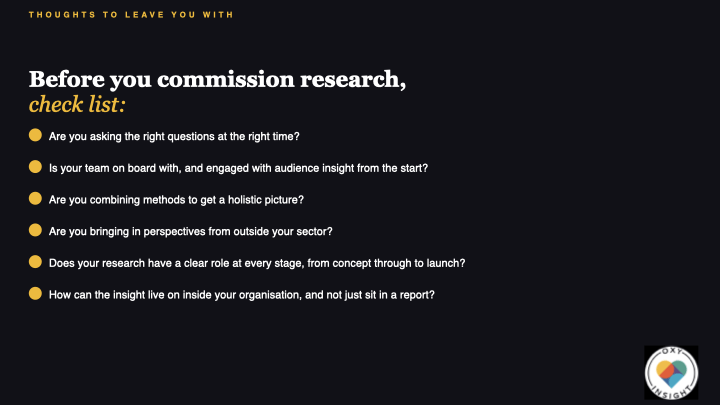
- How can the learning remain active rather than sitting in a final report?
- What decision do we need this research to inform?
- Are we asking the right question at the right stage of development?
- Which method can answer that question, and what can it not tell us?
- Are we observing what participants actually do as well as asking what they think?
- How will the insight reach creative, operational and commercial teams?
- How can the learning remain active rather than sitting in a final report?
For more Experience Briefings, head here.
For more information on how to join the WXO, head here.