
Smart experience teams protect investment by defining value in advance, measuring credible changes and turning the results into better decisions.
Events – and especially experiences – can be considered expensive.
That’s what makes them come under such scrutiny whenever budgets are reviewed.
A compelling environment, strong attendance and positive executive reactions may all suggest that an event ‘worked’. But when a CFO, sponsor or senior stakeholder asks what the investment achieved, impressions and anecdotes rarely provide a sufficient answer.
The worst time to discover that the evidence is weak is during a budget review.
That’s why measurement needs to begin before the experience is designed, not after it has taken place.
This Experience Briefing draws on a WXO Campfire with Dax Callner and distills its most useful ideas for experience leaders.
Dax Callner is an event and experiential marketing strategist with more than 25 years’ experience supporting organisations including Amazon, TikTok, Vodafone, Google, Toyota, HSBC and Meta.
He is also founder and board president of the Event Marketing Measurement Association, which works to improve standards, techniques and education across the industry.
Measurement – accordinng to the EMMA – should not seen as a retrospective reporting task. Instead, it should be seen as a system for defining success, proving value and improving future performance.
“What’s the cost of not measuring?”
– Dax Callner
1. Treat measurement as part of the experience budget
The two most common barriers to event measurement are perceived cost and lack of knowledge.
Neither is a strong reason to avoid tackling it upfront.
A sophisticated programme combining behavioural tracking, interviews, lead data and large quant surveys can require substantial investment. But credible measurement does not always need to be complex or expensive.
A short, well-designed survey can establish whether audiences received value, whether perceptions changed and whether people intend to take a desired action. Observation and a small number of deeper conversations can add the context needed to understand those results.
The greater risk is spending heavily on an experience and having no credible way to explain what it achieved.
Callner offered an all-too-familar example: a large technology conference whose success was judged by one standard. Whether senior executives were happy.
That seemed acceptable to the organizers – until the new CFO reviewed the programme… There was no evidence showing the event’s audience value, business effect or contribution to wider objectives.
The event disappeared the following year.
There is a simple lesson here:
Positive reactions from senior people are not a measurement system.
Measurement should therefore appear as a default line in the budget. Any changes to it – and ideally there would be none – should be a conscious decision, not the automatic response to financial pressure.
Measurement also changes who becomes involved in the programme.
A discussion about logistics may remain with an event manager. But a discussion about objectives, KPIs and investment MUST bring in marketing leaders, commercial teams and senior stakeholders.
This gives experience teams direct access to the people who decide whether budgets continue, shrink or grow.
2. Use measurement to learn, prove and improve
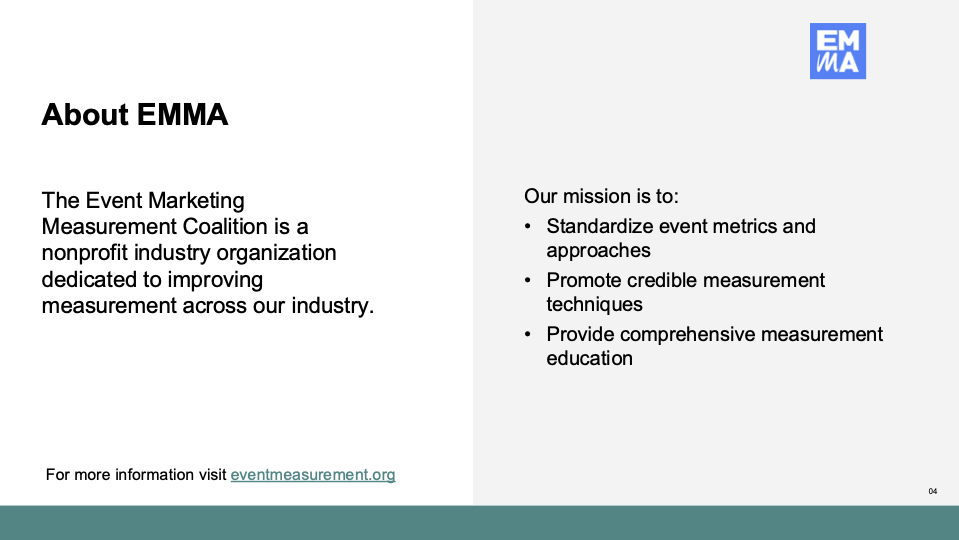
Measurement has three main jobs.
(i) Learn
The data should show:
- what works
- what does not
- where participants struggle
- which elements deserve greater investment
- which problems need to be solved
Quantitative data reveals scale and patterns. Qualitative insight explains why those patterns may exist.
A survey might show that a particular part of an experience receives a lower score. But interviews and observation can reveal whether the detail behind the score – examples hidden by a simple score include unclear instructions, poor flow, sensory overload, staffing or a mismatch between promise and delivery.
Neither quantitative or qualitative data is sufficient on its own.
“I need both, and I would suggest that we should, as an industry, try to collect both.”
– Dax Callner
(ii) Prove
Measurement provides stakeholders, clients and sponsors with credible evidence that the experience creates value.
That does not mean claiming that an event caused every later sale or business result.
Experience teams often control the event but not the many touchpoints that follow it. A participant may leave an automotive experience interested in a vehicle, only to encounter poor service at a dealership.
The event creates potential, but it does not control the conversion.
Credible measurement distinguishes between those contributions.
(iii) Improve
Consistent measurement creates a learning cycle.
The team establishes objectives, collects evidence, identifies improvements and applies them to the next iteration. Over time, comparisons reveal whether the work is becoming more effective.
Without that record, teams depend on memory. Important decisions, mistakes and observations disappear between annual events.
A useful report does not simply describe what happened. It records what should happen differently next time.
3. Start with three foundational metrics
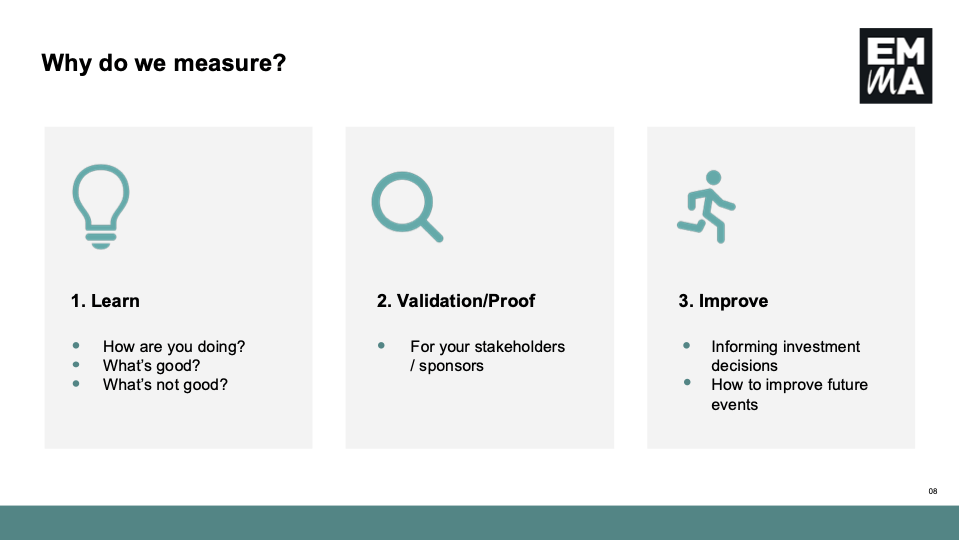
Different experiences have different objectives, but implementing three simple measures can provide a common foundation.
(i) Value to the audience
Start by asking:
“How would you rate the value for your time spent?”
The wording here is deliberately broad.
Value can mean learning, enjoyment, connection, entertainment, access, status or simply time well spent. Participants define it through their own needs and expectations.
The question works across consumer activations, conferences, employee events, cultural programmes and trade shows because nobody wants to feel that an experience wasted their time.
It also places the participant at the centre of the measurement system.
Attendance records who appeared. Audience value begins to reveal whether appearing was worthwhile.
“Everyone wants to get some kind of value out of their experience.”
– Dax Callner
(ii) Brand uplift
Experiences affect how people perceive an organisation, place or product, and even the cause behind them.
The relevant question is not simply whether participants liked the event. It is whether the experience moved the perceptions the organisation intended to change.
A team might want to be seen as:
- trustworthy
- innovative
- welcoming
- community-focused
- useful
- culturally relevant
- a good place to work
Where possible, asking the same question before and after the event creates a direct comparison.
If agreement with “This brand brings people together” rises after participation, the team has evidence of brand movement rather than a general satisfaction score. It’s simple and maybe even obvious – but it works.
(iii) Post-event behaviour
Most experiences are intended to prompt some form of action.
That might mean:
- buying or considering a product
- returning
- recommending the experience
- sharing content
- joining a mailing list
- applying for a role
- changing an attitude or habit
- continuing to do business with the organisation
The metric becomes universal when the team asks what percentage of participants intend to do the thing the experience is designed to encourage.
These three measures provide a clear and consistent base:
- Did the audience receive value?
- Did the experience change relevant perceptions?
- Are participants more likely to take the desired action?
Callner adds a fourth area: societal impact, particularly carbon emissions and landfill waste per attendee. This addition may not obviously connect directly to commercial performance, but consistent measurement is necessary if the industry intends to reduce its footprint.
4. Do not claim more than the data can prove
Return on investment (ROI) is attractive because it appears to translate an experience into one decisive financial number.
It can also create false precision.
Callner uses ROI in its strict financial sense: the financial return produced by an investment. Proving that return requires credible attribution.
That is extremely difficult when the event is only one part of a much longer customer journey.
Example: A participant may encounter advertising, reviews, sales teams, websites, peers and retail staff before making a purchase. Assigning the eventual sale entirely to the event ignores those other influences.
The safer – and thus accurate and defensible – approach is to measure the value the experience genuinely controls.
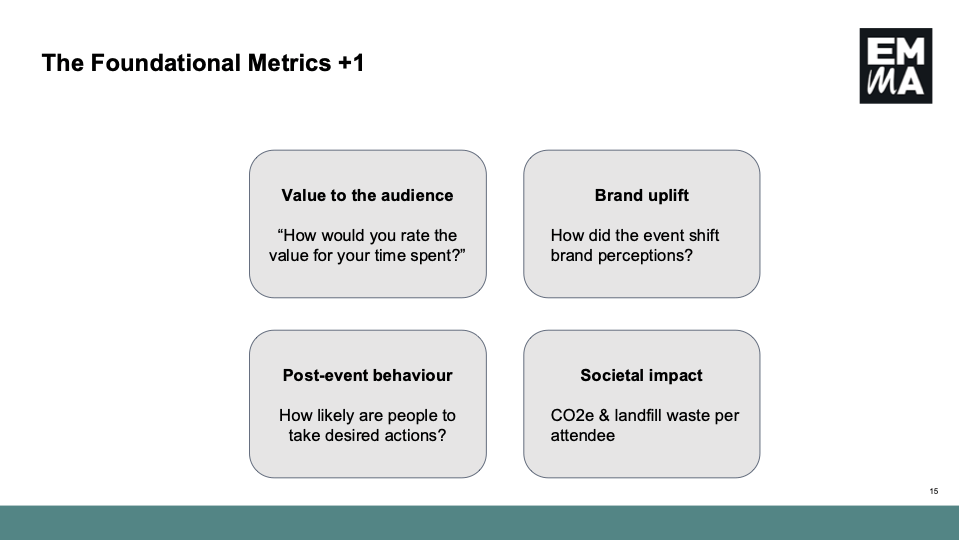
For events designed to support sales, that may mean assessing potential revenue:
Number of qualified leads × revenue associated with relevant products = potential event revenue
A qualified lead is someone who can make or influence a purchase decision.
This produces an estimate of the pipeline influenced by the event WITHOUT claiming that every prospect will convert.
If a £100,000 experience generates an estimated £1 million in qualified potential, that is useful evidence for stakeholders. Crucially, it remains a projection rather than a claim of realised revenue.
“It sounds simple, because it is.”
– Dax Callner
This approach is more credible than potentially indefensible attempts to force every effect into ROI.
It tells stakeholders what the experience contributes while openly acknowledging where the team’s control ends.
5. Define success before creative work begins
Measurement becomes much harder when objectives remain vague and success is subjective.
“Create buzz”, “build engagement” and “deliver something memorable” may express wild ambition, but they do not define success.
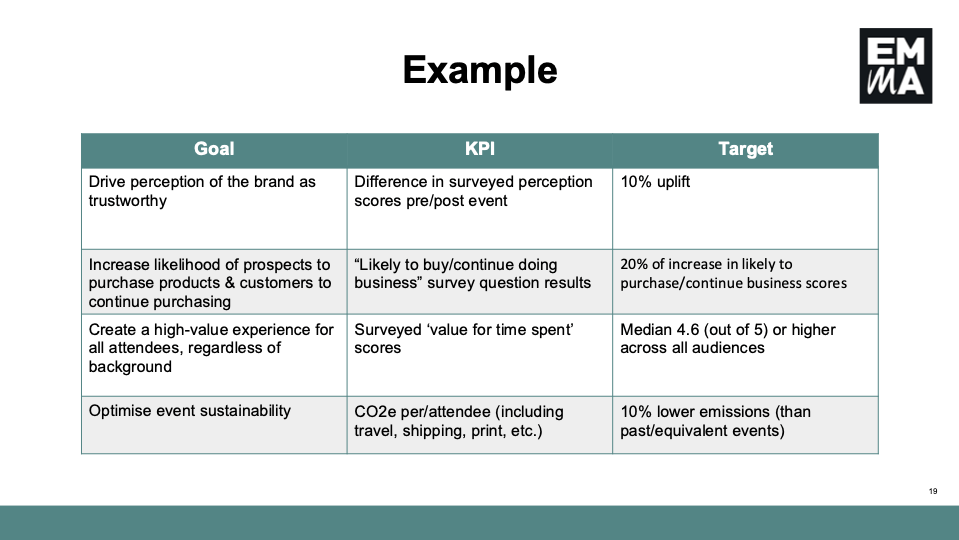
Each objective needs:
- a clear goal
- a KPI
- a target
The goal describes the change the team wants to create.
The KPI identifies the most important measure of that change.
The target defines the level of performance that would count as success.
For example:
| Goal | KPI | Target |
|---|---|---|
| Improve perceptions of trust | Difference between pre- and post-event perception scores | 10% uplift |
| Increase purchase intention | Change in reported likelihood to buy | 20% increase |
| Create value for all audience groups | Value-for-time-spent score | Median 4.6 out of 5 or higher |
| Improve sustainability | Carbon emissions per attendee | 10% below a comparable event |
The first time targets are set may involve some estimation. That is acceptable.
Measurement builds its own evidence base. Once the team has comparable data from previous events, future targets become more informed, useful and easier to explain.
Defining success early also aligns the organisation, also ensuring everyone has a set role:
- Creative teams know what the experience must achieve.
- Marketing teams know what perceptions or behaviours matter.
- Senior stakeholders agree to the standard against which the programme will later be judged.
When reporting begins, the conversation is now straightforward:
Here is what we agreed to achieve. Here is how we measured it. Here is how the experience performed.
6. Match the data tool to the question
The scope of measurement can expand or contract with the project.
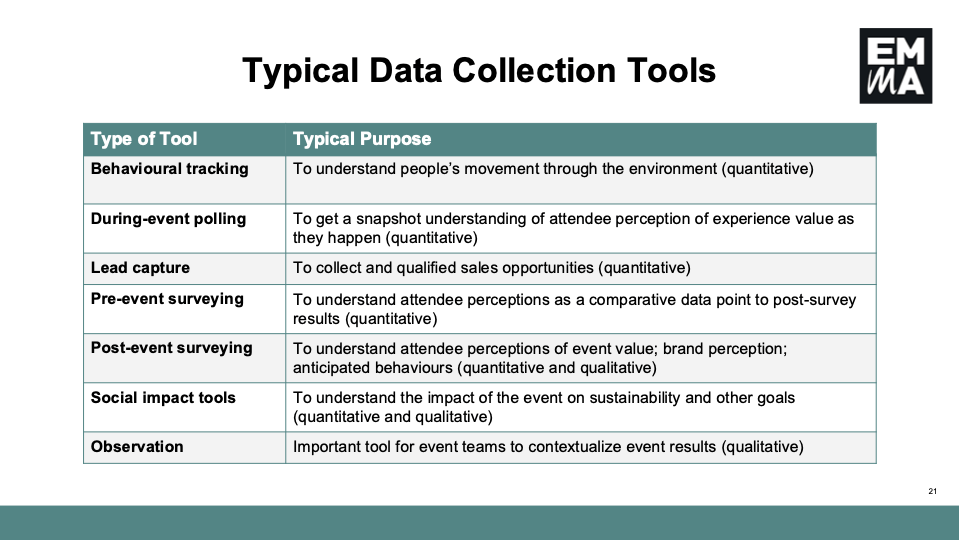
Useful tools include:
- behavioural tracking
- during-event polling
- lead capture
- pre-event surveys
- post-event surveys
- social-impact tools
- observation
The most expensive method is not automatically the most useful.
Behavioural tracking can reveal movement, dwell time and engagement patterns, but the cost must always be justified by the decision the data will inform:
- During-event polling can capture an immediate response before memory fades or different parts of the experience merge together.
- Pre- and post-event surveys can reveal changes in perception.
Observation gives event specialists the context to explain why a number rises or falls.
A practical minimum is often a short survey that is easy to complete and directly connected to the objectives.
The question should always come before the tool:
What evidence do we need, and what is the simplest credible way to collect it?
7. Report for action, not storage
Data has little value if it remains inside a document nobody revisits.
Results must be adapted for the people who need to use them.
Internal stakeholders need to know:
- how the event performed against its objectives
- what the quantitative evidence shows
- which qualitative observations explain the results
- what should change next time
Sponsors need evidence of the value created through their participation, such as audience profile, traffic, engagement or aggregated lead results.
Participants may benefit from seeing audience figures, quality scores or sustainability performance.
Sharing results with attendees also creates accountability. It allows an organiser to say:
You told us this. Here is what we are changing.
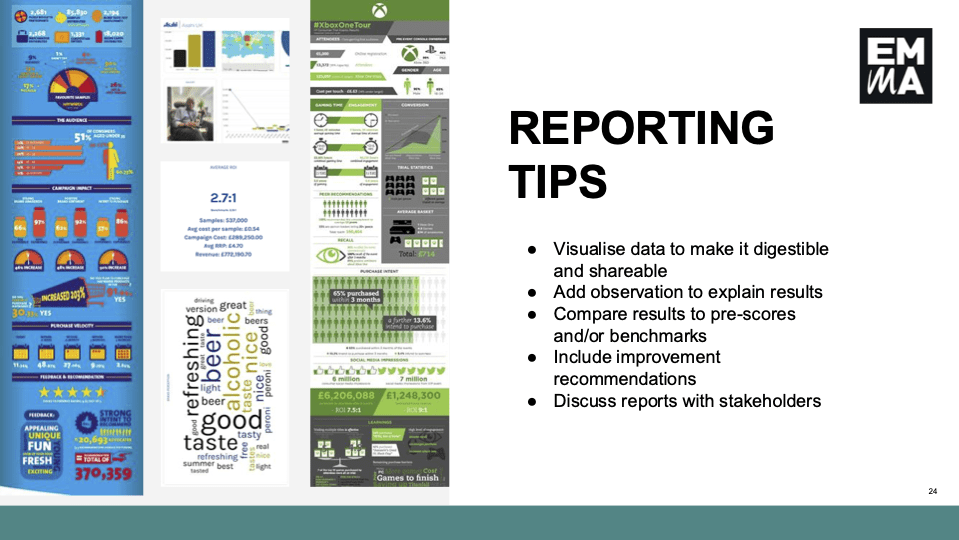
Good reporting makes the evidence easy to understand.
It visualises the data, adds expert observation, compares results with previous scores or relevant benchmarks and includes clear recommendations.
Benchmarks are essential because numbers always need context, not assumed knowledge.
A score of four out of five may be excellent or disappointing depending on how it compares with previous years, other audiences or similar events.
“Otherwise it’s just numbers, and I need comparisons.”
– Dax Callner
Any report should end with decisions, not merely charts.
- What should be preserved?
- What should receive more investment?
- What should be fixed?
- What should stop?
This turns measurement into part of continuous improvement rather than an administrative record at the end of a project.
The bigger lesson
Measurement is not the opposite of creativity.
It gives creative work a clearer purpose and a stronger case for investment.
When objectives remain vague, teams can produce impressive experiences without knowing whether they create the intended value. When the evidence is weak, senior stakeholders may judge the programme through cost, personal preference or anecdote.
A credible measurement system changes that conversation.
It shows whether participants value the experience, whether perceptions move, whether intended behaviours become more likely and whether the programme creates commercial or social potential.
It also makes the next experience better.
This matters beyond event marketing. The wider Experience Economy needs credible ways to define success, compare practice and show stakeholders why experiences deserve investment.
Not every experience needs the same objectives.
But every experience should be able to simply explain:
- what it is trying to change
- how that change will be measured
- what success looks like
- what the team learns from the result
Measurement protects budgets because it replaces unsupported claims with evidence.
It grows budgets when that evidence demonstrates value and creates confidence in what the team can achieve next.
What to ask in your next meeting
Before any meeting starts, agree the following:
- Measurement must appear as a default line in the budget and be protected.
- Discussions about logistics may remain with an event manager.
- Any discussion about objectives, KPIs and investment must bring in marketing leaders, commercial teams and senior stakeholders.
At the meeting, ask these questions:
- What is this experience intended to change?
- Which single KPI best represents each objective?
- What result would count as success?
- Are we measuring audience value, brand uplift and intended behaviour?
- Which outcomes can we credibly attribute to the experience?
- What qualitative insight will help us understand the numbers?
- How will the findings improve the next iteration?
- Who needs to see the results, and what action should each audience take?
For more Experience Briefings, head here.
For more information on how to join the WXO, head here.