
If experiences create value through memory, emotion and meaning, then experience teams need better ways to measure more than reach, attendance and impressions.
Experience professionals are under pressure to prove value.
- Clients want evidence.
- CMOs want confidence.
- Investors want numbers.
- Operators want to know what worked.
- Teams want to know what to improve.
So the industry reaches for the metrics it already has: attendance, reach, impressions, dwell time, clicks, shares, revenue, cost per head, survey scores, NPS and ROI.
These matter. But they are not enough.
An experience can be widely seen and barely remembered. It can generate attention without connection. It can reach thousands of people and still fail to create lasting value. It can look successful on a dashboard while leaving little emotional trace.
This Experience Briefing draws on a WXO Campfire with Laura Hess and distils its most useful ideas for experience leaders.
Laura Hess is an experience strategist and ROX specialist whose work examines how organisations can understand and measure the emotional value created by experiences.
Her central argument is simple but important: if experiences create value through emotional resonance, the industry needs better ways to understand, describe and measure that resonance.
That does not mean abandoning numbers.
It means asking better questions about which numbers matter, what they reveal and what they miss.
1. Do not confuse what is easy to measure with what matters most
The first trap is the belief that the most measurable things are the most important things.
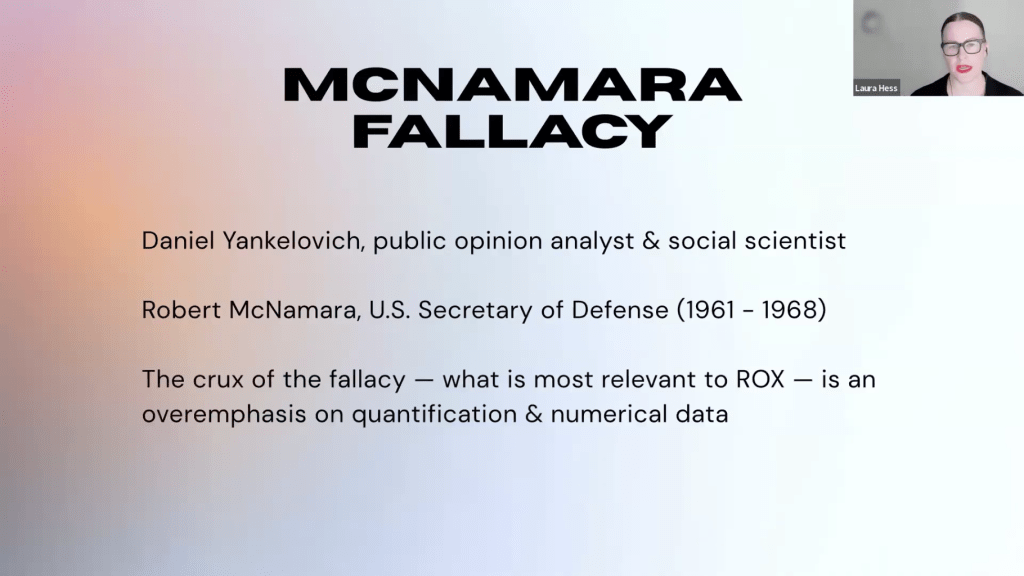
The McNamara fallacy describes this danger: the tendency to measure what can be easily measured, then disregard what cannot. In experience terms, that means over-valuing the numbers that are easiest to collect and under-valuing the human responses that are harder to capture.
This is a major problem for experience teams.
The most important effects of an experience are often not immediate or obvious. They may show up as memory, loyalty, trust, desire, identity, recommendation, repeat participation or brand affinity. These are not always visible in the first dashboard after the event.
“What matters most to people, what they actually remember, is how something made them feel.”
– Laura Hess
On the Wings of Hermès, a Los Angeles activation staged by the luxury-goods group in 2023 and attended by Hess, shows what this can look like.
Technically, it was a marketing activation. But it behaved very differently from most marketing activations. There were no QR codes. No promo codes. No obvious sales push. No hard product display beyond the way items appeared within the vignettes. Hermès captured Hess’s email because she had to RSVP, but she never received an email from them afterwards. It was not heavily pushed on social media. It was not tied to a short-term product launch.
So what was Hermès doing?
It was creating artistry, connection and wonder.
“It felt transactionless. How rare is that?”
– Laura Hess
Hess did not buy a Hermès product as a result of the experience, but her affinity with the brand was far stronger. That is the kind of value many current measurement systems struggle to capture.
For experience professionals, the lesson is not that sales, data or conversion do not matter. They do.
The lesson is that some experiences are designed to create long-term emotional capital, not immediate transaction.
That changes how they should be judged.
A brand activation designed to deepen affinity should not be measured only like a coupon campaign. A cultural experience designed to build memory should not be judged only by reach. A destination experience designed to create advocacy should not rely only on website traffic.
The practical question is:
What kind of value is this experience supposed to create?
If the answer is emotional resonance, memory, trust or long-term relationship, then the measurement system has to be designed around that.
2. ROX needs both data and interpretation
Hess’s definition of ROX is important because it separates ROX from ROI.
- ROI is about financial return.
- ROX is about emotional resonance.
That distinction matters because experience value is not purely transactional. People remember how an experience made them feel. They talk about it because of what it means. They return because it gives them something they cannot get elsewhere. They recommend it because it changes their relationship with a brand, place, community, story or idea.
But feelings are subjective. They are complex. They are contextual.
That means ROX cannot be reduced to a single number without losing something essential.
“Ultimately, ROX is a metric about emotional resonance, and so it requires human intelligence and interpretation.”
– Laura Hess
Hess’s point is not that measurement is useless. Quite the opposite. Instead she argues for a more comprehensive toolkit combining qualitative and quantitative methods. That might include sentiment, behavioural data, biometric data, traditional business metrics and structured reflection.
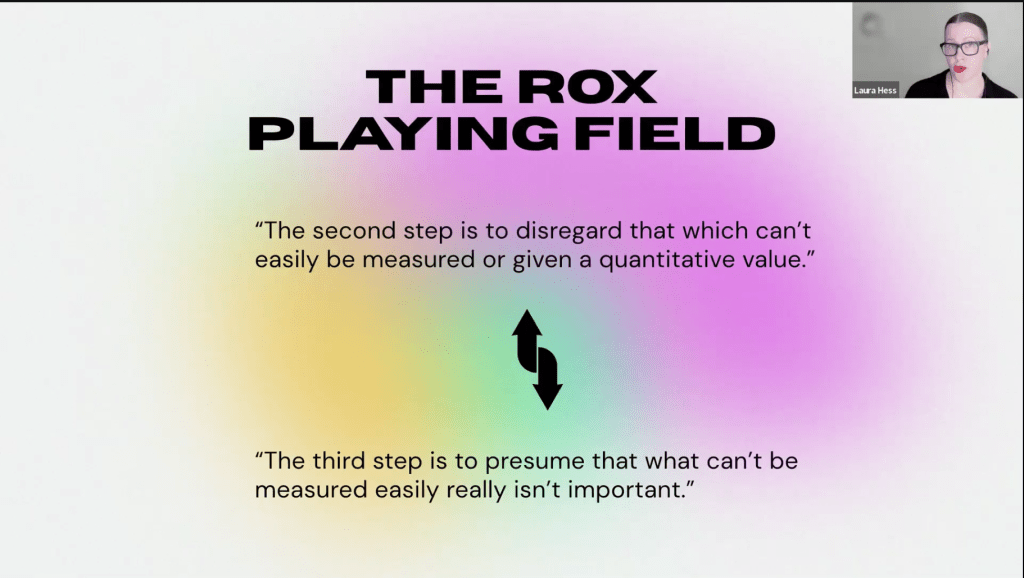
The common thread is that experience measurement needs context and discernment.
Without those, numbers can become amorphous. They float around without meaning. A big number looks impressive, but it may not tell you whether the experience worked.
There are two important distinctions to make:
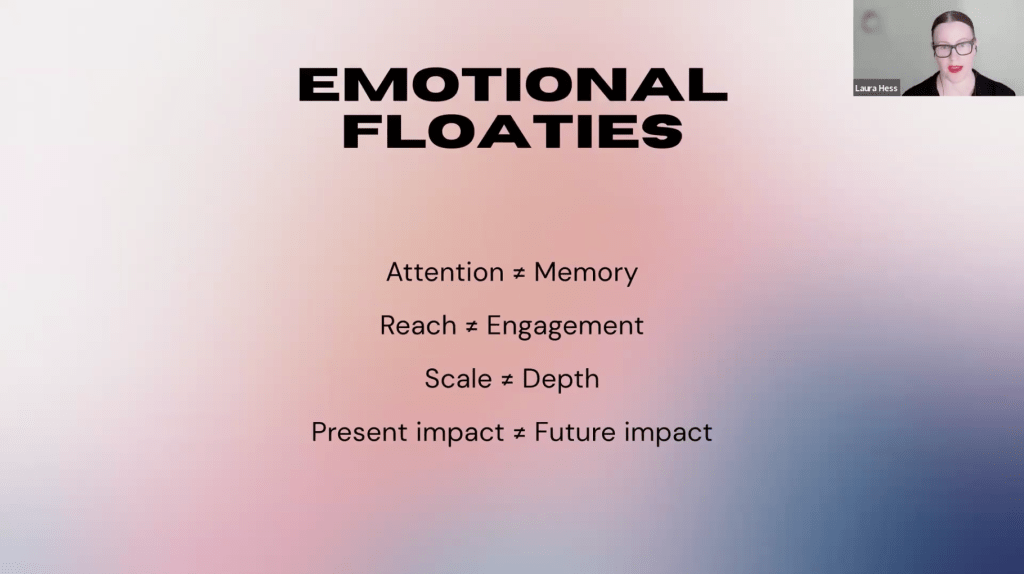
- Grabbing an audience’s immediate attention does not necessarily mean they will commit your experience to longer term memory.
- There is zero guarantee your initial big budget ‘wow moment’ will translate into longer-term impact.
- A large attendance number does not equate to an engaged audience. Quite simply, scale does not equal depth.
“Attention does not necessarily translate to memory. Reach does not necessarily mean engagement. Scale doesn’t necessarily equate depth.”
– Laura Hess
These distinctions are vital for anyone commissioning, designing or evaluating experiences.
- A packed room may look successful. But did people feel anything?
- A viral moment may look successful. But was it manufactured, fleeting or meaningful?
- A social post may reach a large audience. But did it create trust, action or desire?
- A high attendance number may please stakeholders. But did the experience create enough emotional capital to sustain the desired outcome?
Tourism and hospitality provide a useful test case. Destination marketing has often relied on website traffic, page views and other digital measures. But as AI changes how people discover restaurants, attractions and destinations, those numbers may decline or become less meaningful.
That does not mean the destination has become less valuable.
It means the measurement system needs to evolve.
If AI points people directly towards a restaurant, attraction or hotel, then website traffic may no longer be the best proxy for interest. The deeper question becomes whether the experience itself is memorable, recommendable and emotionally resonant.
There is no substitute for talking to people.
“You have to talk to people because there is no quick way, there is no widget that’s going to give the information around why that was meaningful.”
– Laura Hess
This is one of the most important lessons in this briefing. ROX is not a magic metric. It is a discipline. It requires teams to combine data with human interpretation.
3. Shared language turns feeling into something teams can work with
Measuring emotional resonance requires a shared language for discussing it. This is the exact problem Hess’s recently refreshed REMARKABLE framework is designed to address.
REMARKABLE is a framework for examining experiences. It works as both a product and a process.
- As a product, it creates a score. It converts qualitative response into a numerical structure.
- As a process, it creates reflection. It helps people understand and articulate the impact of a production.
That distinction matters.
Many frameworks promise a score. Fewer help teams have a better conversation.
“REMARKABLE at its core is a framework for examination.”
– Laura Hess
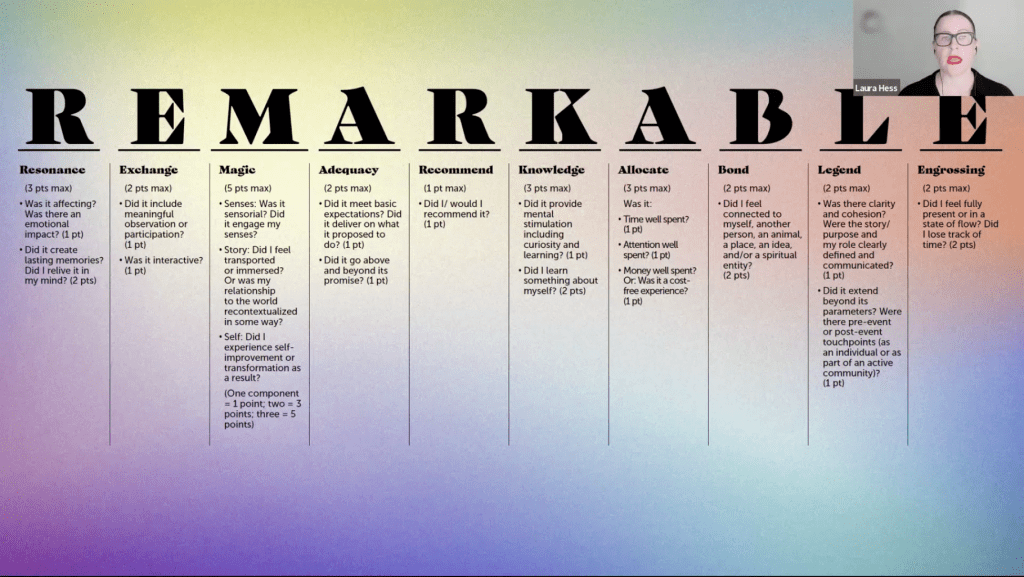
REMARKABLE uses 10 components:
- Resonance
- Exchange
- Magic
- Adequacy
- Recommend
- Knowledge
- Allocate
- Bond
- Legend
- Engrossing
These components are not just labels. They create a shared vocabulary for discussing what an experience is trying to do and whether it worked.
The framework can be used in two ways.
First, as an evaluative tool. It uses a 25-point weighted system to turn qualitative information around sentiment into a score.
Second, as a diagnostic tool. It gives teams, clients and audiences more consistent language for discussing the nature and performance of an experience.
This is where the framework becomes especially useful for professionals.
- It can support ideation.
- It can support development.
- It can support beta testing.
- It can support post-experience evaluation.
It can help a team ask not only “Do people like it?” but “What kind of experience is this trying to be, and is it delivering?”
“This is not just a mechanism for labelling. It facilitates a more essential investigation of: is the work working?”
– Laura Hess
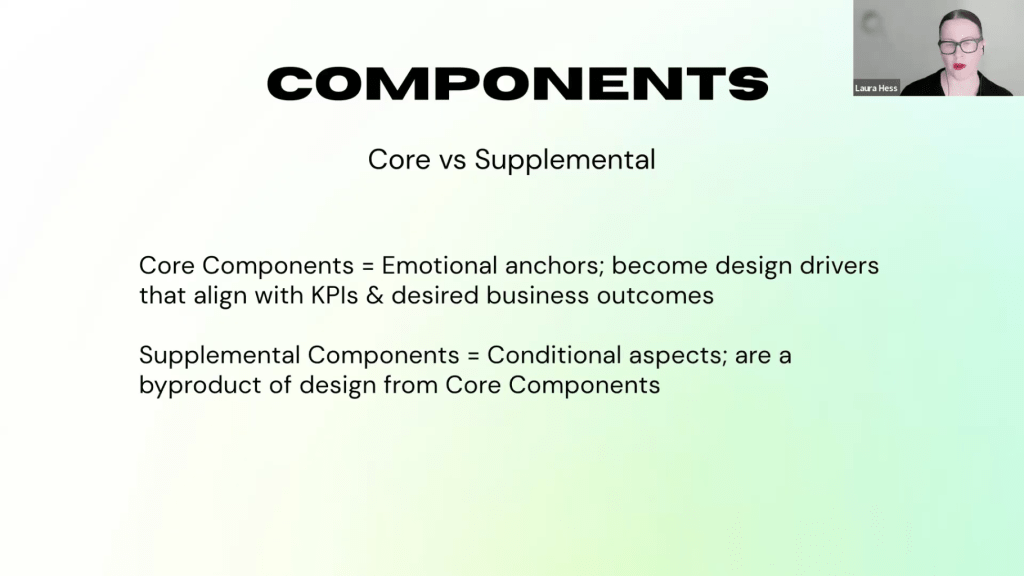
The components fall into two categories.
- The core components are emotional anchors. These are the design drivers. They include resonance, magic, knowledge, bond and engrossing.
- The supplemental components still matter, but they are more conditional. They include exchange, adequacy, recommend, allocate and legend.
Hess’s research suggests that when a production delivers on the core components, the supplemental components tend to rise too.
That is useful because it helps teams avoid trying to optimise everything at once.
Not every experience needs to score highly on every dimension. Not everything has to be interactive. Not everything has to become a 25-point experience. The key thresholds in the framework, according to Hess, are the points 10, 12 and 15.
This is a helpful corrective.
The goal is not to chase the highest possible score.
“The focus should be on the thresholds and not just the score.”
– Laura Hess
The goal is to understand what kind of experience you are making, which emotional anchors matter most and what level of performance is appropriate for the design.
In practice, teams need not use the entire framework with audiences. They can select the components most relevant to the project.
If a team wants people to feel deeply impacted and lose track of time, then resonance and engrossing might become the key design drivers. Those can then inform post-event surveys, integrated feedback moments or internal review.
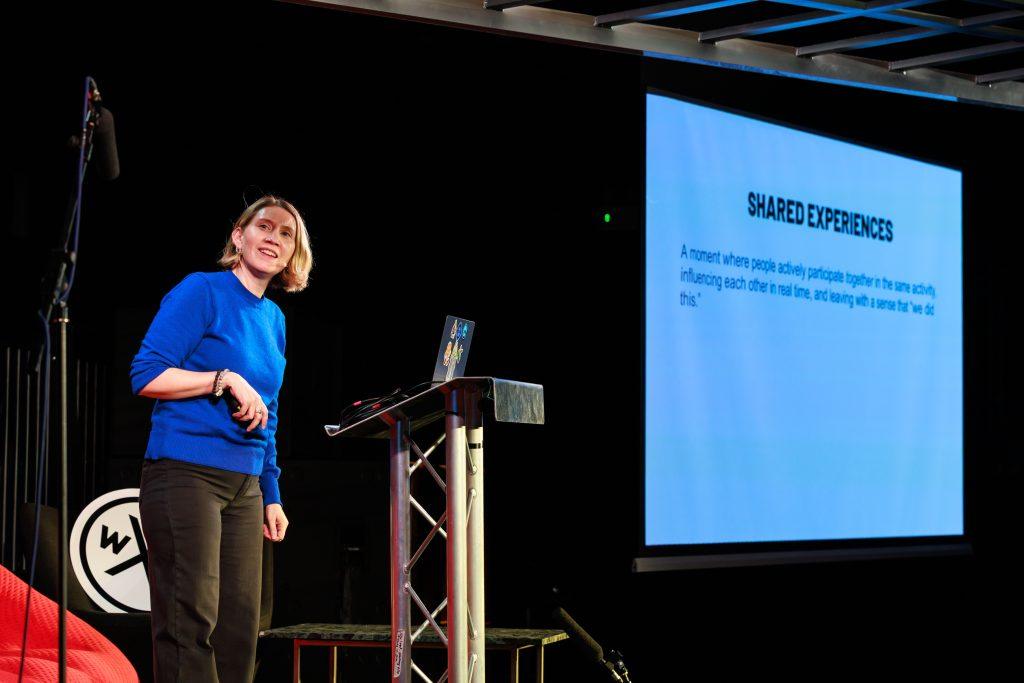
At Supercell, the Finnish mobile-games company, implementation of REMARKABLE gave creative, production and operations teams a common language for defining the intended audience response and assessing whether the work delivered it.
“It’s establishing that shared language so that there’s alignment and clarity around what are the goals, what are the targets, what are we hoping people will walk away with?”
– Laura Hess
That may be one of the most useful applications of ROX thinking.
Before you measure the audience, align the team.
4. Emotional fluency is the starting line
The most practical idea may also be the simplest: emotional fluency is the starting point for ROX.
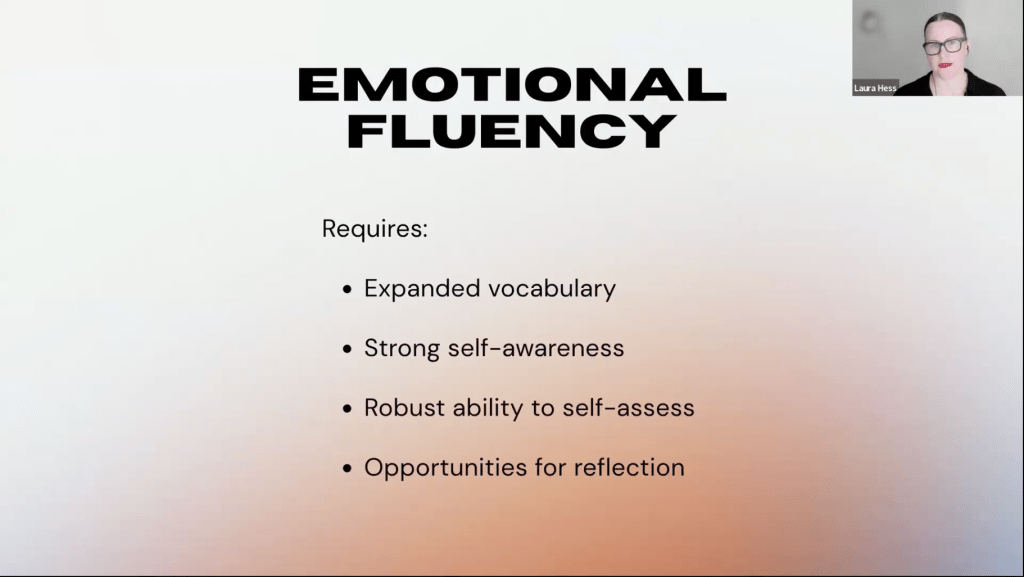
There are four requirements:
- An expanded vocabulary.
- Strong self-awareness.
- A robust ability to self-assess.
- Opportunities for reflection.
These are not soft extras. They are professional tools.
If a team cannot describe the emotional response it is trying to create, it will struggle to design for that response. If a client cannot articulate what kind of resonance they want, the brief will remain vague. If participants are never given time or space to reflect, the experience may fail to become fully memorable.
“We do not learn from experience. We learn from reflecting on experience.”
– Laura Hess
For experience professionals, that has major design implications.
Reflection should not be an afterthought.
It can be built into the experience itself. It can happen through conversation, prompts, rituals, hosted moments, post-experience surveys, community spaces or informal social settings.

One useful model comes from LARP: “frothing”, the post-experience ritual of talking through what has just happened. Derived from the ritual of going to a bar and discussing what people have just experienced, the term comes from the frothy head of a draught beer.
This matters because many experiences end too abruptly.
People are moved, stimulated, challenged or excited, then pushed straight into the gift shop, the exit corridor or the next thing. The moment for meaning-making is lost.
People are hungry for opportunities to think and talk about what they have just seen or done. That can happen socially, as with “frothing”, or individually, through a reflective framework such as REMARKABLE.
“People want to think and talk about what they just saw, what they just did.”
– Laura Hess
- Reflection helps people articulate value.
- For teams, that creates better feedback.
- For audiences, it can deepen memory.
- For clients, it can reveal forms of impact that would otherwise remain invisible.
The bigger lesson
The bigger lesson is that the experience economy needs better ways to prove value without reducing experiences to the wrong numbers.
The industry is growing up. That means it needs shared language, better tools and more rigorous ways to connect feeling to value.
This is not just a measurement issue. It is a professionalisation issue.
Fields advance when people can define their terms, compare practice, debate standards and build on each other’s work. Without shared terms, people cannot discuss the field intelligently, compare practice or help it advance.
That is why ROX matters.
Not because it gives everyone a neat new acronym.
But because it points to a missing layer in how experiences are designed, funded, measured and improved.
The experience economy is built on the idea that people value experiences not simply because they consume them, but because they keep them. They become memories, stories, relationships, identity and meaning.
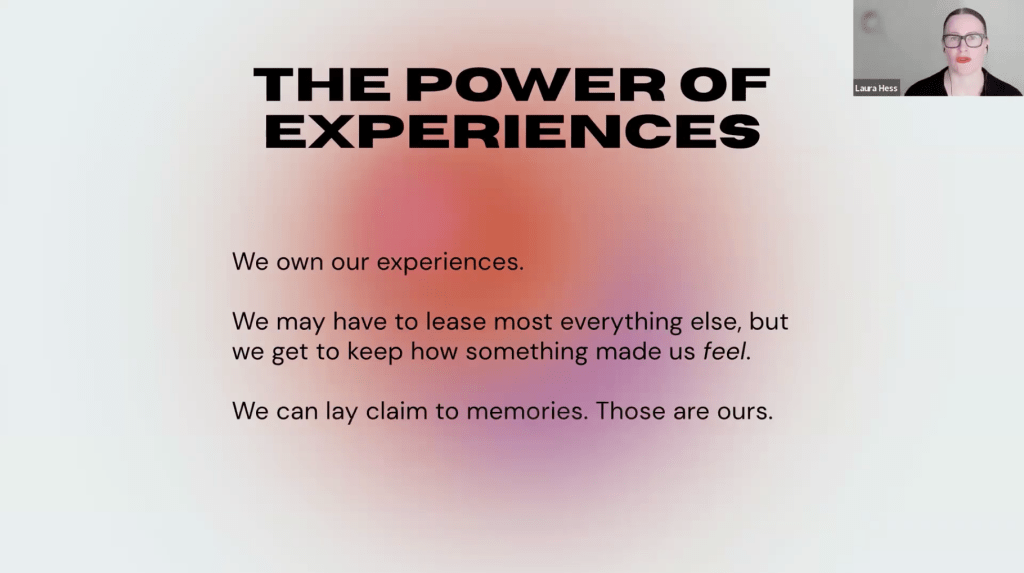
In a world where many goods are leased, subscribed to or made temporary, experiences offer something people can retain: how they felt.
That is the opportunity.
“The power of experiences is that we own them. We may have to lease most everything else, but we get to keep how something made us feel.”
– Laura Hess
But if the industry wants to be taken seriously, it needs to show how that emotional value works. It needs to help clients, teams and stakeholders understand why resonance matters, how it can be designed for and how it can be measured with intelligence.
This is where WXO has a role to play: helping experience professionals connect across sectors, develop shared language, test tools, compare practice and build the standards that allow the field to mature.
The aim is not to make every experience fit one model.
The aim is to help the people creating experiences ask better questions.
What to ask in your next meeting
- What emotional response are we designing for?
- Which metrics help us understand that response, and which ones are just easy to collect?
- What would be lost if we removed the reflective moment?
- Are we measuring attention, or are we measuring memory, meaning and behaviour?
- Do we have shared language for what “good” looks like on this project?
- How will we know whether this experience created value beyond the day itself?
For more Experience Briefings, head here.
For more information on how to join the WXO, head here.