
Welcome to the third episode of The LXW26 Series, an eight-part video series produced by The Experience Designers Show in partnership with the WXO.
Recorded live at Ministry of Sound during London Experience Week 2026, this conversation is part of the WXO’s ongoing partnership with The Experience Designers Show. Over the coming weeks, you can expect a series of indepth conversations with some of the people shaping the future of the experience economy.
Episode 3: Paul Nicholls (Factory Fifteen)
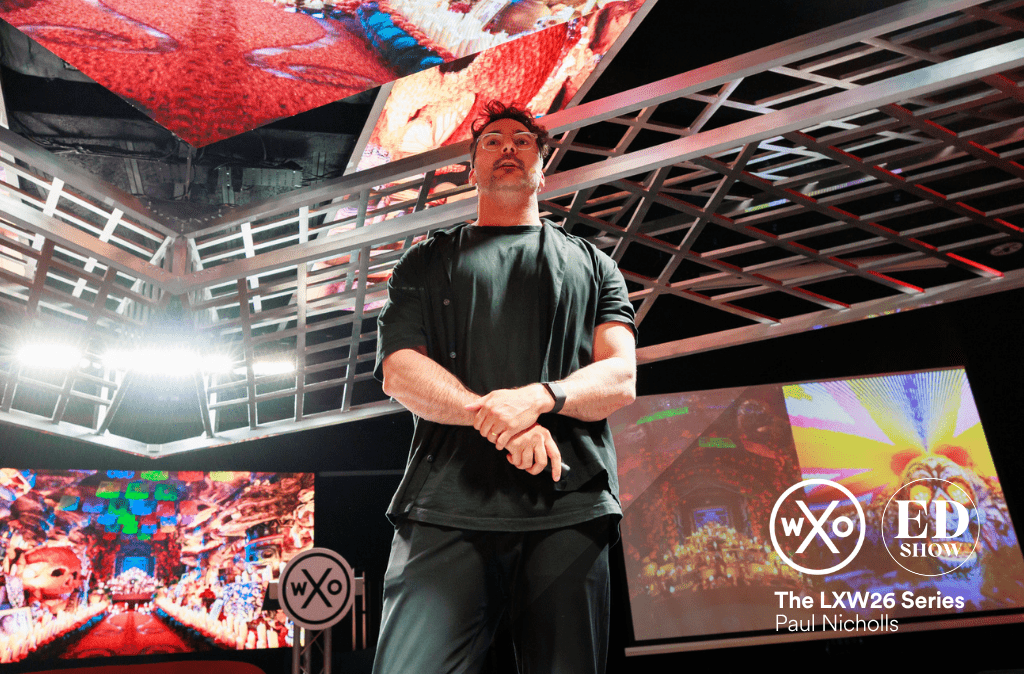
The third episode features Paul Nicholls, the BAFTA and Emmy Award-winning director, CEO and Chief Creative Officer of Factory Fifteen.
After completing a first-class master’s degree in architecture at The Bartlett, UCL, Nicholls co-founded Factory Fifteen, a film and experience design studio that creates cinematic worlds and live experiences. Its work has included projects for Sphere, the Olympic Games, the Royal Opera House, the Royal Albert Hall and several World Expos.
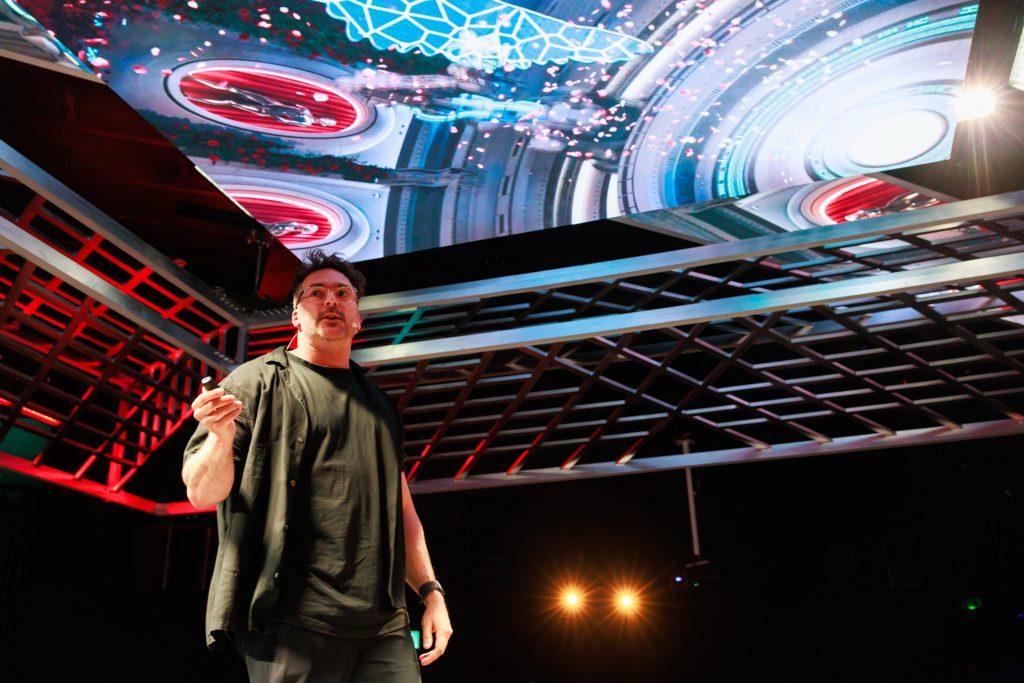
At London Experience Week, Nicholls presented Building Worlds Within The Sphere, tracing Factory Fifteen’s involvement from helping to visualise the original concept in 2016 to creating content for events including UFC and the Backstreet Boys. Factory Fifteen also transformed The Box at Ministry of Sound with The Shape of Memory, an audio and visual installation created with electronic musician Max Cooper.
His conversation with The Experience Designers’ Steve Usher moves between architecture, filmmaking, immersive technology, worldbuilding, artificial intelligence and the future of audience participation.
But the central lesson is straightforward:
The future of experience will not be created by making existing formats larger. It will come from understanding what each medium allows people to feel and do.
Testing an audiovisual experience inside Ministry of Sound
Nicholls had already spent part of the day testing this principle.
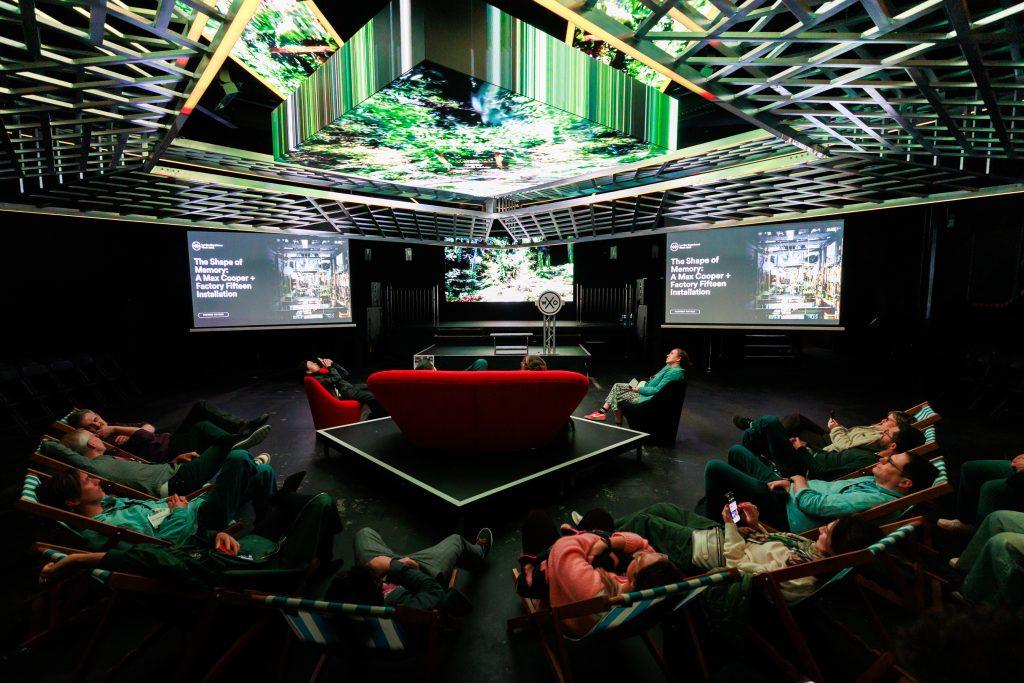
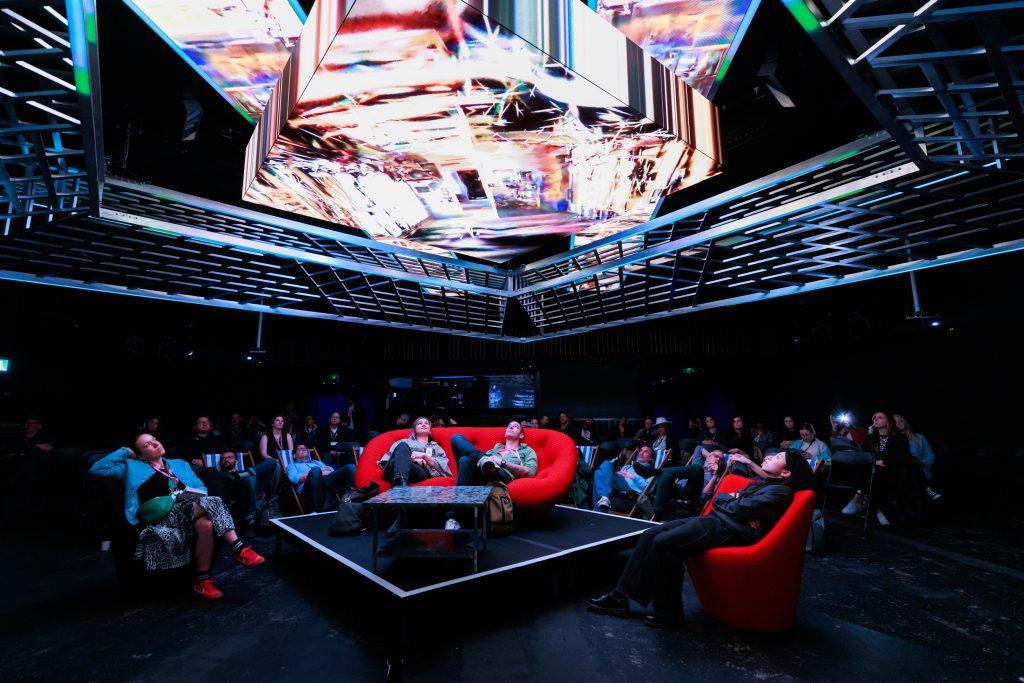
Before his talk, Factory Fifteen took over the central Box stage at Ministry of Sound with The Shape of Memory. The work had recently premiered at the Royal Albert Hall as part of Max Cooper’s live show, but needed to be reconsidered for the screens and spatial configuration at Ministry of Sound.
Based on photographs submitted by Cooper’s audience, the work moves through fragmented images and environments, exploring the way memories become less stable each time they are recalled.
Factory Fifteen used artificial intelligence and Gaussian splatting – a technique that turns images and scans into navigable 3D environments – to move between these memories in space.
Rather than treating the London Experience Week installation as a simple playback of the original work, the team reformatted it for the room.
That distinction matters. Experience design is not only about producing content. It is about understanding the physical environment in which the content will be encountered.
- A piece created for the Royal Albert Hall will not automatically work inside a nightclub.
- A film created for a cinema will not automatically work on a wraparound screen.
- An asset created on a laptop may look very different when it becomes the size of a building.
The medium changes the experience.
From architecture to experience design
Nicholls studied architecture for seven years before deciding that he did not want to become an architect in the traditional sense.
What he retained was an interest in space, design and what he calls spatial narratives: the way an environment can contribute to a story rather than simply contain it.
Factory Fifteen began by creating architectural films while Nicholls and his co-founders were still at university. Those films gained attention online and eventually led to commercial representation, first through RSA and later through Nexus Studios.
Their architectural training gave the work a distinctive quality.
“We’ve always been the architects of the film world,” Nicholls explains. “All of our films have a very spatial design aspect to them. The environment plays a character in the story.”
In Factory Fifteen’s short film Jonah, Stone Town in Zanzibar is not simply a backdrop. The place has its own presence within the story.
In the studio’s BAFTA-winning titles for the BBC’s coverage of the Tokyo Olympics, Tokyo becomes the central character: a dense, surreal city filled with athletes, sporting references and details designed to reward repeat viewing.
Now, Nicholls sees the studio completing a creative loop.
“We started off putting architecture into narrative media, and now we’re putting narrative media into architecture.”
The first part of that journey was about bringing cinematic movement, characters and stories into designed environments.
The second is about placing stories, images and media back into buildings, venues and physical experiences.
That intersection between media and architecture is where much of Factory Fifteen’s current work now sits.
Sphere began as an idea about the future of culture
Factory Fifteen’s relationship with Sphere began long before the building opened in Las Vegas.
In 2016, the studio was commissioned to help visualise what the venue might become. The resulting four-minute concept film was used to communicate the ambition behind the project and help secure support for its development.
The brief was not simply to draw a spherical building.
The team was asked to imagine the future of gaming, esports, music, performance, live events and sport.
Many of the early ideas were deliberately speculative, including holographic performances and other technologies that were not yet available at scale. But beneath them was a larger argument about the cultural role of major venues.
Nicholls points to places such as the Roman Colosseum, Shakespeare’s Globe and La Scala. Each represented the culture, technology and collective entertainment of its time.
Sphere was intended to do something similar for an era shaped by digital technology.
“The aspiration was there from the beginning to turn this into a new kind of cultural destination that centres around technology.”
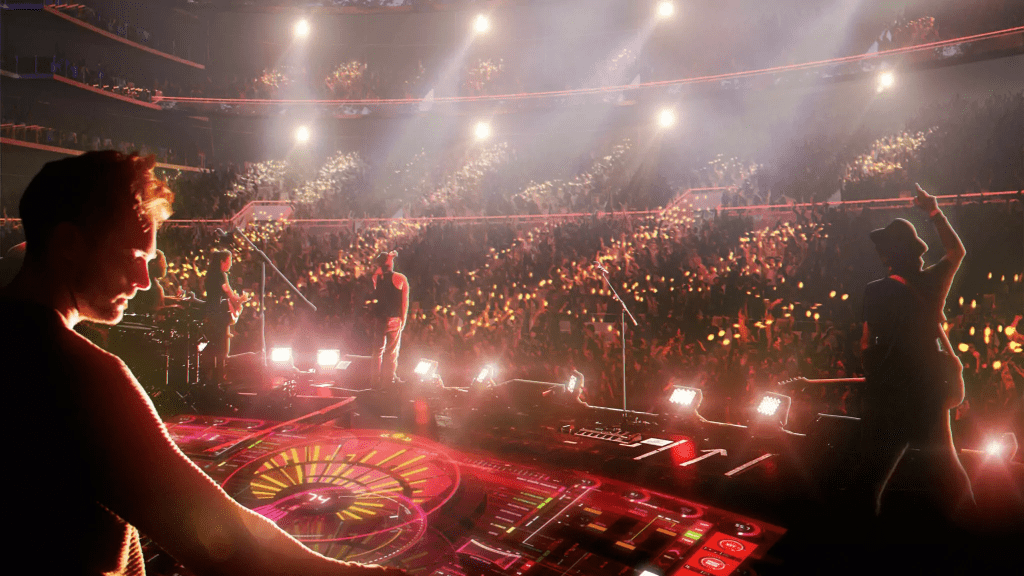
Years later, Factory Fifteen returned to create content for the completed venue.
Its work has since included films for the UFC’s Mexican Independence Day event, performances by the Backstreet Boys and a range of brand projects.
The studio has therefore experienced Sphere from both sides: first as a future concept and later as a functioning creative platform.
Bigger can be better – but does it make every story better?
Steve Usher asks whether the completed Sphere has lived up to the original ambition.
Nicholls’ response begins with a question he raised during his London Experience Week presentation:
Does bigger equal better?
His answer is yes – but only in certain ways.
Entering the Sphere can create a feeling of awe that depends on its scale. Nicholls compares it to entering a vast cathedral and suddenly becoming aware of what human beings have built.
“The size gives it a sense of majesty that you can’t really grasp unless you’ve been there. It is a technical marvel.”
That scale produces powerful physical immersion. The visitor is surrounded by an environment that dominates their field of view and alters their awareness of the space.
But Nicholls makes an important distinction between physical immersion and narrative immersion.
A person can feel physically overwhelmed by a space without becoming deeply involved in its story.
“There’s a big difference between physical immersion and story immersion.”
For Nicholls, Sphere is exceptionally well suited to music. The relationship between sound, scale, performance and imagery can elevate a concert into something that would not be possible in a conventional arena.
Other spatial venues have found different strengths. Cosm, for example, has developed a format in which audiences can watch live sport on large wraparound screens, creating the sensation of sitting inside the stadium while remaining in a social hospitality environment.
Traditional films are more complicated.
“I don’t think it’s a bigger cinema. It’s not the evolution of IMAX. It’s a different kind of experience.”
This may be one of the most useful observations in the interview.
New platforms are often introduced by placing old content inside them.
- A film is enlarged.
- A stage show gains more screens.
- A familiar format is surrounded by new technology.
But the strongest work usually emerges when creators stop treating the platform as an upgraded version of something that already exists.
The better question is not: How can we make cinema bigger?
It is: What can this environment do that cinema cannot?
Designing for The Sphere = Creating collective VR
Factory Fifteen adapted quickly to producing content for Sphere because of its previous work in virtual reality.
Nicholls describes the venue as a form of “collective VR”. The audience does not need to wear a headset, but many of the same design rules still apply.
Creators have to think carefully about:
- Speed and movement
- The position of the audience
- Changes in scale
- Motion sickness
- Camera direction
- Visual orientation
- How quickly an environment moves around the viewer
Teams accustomed to designing flat film content may not immediately consider these factors. A camera movement that feels ordinary on a television can become uncomfortable when it fills almost the entire field of vision.
Factory Fifteen could test its work through VR before reviewing it inside the venue. This allowed the team to understand the spatial effect of creative decisions earlier in the production process.
The more difficult challenge was technical.
The Sphere requires assets at an extraordinary resolution. Objects that look detailed on a workstation can appear unfinished once projected at architectural scale.
As Nicholls puts it:
“You don’t realise some assets are going to be the size of a double-decker bus.”
A candle in a scene may suddenly become the size of a building.
After its first major project, Factory Fifteen developed a custom real-time production pipeline for Sphere content. This allows the team to render work faster, retain visual quality and gather feedback from clients earlier.
This is not merely a technical improvement. Faster feedback changes the creative process.
When teams can see and test ideas sooner, they can spend more time designing for the actual experience rather than discovering problems during final delivery.
Worldbuilding begins before the script is finished
Worldbuilding has become a popular term across entertainment and experience design. Factory Fifteen has been using it since the studio began.
For Nicholls, it is not a layer that is added after the main story has been written.
It is the process of researching, designing and defining the world at the same time as the story is developed.
“Nothing is surface value. There’s a lot of thought that has gone into it.”
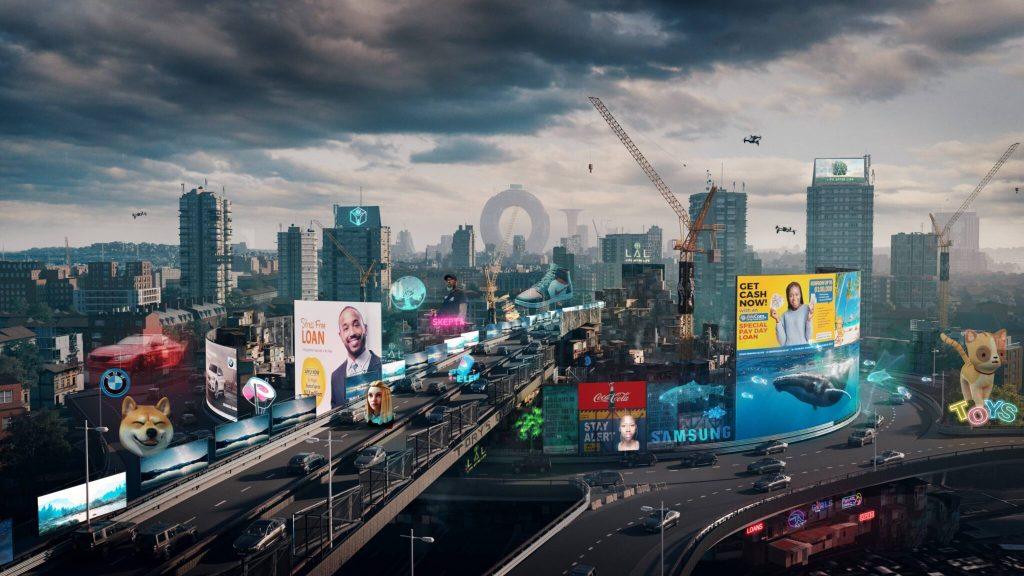
If a project is set within a particular culture, the team researches that culture. If it presents a future city, the team considers how that city works. If it imagines London in 2035, it asks what has changed – and what has remained recognisably London.
Factory Fifteen applied this process to The Kitchen, the Netflix film directed by Kibwe Tavares and Daniel Kaluuya.
The project presents a near-future London with an Afrocentric perspective. The design team therefore had to answer questions that were larger than the immediate plot.
What does Brixton look like in 2035?
How have buildings, streets, transport, signage, clothing and technology changed?
What has happened socially and economically?
How is the history of the place still visible?
Each answer informs the next design decision.
“The more layered and detailed you can be, the richer that world is going to feel.”
Nicholls argues that story and design should be given equal weight.
Too many projects concentrate almost entirely on characters and plot. The setting is then assembled around them as a collection of familiar visual signals.
The result may tell the audience what is happening, but it does not allow them to understand what living inside that world would feel like.
That is the difference worldbuilding makes.
For experience designers, the principle extends beyond film.
A themed attraction, exhibition, immersive production, brand home or interactive installation also needs a coherent world.
Guests notice when the front-of-house language does not match the story, when an interaction contradicts the supposed rules of the environment, or when the physical design feels disconnected from the narrative.
Worldbuilding gives every discipline a common context for its decisions.
Do not sacrifice the experience to make the case-study film
One of Nicholls’ most practical examples comes from Kia Joyride, a project created with Nexus Studios for children receiving cancer treatment at St Jude Children’s Research Hospital in Memphis.
The children could not leave the hospital during the festive season, so the experience brought a journey to the North Pole to them.
A Kia EV6 was placed inside a pop-up LED environment. From inside the car, the surrounding images created the sensation that the vehicle was flying through a changing landscape.
The project had two intended outputs.
The first was the experience for the children.
The second was a national television advertisement documenting it.
That created a difficult design problem. The production team needed to capture particular images and tell a coherent story, but an overly controlled shoot would weaken the children’s actual experience.
Nicholls describes himself as a meticulous planner. In conventional film production, the shoot is often the execution of decisions made during pre-production.
This project required a different approach.
“You have to be more open-minded so you don’t sacrifice the experience for the kids.”
Instead of forcing each interaction into a predetermined shot list, the team allowed the experience to unfold and captured the children’s genuine responses.
Nicholls summarises the method simply:
“Let it flow as an experience. Loosen your strength on what you thought you were going to capture, so you can do more in the edit than in pre-production.”
This challenge appears frequently in experiential marketing.
An activation may be designed to create a live encounter, but it is also expected to generate a film, social content, photography, press coverage and a case study.
When the documentation becomes the priority, guests risk being treated as performers in somebody else’s campaign.
The live experience should not become a production set that happens to contain an audience.
Design the experience first. Capture what genuinely happens inside it.
The BAFTA was designed to reward repeated attention
Factory Fifteen won a BAFTA for the BBC’s titles for the Tokyo Olympic Games.
The film moves through an imagined version of Tokyo in which athletes and sporting events are embedded throughout the city. It was created during the disruption of the pandemic, with Nicholls and the team directing filming remotely while strict restrictions remained in place in Japan.
Its density was intentional.
The titles would be shown repeatedly during the Games, so Factory Fifteen did not want viewers to understand everything on the first watch.
“Even on the hundredth time, you’ll notice a different athlete.”
This is another form of worldbuilding.
The audience is given more than it can immediately process. Each return reveals another detail, relationship or visual joke.
The goal is not confusion. It is repeatable discovery.
The BAFTA itself also carries a more personal meaning.
Nicholls’ co-founder Jonathan Gales took the trophy onto the dance floor on the night of the ceremony and accidentally broke it. After Gales died in a car accident in 2023, Nicholls decided not to repair it.
The broken award remains in the Factory Fifteen studio as a monument to his friend and collaborator.
It is a reminder that creative businesses are built not only from processes and technology, but through long relationships between people with different skills and instincts.
The future is technology that feels more human
Asked about the future of the experience economy, Nicholls does not predict a simple progression towards larger screens and more expensive venues.
He expects a deeper merger between technology and physical experience.
“There’s going to be an even bigger merger of tech with experiences in more human ways.”
The important phrase is more human ways.
Technology still introduces considerable friction into many experiences. Headsets are heavy. Interfaces need explanation. Guests have to stop what they are doing, learn a system and visibly interact with a device.
Nicholls expects that boundary between the human and the machine to become less obvious.
Wearable technology, augmented reality, artificial intelligence and more natural interfaces could allow digital systems to respond without constantly demanding attention.
Audiences will also become more active within the story.
“We’re going to be more like participants in the story – more like actors and gamers within these environments.”
Gaming offers an important model because it gives people agency. The player does not simply observe the story. They make decisions, test possibilities, develop skills and affect what happens.
Future experiences may increasingly combine this agency with the social and sensory qualities of physical environments.
The result will not necessarily look like a game. But it may give visitors a clearer role in shaping what they encounter.
New tools will allow smaller teams to build new kinds of experiences
Nicholls sees artificial intelligence as part of a wider change in who can create technology.
When Factory Fifteen began, new consumer cameras and faster desktop processors allowed a small group of architecture graduates to produce cinematic work that would previously have required a much larger studio.
The Canon 5D Mark II made high-quality digital filmmaking more accessible. Advances in computer processing made it possible to render sophisticated 3D work on an individual machine.
That combination allowed Factory Fifteen to compete with much more established production companies.
Nicholls believes AI could create a similar shift.
Rather than simply replacing programmers, AI-assisted development may allow individuals and small teams to build software for much more specific uses.
Large software companies need large audiences because development is expensive. When the cost of development falls, teams can create smaller tools for niche communities, organisations, families and experiences.
The comparison Nicholls makes is with online video.
Television and cinema were built around expensive productions for mass audiences. Platforms such as YouTube then allowed millions of smaller creators to produce content for audiences that traditional media would never have served.
AI-assisted coding could do something similar for software and interactive experiences.
Small creative teams may be able to build:
- Bespoke audience interfaces
- Interactive characters
- Personalised story systems
- Operational tools
- Experience-specific games
- Responsive installations
- New forms of accessibility
- Software created for a single venue or community
This does not remove the need for expertise. But it could reduce the amount of infrastructure required to test an idea.
Capturing the real world as a digital environment
Another emerging technology discussed in the interview is Gaussian splatting.
Traditional photogrammetry uses a large collection of photographs to generate a three-dimensional model of a place or object.
Gaussian splatting can produce a highly detailed spatial capture that feels closer to the original environment and can be explored from different positions.
Factory Fifteen used the technique artistically in The Shape of Memory, turning personal photographs into fragmented spatial worlds.
The technology could also transform live sport.
Nicholls describes experiments with four-dimensional Gaussian splats, in which an event is captured spatially over time. Instead of watching from the fixed position chosen by a broadcaster, audiences could theoretically move their viewpoint around the action.
A tennis match might be watched from the stands, beside the court or through a virtual-reality environment. The viewer could choose the camera position as if moving inside a video game.
The important development is not simply better image quality.
It is the transition from recorded footage to a navigable digital event.
This could change how performances, sports, locations and cultural events are documented and experienced after they happen.
What this means for experience designers
Nicholls’ career connects architecture, film, visual effects, live performance and immersive technology.
Across those disciplines, several principles remain consistent.
- Do not begin with the size of the screen. Begin with the experience the medium can uniquely create.
- Do not assume physical immersion will produce narrative immersion. Design the world, its rules and its environment alongside the story.
- Do not add technology simply because it is available. Use it to reduce friction, increase agency or enable something that could not otherwise happen.
- Do not compromise the live encounter to produce cleaner marketing content. Allow real participants to respond in their own way.
- Do not treat audiences only as viewers. Give them a meaningful role inside the experience.
- Do not assume that the future will belong only to organisations with the largest teams and budgets. New tools may allow smaller studios to build specialist technologies, environments and interactions for audiences that have previously been too niche to serve.
The future Nicholls describes is not a straight line from cinema to IMAX to Sphere.
It is a much wider field in which architecture becomes media, media becomes space, audiences become participants and technology becomes less visible.
The screens may become larger.
But the more important change is what people will be able to do inside them.
Watch the full conversation
This article summarises the first interview in The LXW26 Series, produced through the partnership between WXO and The Experience Designers Show at London Experience Week. Watch the full conversation with Paul Nicholls above, or follow through to The Experience Designers Show for the complete episode.
Coming next in The LXW26 Series
This is the third of eight full-length conversations filmed live at London Experience Week 2026 and shared here as part of the WXO / The Experience Designers Show partnership.
Watch now:
- Dr Amna Khan — Consumer behaviour expert, 1,000+ media appearances on BBC, ITV, Channel 5.
- Lea Karam — Founder, MindScope Labs; working with clients including Google, Pinterest, TikTok, BBC, ITV and AMEX.
- Paul Nicholls — CEO + CCO, Factory Fifteen; BAFTA and Emmy Award-winning director, with work connected to The Sphere.
Coming up:
- Eyal Danon — Co-Founder, COGS / Clockwork Dog; the platform powering experiences for Punchdrunk, Secret Cinema and Netflix House.
- Abraham Burickson — Co-founder, Odyssey Works; immersive pioneer and Yale University Press author.
- Anam Ahmad — CCO, The Hanging House; award-winning agency founder and Forbes 30 Under 30 honouree working across the UAE and KSA.
- Joe Pine — Author and experience economy thinker; widely recognised as the father of the Experience Economy.
- Vance Garrett — Director and storyteller; formerly of Sleep No More, Museum of Ice Cream and 29Rooms.
We’ll be publishing each conversation as part of this series on the WXO website, exploring how experience thinking is changing the way brands, places, communities and organisations create value.