

Heritage at scale, game IP, fast technology adoption and new models for international collaboration are turning China into one of the world’s most valuable laboratories for experience design.
Most discussion of China’s experience economy focuses on its size, speed and willingness to adopt new technology.
That is interesting, but it misses the bigger opportunity.
China is becoming one of the world’s most valuable laboratories for experience design.
Rather than simply creating Chinese versions of Western attractions, creators are combining heritage, gaming, fandom and technology in ways that challenge many of the assumptions behind Western attractions, immersive theatre and brand experiences.
This Experience Briefing draws on a WXO Campfire with Changting Lu and distils its most useful ideas for experience leaders.
Changting Lu is a former Walt Disney Imagineer, a show writer on Shanghai Disneyland’s Zootopia land and founder of Shanghai-based studio Get Dreams Done Co. Her work offers a view into how China’s immersive entertainment sector is developing its own formats, behaviours and creative rules.
Together, the examples below point to five lessons every experience leader should consider.
1. Design around desire, not technology
Experience teams often begin with technology.
- AI
- XR
- Projection mapping
- Interactive media
A better starting point is unmet desire.
“What are the things that people crave but can’t get from their real life?”
– Changting Lu
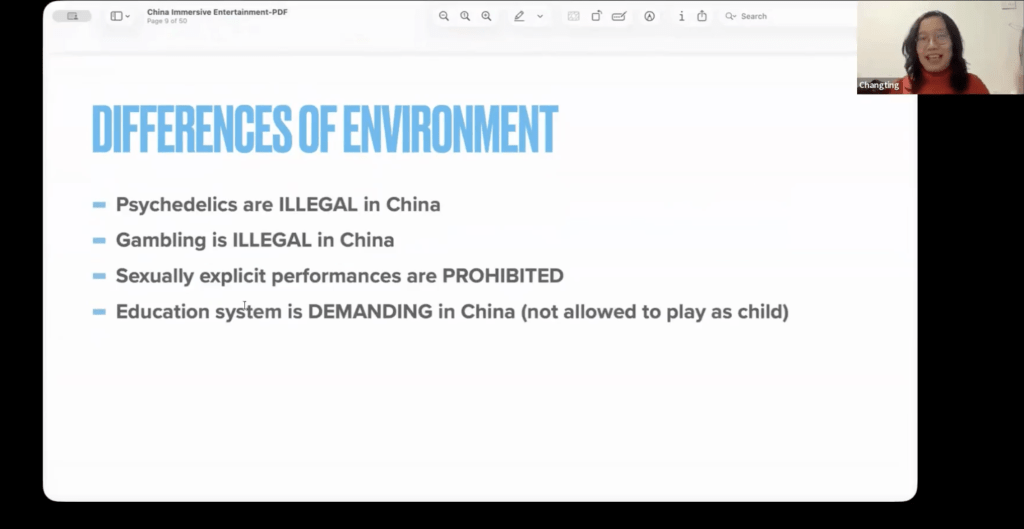
In China, experiences that reproduce the thrill of gambling without using real money have found commercial success in a country where gambling is illegal.
Experiences that create altered-state feelings through music, lighting, sound and scenography can also become desirable in a market where psychedelics are illegal.
The point is not that audiences want illegal activities.
People pay for experiences that safely recreate emotions they cannot easily access in everyday life:
- risk without danger
- transgression without consequences
- intimacy without uncertainty
- adventure without real-world cost
The lesson is not to copy these particular ideas. It is to recognise that the strongest experiences often satisfy unmet desires.
Not every audience wants spectacle.
Some want adventure.
Some want belonging.
Some want permission to break the rules.
Others want to become someone else for a few hours.
Technology may help deliver those feelings.
But it rarely creates them.
2. Turn heritage into participation
A major shift is the rise of heritage at scale.
Many heritage attractions ask visitors to observe history.
China is showing another approach.
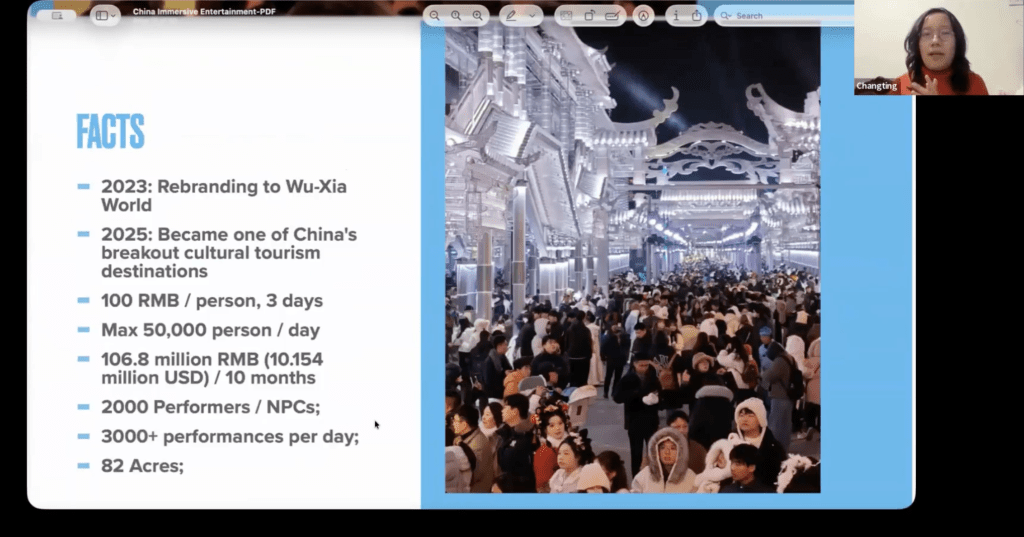
In Kaifeng, a historic attraction has been transformed into a wuxia-themed world inspired by Chinese martial-arts stories.
Instead of relying primarily on rides, the attraction builds participation.
Today, the experience includes:
- around 2,000 performers
- more than 3,000 live performances each day
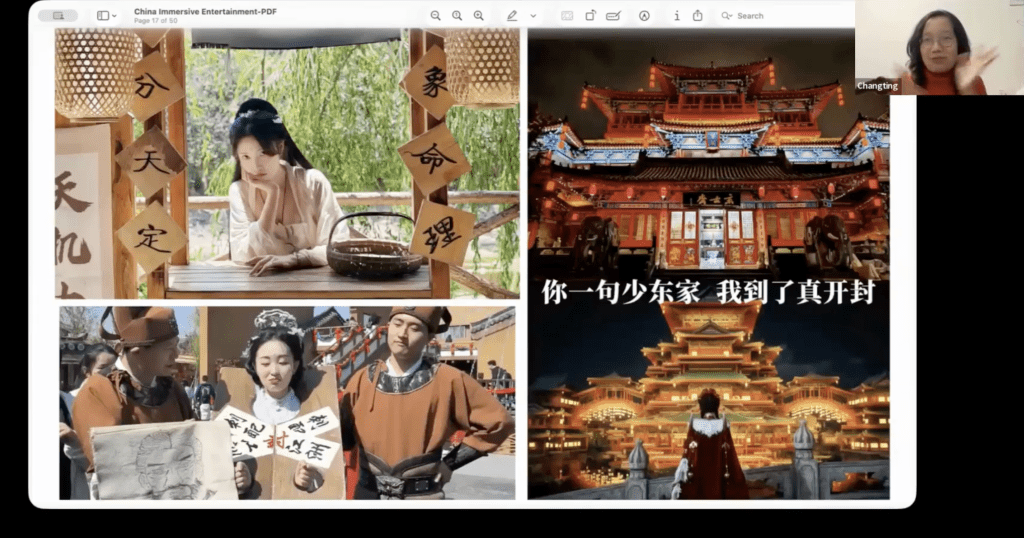
- Song Dynasty-inspired paper currency that visitors earn, trade and spend
- interactive games in which guests negotiate with performers, complete challenges and use fictional money in gambling-style mechanics
Visitors are not simply learning about history.
They are living inside it.
History becomes less like an exhibition people go to see and more like a social system they can play within.
At Kaifeng, visitors earn currency, negotiate with performers, complete challenges and shape their own individual journeys through the world.
3. Learn from games, do not copy them
Open-Open-world games have changed how many people expect interactive experiences to work.
Players are used to:
- discovering hidden content
- talking to characters
- completing quests
- trading
- earning status
- making choices that affect what happens next
When those audiences arrive at a physical experience, they do not leave those expectations behind.
Attractions are increasingly designing for these behaviours rather than forcing visitors back into passive observation.
Kaifeng rewards exploration. Visitors familiar with wuxia games already understand how to interact with characters and navigate the world.
The lesson is not that every experience should become a game.
It is that audiences are becoming increasingly comfortable participating rather than simply watching.
Experience designers need to consider what those expectations mean for the environments they create. Simply put, game fandom is moving into physical life.
Love and Deepspace shows how game fandom can extend beyond the screen.
The romantic simulation game has developed a large fan base in China. Some fans commission professional cosplayers to perform as favourite characters during one-to-one encounters or dates.
Fans of Love and Deepspace commission one-to-one immersive encounters with professional cosplayers playing favourite characters.
An official Shanghai activation expands the same desire into a larger physical experience.
A temporary luxury house beneath the Oriental Pearl Tower allows fans to enter the world and take photographs with official cosplayers playing their favourite characters.
The boundaries between player, fan, visitor, customer and participant become increasingly blurred.
Publishers behind Honkai: Star Rail and Reverse: 1999 re extending their digital worlds through concerts, immersive activations and themed environments.
These projects do not need to teach audiences entirely new behaviours. They build on existing habits of cosplay, fan gatherings, role-play, concerts, commissions and high-intensity attachment to fictional characters.
In Shanghai, the hit Netflix series Arcane has been adapted into an immersive musical in Shanghai by Tencent, Riot Games, Punchdrunk and SMG Live.
The important point is not simply that a major Western game and animation IP has become a physical production.
The Chinese market already has the behaviours that make the move understandable:
- cosplay
- fan gatherings
- character commissions
- concerts
- role-play
- game-world activations
- high-intensity IP fandom
An international producer looking at China only through the lens of theatre or theme parks risks missing this convergence.
Games are not just content.
They are social infrastructure.
4. Let story lead technology
China is often described as a leader in technology adoption.
Lu argued the more interesting question is how technology is used.
Three Body Problem: Beyond Gravity, an immersive production creatively directed by Lu, shows how narrative can turn a technological limitation into an advantage.
The project was funded by an AI company rather than a conventional entertainment business.
When development began, conversational AI was not convincing enough to play a realistic human character.
Rather than forcing it to behave like one, the creative team rewrote the role.
The AI became a four-dimensional alien intelligence.
Its unusual responses suddenly felt believable.
The technology had not changed.
The storytelling had.
Three Body Problem: Beyond Gravity turns the limitations of conversational AI into a credible part of its fictional world.
Emerging technology does not always need to imitate people.
Sometimes the better creative decision is to build a world in which the technology’s limitations make narrative sense.
The project also reveals a different investment model.
In China, technology companies increasingly invest in immersive experiences because they want to demonstrate the futures they are building.
It becomes a way for audiences to imagine how a company’s technology might fit into everyday life.
The experience becomes more than entertainment.
5. Local stories need local authors
An old Chinese saying captures the advantage once enjoyed by many international creators:
“Foreign monks chant better.”
For years, overseas expertise could carry an assumption of superior quality.
That advantage is disappearing.
International creators often assume that adapting a successful format is enough. But production value cannot compensate for weak cultural authorship.
One major European production opened in Shanghai with ambitious staging and significant technical investment.
Audiences struggled with the story.
Historical events, mythology and fantasy had been combined in ways that did not feel authentic to Chinese audiences. The production closed during previews before reopening after significant changes.
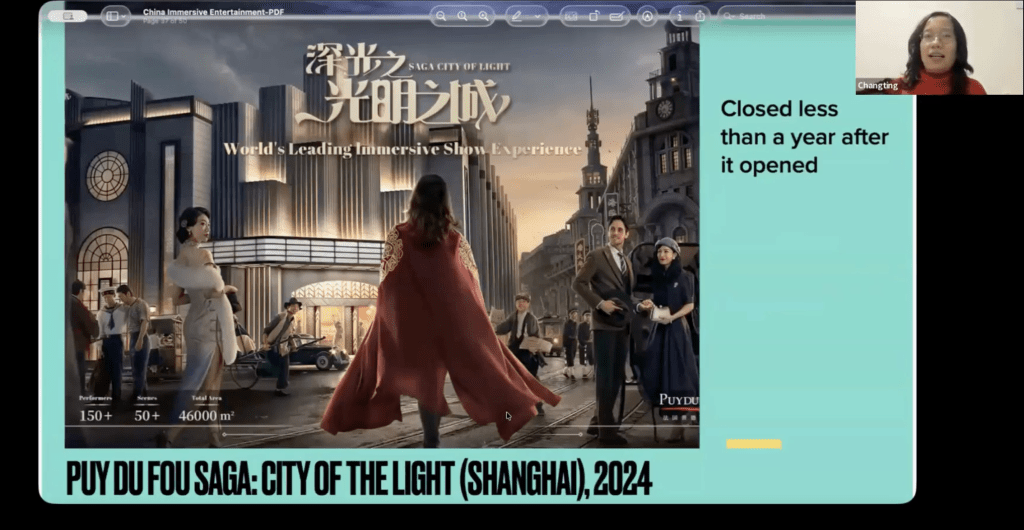
If an experience tells a local story, local creators need to be involved from the beginning.
Authenticity is not achieved through architecture, costumes or translation.
It comes from understanding how local audiences interpret their own history, culture and mythology.
Without that understanding, even beautifully produced experiences can fail.
The reverse can also be true.
A French company telling an authentic French story may succeed in China precisely because it offers something genuinely different.
The problem is not that the creators are foreign.
The problem is trying to tell a Chinese story without sufficient Chinese authorship.
The Bigger Lesson
None of this suggests that the rest of the world should copy China’s formats.
That is not the point.
The opportunity is to understand the thinking behind them.
Across these examples, creative teams start with audience behaviour before deciding on technology, business model or format.
They ask:
- What do people want that everyday life does not provide?
- Which behaviours already exist?
- Which stories already matter?
- How can participation feel meaningful rather than decorative?
These questions apply just as much in London, Los Angeles and São Paulo as they do in Shanghai.
China’s immersive entertainment sector also demonstrates why experience professionals need to look beyond the boundaries of their own sectors.
Heritage attractions borrow from games.
Game publishers move into concerts, theatre and physical environments.
Technology companies become experience investors.
Cosplay becomes a commercial service and a route into character-based participation.
History becomes a world people can navigate, rather than a story they passively receive.
This convergence is helping China develop its own immersive language. It is not simply importing Western formats or adding technology to familiar attractions.
It is building experiences around local behaviours, cultural knowledge and forms of participation that audiences already understand.
That offers a stronger starting point for the next generation of experience design.
What to ask in your next meeting
- What does our audience want that everyday life does not provide?
- Which existing fan, gaming or social behaviours can this experience build on?
- Are we using technology because it supports the story, or because it is available?
- Which parts of the experience require local authorship and cultural knowledge?
- Are participants being invited to shape the world, or merely observe it?
For more Experience Briefings, head here.
For more information on how to join the WXO, head here.