

Is technology a cure all for experience designers in a hunt for quality? Katrina Lat says no – but the answer’s a bit more complicated…
In late May, WXO members gathered for Katrina Lat’s Campfire, ‘High Tech, Low Tech, No Tech’. Spread across two separate time slots, the online session was based on her popular talk from the recent London Experience Week.
What packed the room at Ministry of Sound filled two Zoom rooms a month later as members from around the world attended to interrogate the broad assumption that technology – and whatever that means – is a short-cut for ensuring or even adding quality to an experience.
TL;DR: obviously, it isn’t. And equally obviously, the response is more nuanced than that.
What followed across two sessions was not an anti-technology argument. It was a detailed and ultimately communal reflection that in the Experience Economy, technology is only as valuable as the experience logic it serves.
“Personal, obsessive and unusually broad”
The original Campfire session listing promised an “experience-first perspective” on immersive work, asking when technology adds value and when it merely compensates for weak design. It was also careful to position Katrina Lat’s AURA Framework – Agency, Universe, Resonance and Artistry – as a qualitative lens rather than a ranking system.
Lat, a Toronto-based experience designer, producer and client strategist, started the Campfire with a deceptively simple question: ‘Does more technology necessarily mean a higher-quality experience?’
There’s a simple answer.
“Based on my data, there is no correlation.”
It’s a line that could easily have become a neo-Luddite mantra. Instead, Lat spent both her Campfires colouring that simple response with vital detail and data.
It’s worth highlighting here that the “data” presented was not a generic survey scraped from the internet or a set of industry case studies dressed up as science. It was personal, obsessive and unusually broad as Lat showed a spreadsheet of every immersive piece she had seen over roughly the past decade.
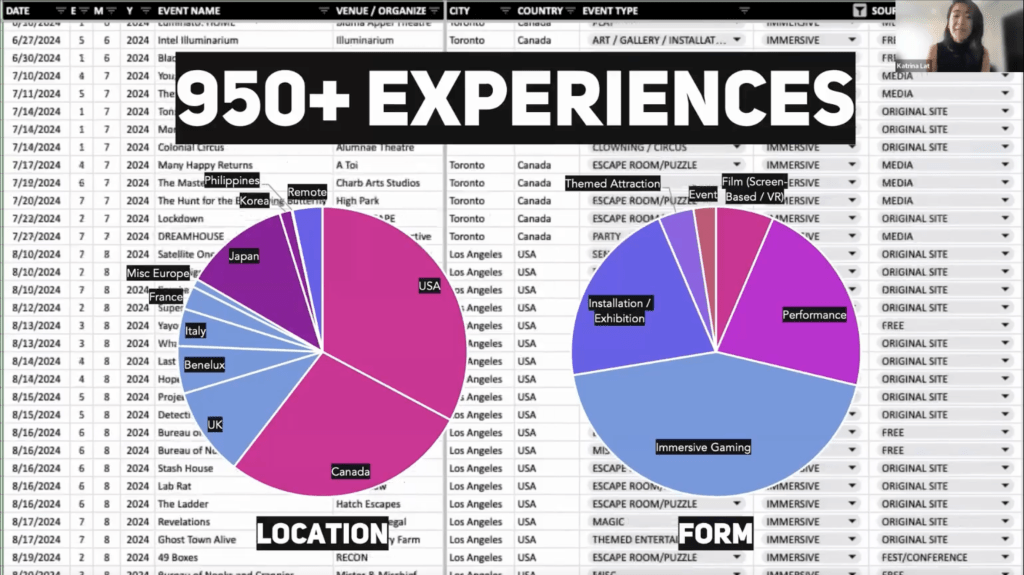
By the time of the talk, Lat was at 996 experiences, just shy of her magic 1,000 target. Roughly two-thirds of her experiences were in North America, with a significant number in Europe and Asia, especially Japan. Around half were immersive gaming, including escape rooms, with the rest spanning installations, exhibitions, theatre, dance, music, themed attractions, events and screen-based work such as VR and projection mapping.
Rather than dwelling on the listing of 900 experiences Lat scrolled through, instead she quickly pushed through to the learns that such impressive quant research brings – namely that after almost a thousand encounters, certain lazy assumptions begin to collapse.
The most persistent of those assumptions is that immersive experience and technology are natural synonyms.
Lat revealed she had repeatedly found herself “in a lot of rooms” where, even if experience and technology were “not the same thing”, they were treated as if they had become almost “entirely synonymous.”
For anyone in the experience business, this integration will feel sadly familiar. The pitch deck centres on the heads-up display. The client wants AI. The stakeholder ask you to consider cheap projection. The press release promises “next generation”.
Technology – and, again, whatever that means – offers the comforting appearance of progress. It is visible. It looks great on Insta. It is easy to budget against. It makes novelty legible.
Lat’s discovery was that while it sounds good, none of this proves quality.
The first problem: “immersive” is too big to behave
Before sharing the experience mapping chart everyone was waiting for, Lat began by defining her two axes: Technology and Quality.
On her TECHNOLOGY scale, a score of ‘one’ meant technology was absent or played no meaningful role. Remove the tech and the experience would remain essentially the same. A ‘five’ meant technology was core to the value proposition. Remove it and the experience could not exist in its current form.
QUALITY was inevitably harder to define. Lat described a ‘one’ as fundamentally flawed: frustrating, confusing, unpleasant, or a misfire. A ‘five’ was “a standout work that is field defining.” She also acknowledged the elephant in the Zoom room: quality is subjective. In immersive work, it is not merely subjective. It is unusually hard to compare for ongoing reasons.
“Part of the issue we have with the word immersive is that it means everything and it means nothing.”
The main reason – and one of the hot topics of any day in the Experience Economy – is the (mis)use of the word ‘immersive’. Lat shared a list of experiences that had recently been marketed as immersive: puzzle hunts, TTRPGs, extended reality, installation art, virtual reality, ARGs, multi-sensory experiences, museums and, with some irritation shared by her audience, a diverse selection of experiences that simply used “immersive” as a synonym for “engaging.”
It’s an irritation that’s justified. What is convenient for marketing is inconvenient for any attempt at evaluation, comparison or measurement. If “immersive” covers an escape room, an XR installation, a museum, a theatre piece, a phone-based remote show AND a projection-mapped Van Gogh experience, then the word is no longer a category. It is barely a promise – and often, an incredibly loose one with zero guarantee of quality.
Lat’s second problem was the lack of a shared baseline. With film, books or music, people can usually access the major works, compare them and argue from a common reference point. Immersive experiences are different. They are physical, temporary, expensive to travel to and often geographically scattered.
Lat’s example was the Oscars. A movie lover can watch every Best Picture nominee and make an informed plea for the winner on Oscar night. In immersive, that is far harder – what’s ‘good’ to one attendee is not good for another, with so many criteria to inform and even block that opinion.
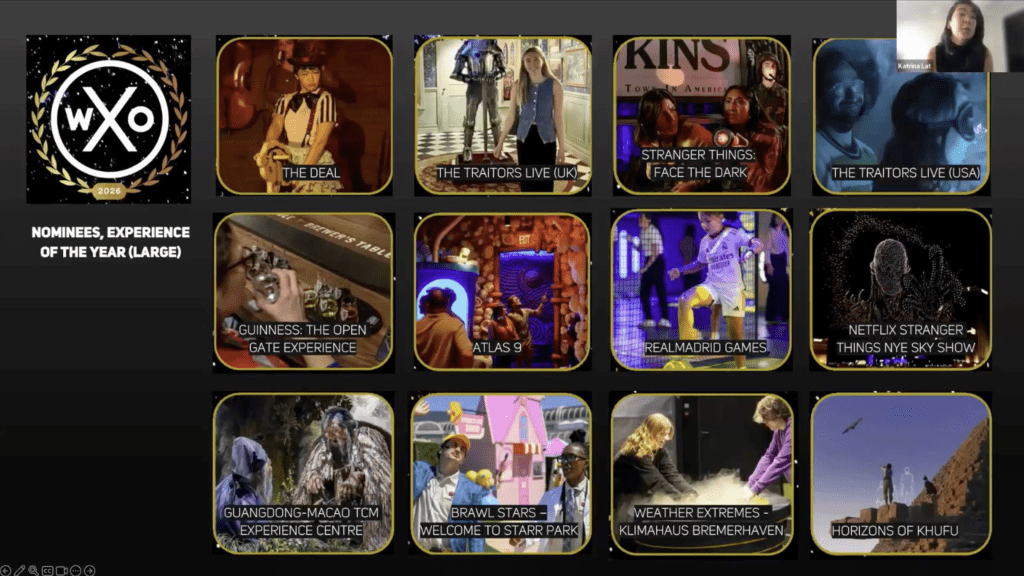
To prove her point live, Lat turned the Zoom room into a small experiment. She asked attendees to raise their hands using Zoom reactions. Then she showed the 12 nominees for Experience of the Year (Large) at the recent WXO World Experience Awards, and asked who had seen at least one. The number dropped quickly. When she asked who had seen two or more, only one person was left with their hand raised.
What was a neat live device was also a serious industry critique. Here was not a room of casual consumers. Campfire attendees were WXO members who had chosen to attend a Campfire about experiences – people who had “actively drank the Kool Aid”! Yet even they had not seen many of the works nominated by their peers as among the year’s best.
That is not a failure of curiosity. It is a structural condition. The Experience Economy is global, but experience remains stubbornly local. Its canon is fragile because its evidence disappears in matter of weeks. You can still watch the Best Picture but you cannot attend Sleep No More.
AURA as a language, not a machine
Lat’s answer to the challenge of judging quality was her AURA framework: Agency, Universe, Resonance and Artistry.
Remember, Lat described AURA as “a shared vocabulary” for thinking about agency, world-building, resonance and craft, rather than a way to score or rank work.
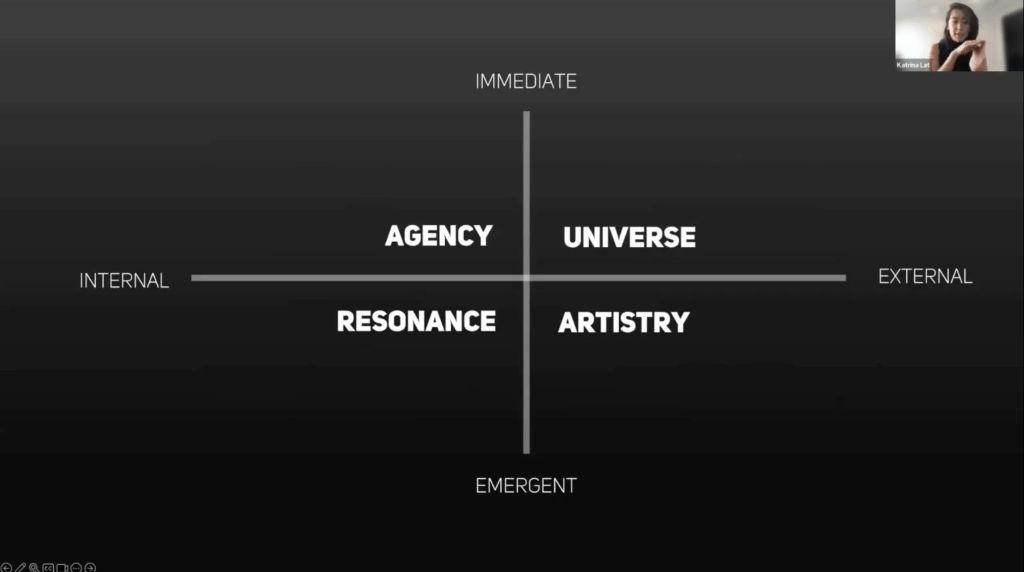
In the talk, she placed these four pillars across two axes: internal versus external, and immediate versus emergent. Agency is what the participant can do. Universe is where the work takes them. Resonance is the way it lands. Artistry is how it is made.
The practical strength of AURA is that it resists the industry’s tendency to dwell on the surface ‘hype’, instead concentrating on meaning, art, experience and meaning.
- AGENCY This pillar asks whether participant choices feel meaningful or merely procedural. It asks whether someone else could have a meaningfully different experience. It asks what role the participant occupies and whether that role is worth inhabiting.
- UNIVERSE Here, Lat’s questions were operational. Were the rules of the world clearly communicated? What promises did the experience make before it began, and were they kept? Did the participant feel physically and psychologically safe enough to stay immersed? This last question deserves more weight than it often receives. Safety is not the opposite of immersion. It is one of immersion’s preconditions. If the audience is confused, uncomfortable, unsupported or unsure of what kind of consent they have given, the world collapses. The production may still be spectacular. The experience has failed.
- RESONANCE Here is where Lat allowed the subjectivity back in got her framing. Resonance asks what the participant felt during the experience, how they feel after it, and whether the work reinforced, challenged or complicated how they see the world. It also asks whether the participant entered in the right mental and physical state. Lat joked about getting up for her first Campfire at 3:30am in her local timezone of Montreal, Canada, and about playing seven escape rooms in one day. By the seventh, even a good room might land less powerfully! This is valuable because many experience businesses still talk as if the audience arrives as a neutral receiver. They do not. They arrive hungry, tired, overstimulated, anxious, delighted, sceptical, jet-lagged, distracted, grieving, over-caffeinated, in love, or checking their phone because childcare has gone sideways. Creators cannot control all of that. But they can design with humility.
- ARTISTRY This final pillar is the craft question. Did the work feel thoughtfully and intentionally made? Did the creative choices align? Did it feel distinctive, or overly derivative?
While looking for depth, none of these questions were overly complex – and that is the point. By digging just deep enough, they are more perfect asking whether a work is “immersive enough”.
The chart that flattened the hype cycle
Once the axes were clear, Lat returned to her core thesis.
“More technology does not mean a higher level of quality.”
She plotted every experience against its technology and quality scores. Larger circles indicated more data at a given intersection. The trend line had an R-squared of 0.0013. “It is basically flat,” she said. From this, she inferred no correlation between technology and quality.
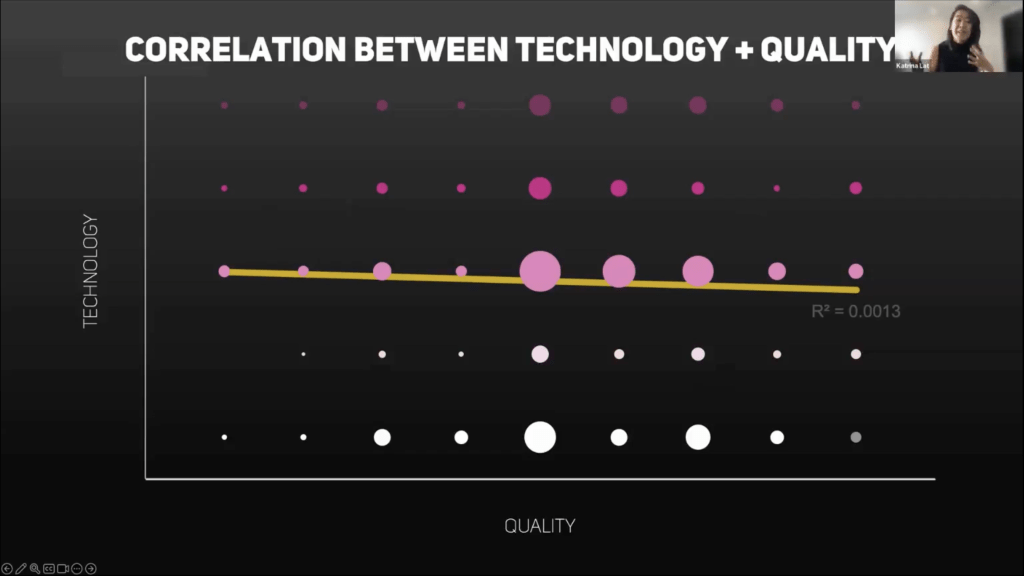
This was Lat’s most commercially useful slide in her deck. Not because it settles the argument forever – Lat was clear that her quality scores are her own – but because it gives experience leaders a proven way to challenge a costly pivot to ‘technology as saviour’. Technology may be essential. It may be beautiful. It may even be the only way an experience can exist. But it is not a proxy for quality.
In fact, Lat suggested it can become the opposite:
“Tech can actually be a risk multiplier.”
Her reasoning was simple. People forgive people more easily than they forgive broken technology. If a singer forgets a lyric mid-concert, the crowd may rally and sing along. The same for an actor who forgets their line. However if a walkabout VR headset breaks during an experience and the participant is left standing around while the tech is rebooted, frustration rises quickly.
It’s an observation that should be printed on all procurement briefs. The more technology an experience relies on, the more points of risk and failure it introduces. A glitch is not just downtime. It feels like a breach of trust.
In a mature Experience Economy, the interesting question is no longer “how much technology can we add?” It is “what burden are we taking on by asking this technology to carry?”
- If the burden is narrative, the tech MUST tell story.
- If it is operational, the tech MUST be robust.
- If it is symbolic, the tech MUST justify its presence beyond novelty.
However if it is merely decorative, that shiny technology solution you spent a lot of budget on may be making the work weaker not stronger.
Quality lives at every tech level
It’s worth stressing here Lat was not arguing for lo-fi, low-tech purity. She was explicit about this at the end: “I’m not saying don’t use technology.” Her point was simply that technology is a tool, and like every tool, “it can be used well, and it can be used poorly.”
“Quality exists at every single tech level.”
Her examples made the argument more nuanced.
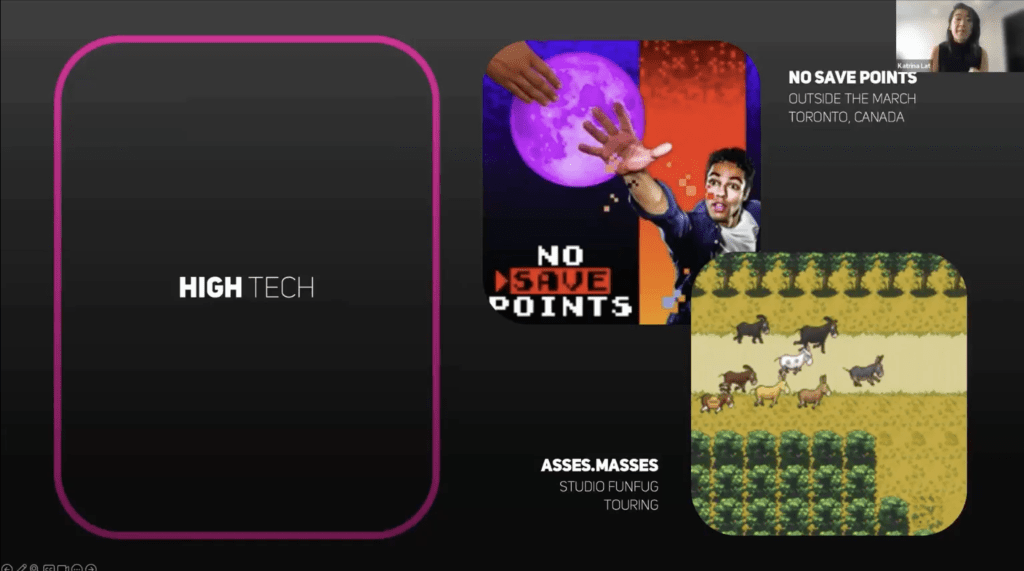
HIGH-TECH At the high-tech end, she cited videogame-forward works including No Save Points and asses.masses. The former used custom-made videogames, motion capture and haptics to tell an autobiographical story. The latter was a seven-and-a-half-hour communal video game “played as a theatre.”
In both cases, she said, the technology was absolutely vital. Without it, these experiences could not exist in the same way.
She also pointed to Body Proxy by Tender Claws and House of Shattered Prisms by Particle Ink as experiences where technology “seamlessly becomes part of the storytelling” – not just a tool, but as a genuine part of the narrative reason for the piece to exist.
Here is the pro-technology argument hidden inside this Campfire’s anti-hype premise. Technology is strongest when it is not an accessory. It is strongest when the experience would be conceptually diminished without it.
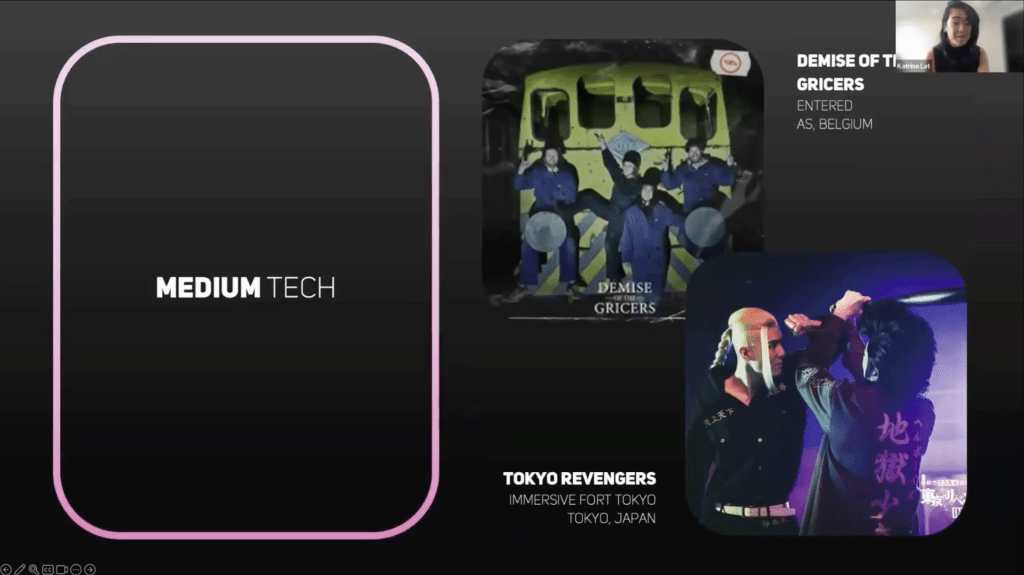
MEDIUM-TECH At the medium-tech level, Lat mentioned works where technology progressed the narrative without being core to the whole proposition. She also cited remote shows delivered over Zoom or phone, where technology functioned as a medium of distribution. Examples included Tokyo Revengers at Immersive Fort Tokyo, Candle House Collective’s Lennox Mutual and the Headlock online escape room The Keeper and the Fungus Among Us.
That distinction is useful. Sometimes technology is the engine. Sometimes it is the road. Confusing the two is where many projects get into trouble.
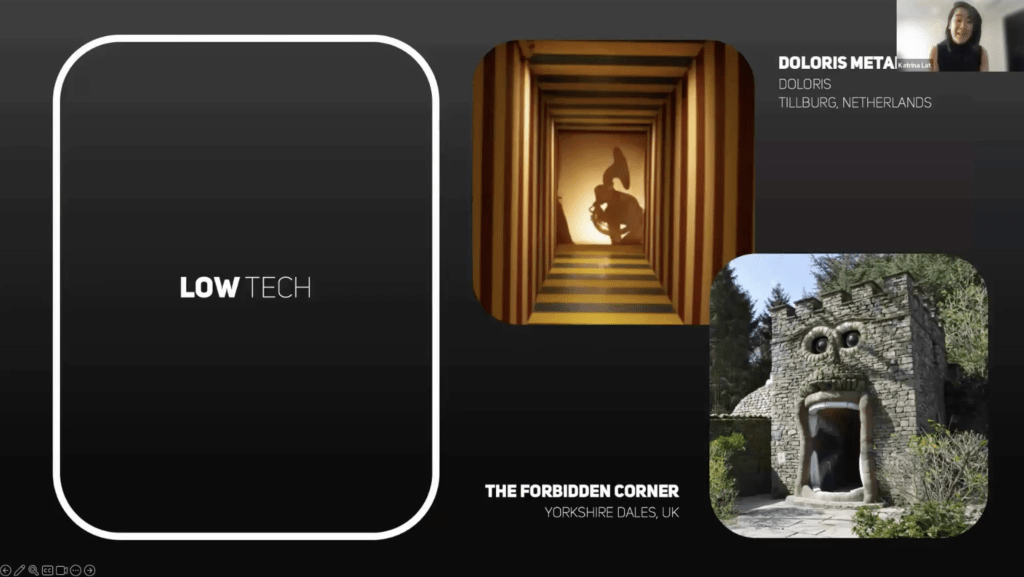
LOW-TECH At the low-tech end, Lat’s examples included Dolores Meta Maze in the Netherlands and The Forbidden Corner in the UK. Dolores, she noted, does not merely avoid making technology central; it actually removes the visitor’s technology by taking away phones and watches. The point is the art itself. The Forbidden Corner, meanwhile, is about physical space, set and setting, and the walk-through experience rather than its mobile layer.
She also cited ritual-heavy pieces such as Undersigned and Funeral, which made very little use of technology.
This is where the Campfire had its sharpest implication for the future of experiences. The next phase of the Experience Economy will not be won by the most advanced technology stack. Nor will it be won by performative rejection of technology. It will be won by better judgment.
Better judgment means knowing when technology is the experience, when it supports the experience, when it distributes the experience and when it distracts from the experience. It means defending low-tech choices when they are right. It also means defending expensive high-tech choices when they are structurally necessary.
The practical test is as brutal as it is obvious: if the tech disappeared, what would be lost?
If the answer is “the marketing angle”, be careful.
If the answer is “the story, the agency, the world, the emotional landing and the craft”, then the technology may not be an add-on at all. It may be the actual work.
What experience leaders should take from this Campfire
Lat’s talk lands at a moment when the experience sector is under pressure from two directions. Audiences expect both the new and VFM. Stakeholders expect evidence and guaranteed footfall. Technology appears to satisfy both. It promises measurable innovation, visible differentiation and future-facing language. It hints slyly at guaranteed success.
But the impressive data Lat brought to the Campfire complicates that seduction.
The most useful takeaway is not “use less tech”. It is “use tech with more accountability”.
When clients ask for technology, experience teams need better questions to interrogate any brief or brainstorm.
- What participant agency does this create?
- What rules of the world does it clarify?
- What resonance does it enable?
- What craft does it deepen?
- What new failure modes does it introduce?
- What operational burden does it place on staff?
- What happens when it breaks?
- What happens when it works perfectly but nobody cares?
The AURA framework helps because it moves the conversation away from equipment and toward experience consequences. It also gives experience teams a way to push back against technology for technology’s sake without sounding conservative, unimaginative or anti-innovation.
Lat closed by saying she hoped this data would help people in conversations with clients, creators and their own teams when deciding whether to include technology “for technology’s sake.”
That may be the real service of the session. The experience sector does not need another binary argument about high tech versus low tech. It needs a better language of fit.
Technology is not the enemy of immersion. But neither is it the guarantor of it.
Or, as Lat put it:
“Technology is a tool. And like every other tool, it can be used well, and it can be used poorly.”
For more on this topic
WXO Campfires are member-only sessions, with members also unlocking access to the organisation’s full on-demand library of Campfire recordings.
The recording, transcript and presentation from this Campfire are available to WXO members inside the membership hub.
You can check out listings for forthcoming Campfires here.
For more information on how to join the WXO, head here.