
What happens when an experience is designed not only to entertain people, but to change how they feel or function?
That was the subject of a WXO IRL Campfire hosted by Pixel Artworks in London.
WXO members joined friends, partners and invited professionals from across the experience economy to explore functional experiences: experiences designed to produce a positive human outcome, from greater calm and focus to better sleep, health, performance or connection.
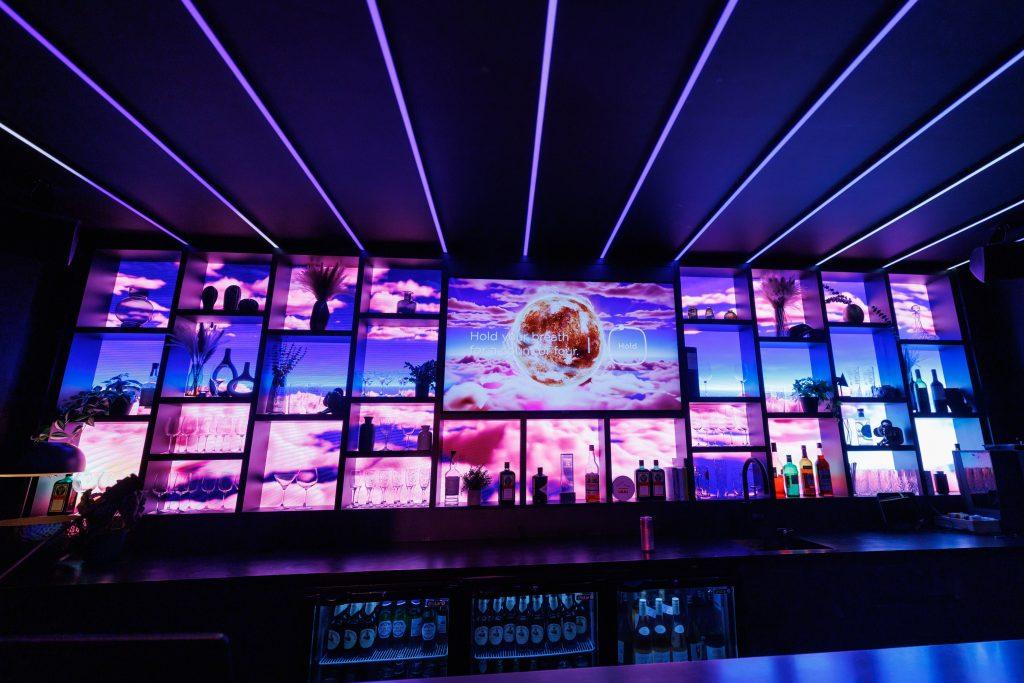
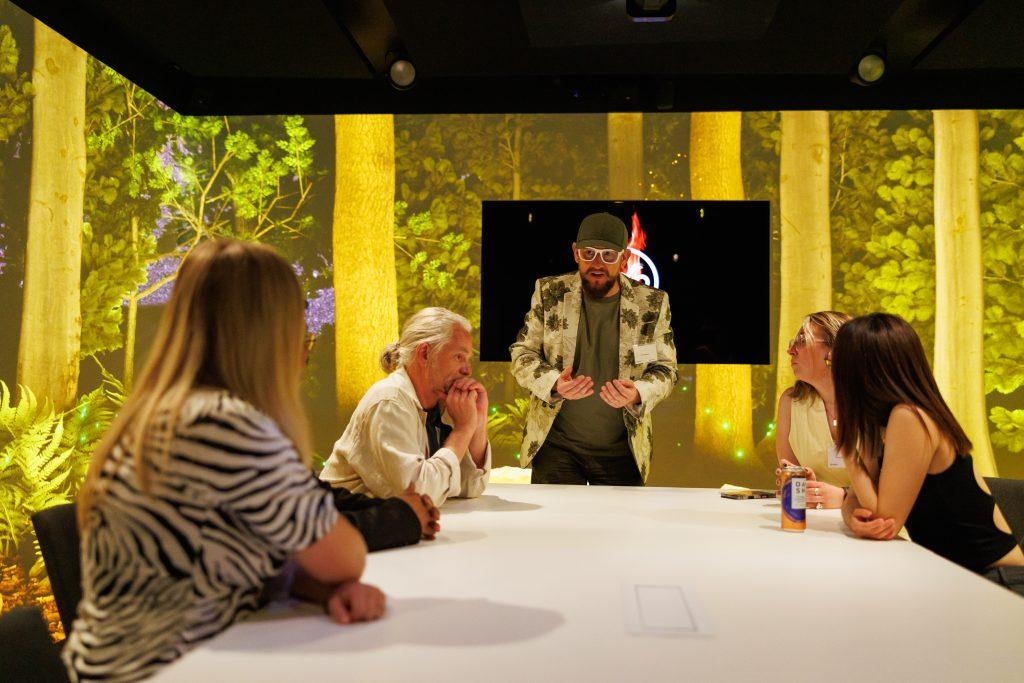
The evening began with a smaller-scale presentation of Pixel Artworks’ Room to Breathe. Through immersive visuals, sound and guided box breathing, attendees experienced the idea before discussing it.
- Mike Goldsmith, Chief Content Officer of the WXO, introduced the broader context and explained why functional experiences could represent a significant new growth area.
- Tom Middleton, founder of Senzomi, then explored how multisensory design can influence human state.
- Finally, Pixel Artworks Managing Partner Miranda Pincott used Room to Breathe to show why evidence matters – and how an experience that can prove its effect can also create new commercial opportunities.
What are functional experiences?
Simply out, functional experiences are experiences with a job to do.
They might be designed to help people relax, concentrate, recover, sleep, learn, connect or perform more effectively. They may still be beautiful, entertaining and memorable, but those are no longer the only measures of success.
The central question changes from:
Did people enjoy it?
to:
What did it do for them?
As Goldsmith put it:
“By functional experiences, we mean experiences that do more than entertain. They are experiences with a job to do.”
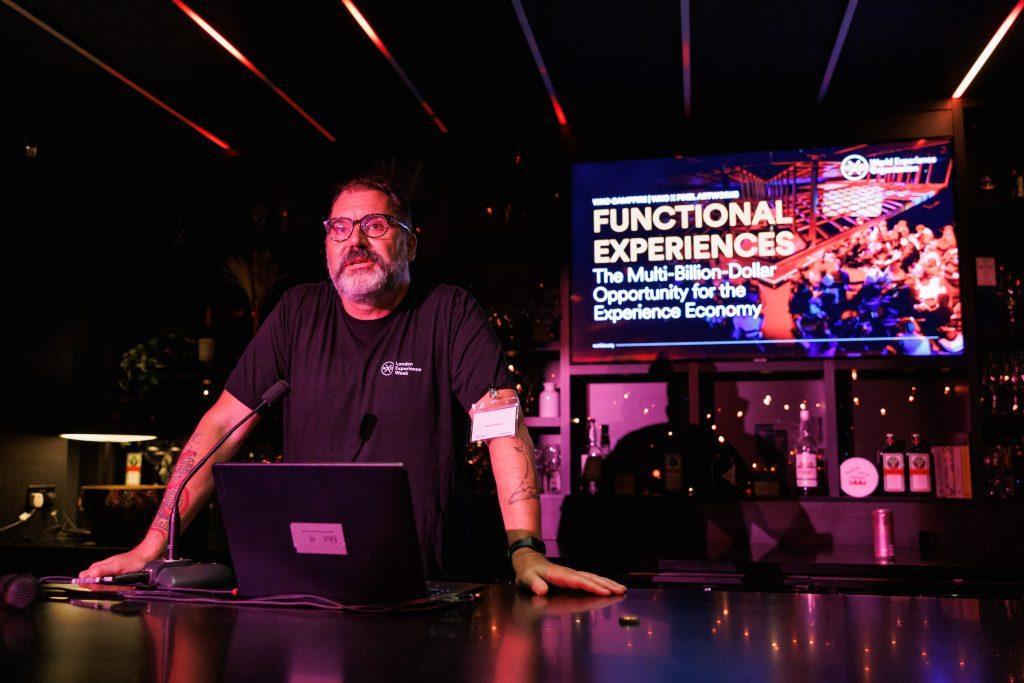
Mike Goldsmith: Why the WXO has identified functional experiences as a growth area
Goldsmith began by explaining how the WXO spots emerging trends.
The experience economy includes sectors as varied as attractions, entertainment, museums, hospitality, healthcare, retail, education and technology. These industries often use different terminology and may not think of themselves as part of the same professional community.
However, they are all designing experiences for people.
The WXO’s cross-sector position makes it possible to identify ideas that are emerging in several industries at once, and to consider how a development in one sector might be applied elsewhere.
“The Seed and the Soil”
Goldsmith described an emerging trend through the analogy of a seed landing in soil.
The seed is the innovation itself. To spread successfully, an innovation should offer a clear improvement, be easy to try, fit into people’s existing lives, produce an observable effect and be simple to explain.
The soil is the wider environment in which the innovation is introduced. It includes social change, technology, economic conditions, environmental concerns, politics, regulation, ethics, demographics, aesthetics and science.
A strong idea can struggle if the wider conditions are wrong. When both the seed and the soil are ready, an innovation has a much better chance of moving into the mainstream.
What functional experiences can learn from functional food
Functional food provides a useful parallel.
Food has always been associated with health and medicine. Herbs, mushrooms, fermented foods, broths and other ingredients have long been consumed because of their perceived effects on the body.
What has changed is the combination of traditional ideas with contemporary food science, sophisticated branding and mass distribution.
Products now promise additional protein, better hydration, improved gut health, greater focus or more energy. They are packaged as familiar, convenient products that also offer a clear additional benefit.
This is functionalism: a shift towards products and services that can demonstrate what they do for the person consuming them.
The same shift is beginning to appear in experiences.
People are already taking part in sleep retreats, cold-water swimming, social fitness, longevity tourism, sound baths and immersive wellness programmes. Education is becoming more personalised. Healthcare is moving into homes and everyday environments. Hospitality and travel are increasingly being sold around recovery, purpose and transformation.
All of these developments require experience design.
They involve the audience, environment, sequence, sensory stimuli, social dynamics and emotional journey.
Why the conditions are right
Goldsmith highlighted several trends supporting the growth of functional experiences.
People increasingly value experiences over possessions. Technology makes it easier to create responsive and personalised environments. Mental health has become a mainstream concern. Interest in neuroaesthetics is increasing awareness of how art, light, sound and space can affect the body and brain.
At the same time, organisations are under pressure to demonstrate value. Brands, employers, developers and public bodies increasingly want experiences to deliver more than attention or footfall.
This does not mean that every functional experience must be a wellness installation.
A functional experience might improve learning, confidence, creativity, recovery, relationships or cultural understanding. The defining feature is that it is designed around an intended human outcome.
Goldsmith pointed to examples including Chromasonic, which uses light, colour, sound and vibration to shift perception; Submersive, which combines bathing, immersive art and wellbeing; Dreamachine, where light generates vivid internal experiences; and Time Echoes, Middleton’s spatial listening experience.
The WXO’s conclusion was simple:
“The soil is ready. Go plant some seeds.”
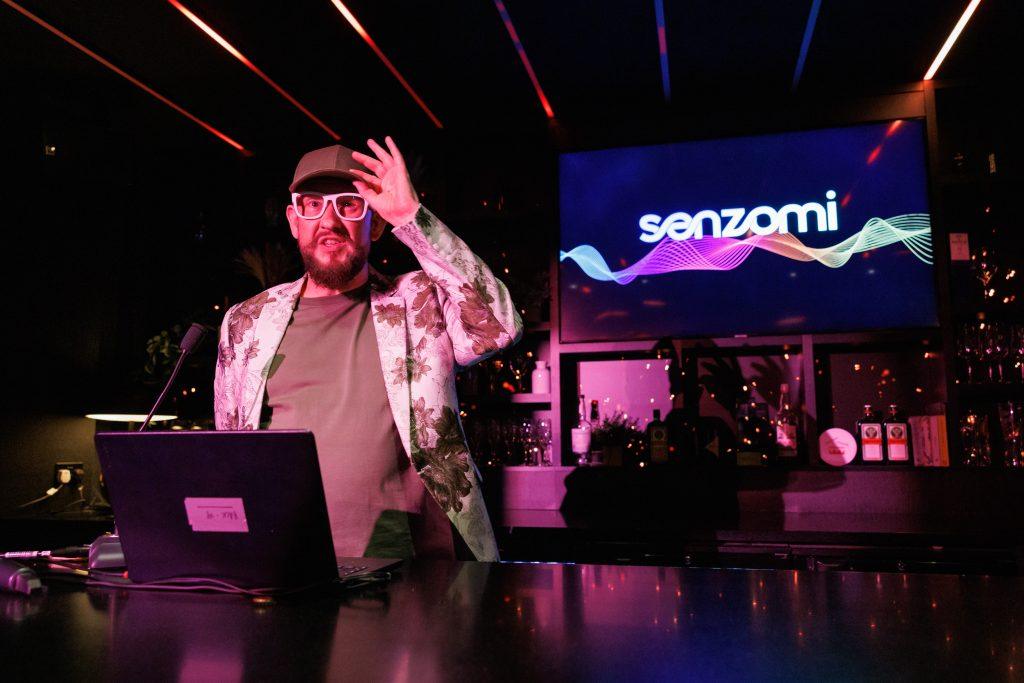
Tom Middleton: From memorable moments to meaningful outcomes
Tom Middleton moved the discussion from the wider trend to the practice of multisensory experience design.
Middleton has spent more than three decades exploring how sound, sensory design and technology influence human experience. His work has crossed music, entertainment, sleep, hospitality, mobility, health and immersive environments.
His interest in functional experiences began before the term existed.
After the release of Middleton’s Global Communication album 76:14 in 1994, listeners reported using the music during counselling, recovery, childbirth, palliative care and end-of-life care.
The response led Middleton to ask whether experiences could be intentionally designed to improve people’s lives.
He later created music and audio for defined outcomes including sleep, focus, relaxation, stress reduction, pain management and creative flow.
But Middleton’s argument extended beyond sound.
Designing a sensory system
People do not experience the world through five separate sensory channels.
Human state is shaped by the interaction of sound, light, scent, temperature, vibration, movement, balance, bodily awareness and the surrounding environment.
Senzomi therefore approaches multisensory design as a coordinated system. Sound, light, visual atmosphere, vibration and scent should not be treated as disconnected effects. They can work together to influence how a person’s body and nervous system respond.
This changes the role of sensory design.
- Sound is no longer simply a soundtrack.
- Light is not simply decoration.
- Vibration is not only a way to increase spectacle.
Each can contribute to a specific intended outcome.
The next stage of the experience economy
Middleton described this as a move from memorable moments to meaningful outcomes.
The experience economy has become highly effective at attracting attention, encouraging participation and creating immersion.
The next question is what happens after immersion.
“What if the next frontier isn’t attention, engagement or immersion? What if it’s outcomes?”
Instead of asking only whether people enjoyed an experience, organisations can ask whether it helped them.
- Did it improve recovery?
- Did it reduce stress?
- Did it increase focus?
- Did it support learning or connection?
This does not remove the importance of creativity or entertainment. It gives the creative work a clearer purpose.
One human operating system
Middleton argued that functional experience design applies across industries.
- A hotel might design a room to support better sleep.
- A workplace could create environments that strengthen trust and concentration.
- A vehicle could use sound and vibration to improve comfort.
- A healthcare setting might reduce patient anxiety.
- A school could design for attention and retention.
The industries are different, but the people entering those environments share the same nervous system.
Middleton’s examples included immersive recovery pods, sleep rituals developed for Equinox Hotels, spatial audio experiences, large-scale sound baths and vibroacoustic vehicle seating.
In each case, sensory design was being used to affect physiology, emotion, perception or behaviour—not simply to make the experience look or sound more impressive.
His own Time Echoes brings audiences into a 360-degree spatial-audio environment designed to encourage presence, reflection and connection.
It does not fit neatly into the categories of concert, wellness session or immersive attraction. That is part of the opportunity: functional experiences may produce new formats that sit between existing sectors.
Middleton ended by reminding the audience that all experiences affect the people taking part, whether their creators intend them to or not.
“Every experience leaves an imprint. It can calm or overstimulate. Connect or isolate. Restore or deplete.”
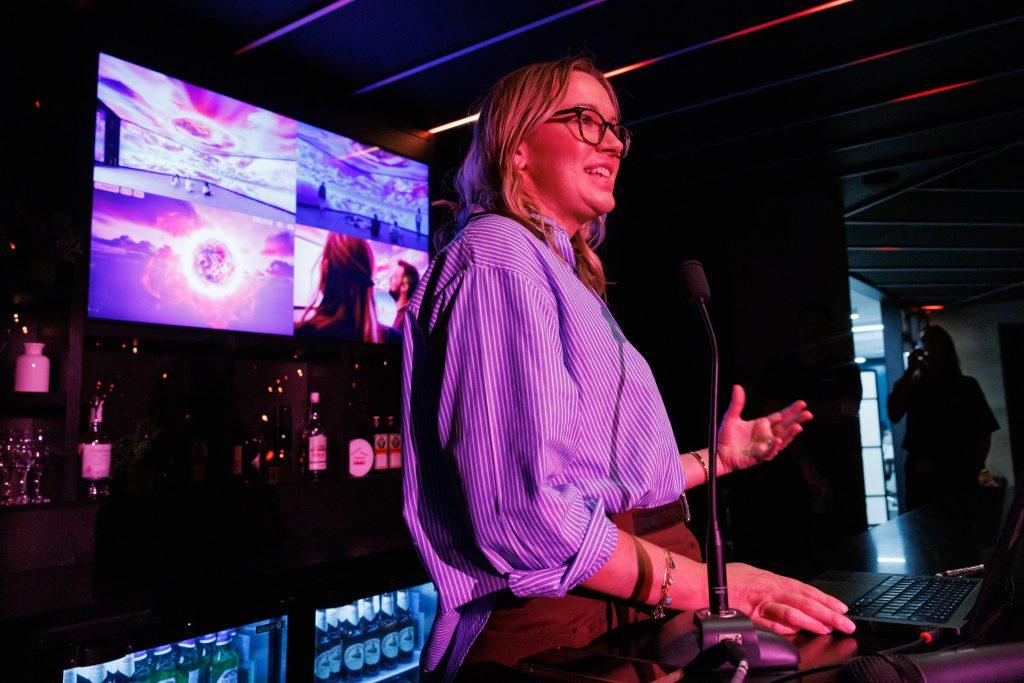
Miranda Pincott: proving that an experience works
Miranda Pincott brought the evening’s ideas back to Room to Breathe and the commercial value of evidence.
Pixel Artworks has built its reputation through large-scale digital and immersive work. Many client briefs begin with a request to create something visually impressive, memorable and shareable.
Functional experiences add a harder requirement.
“Functional experiences aren’t about what people remember after the experience, but rather what happens to their nervous system in the moment.”
The brief must identify the intended change in human state—and establish how that change will be tested.
Designing Room to Breathe
Room to Breathe was designed to create a moment of calm in central London.
The original Outernet installation used immersive screens, sound and a four-second rhythm to guide visitors through box breathing. Rolling clouds, ethereal skies and an expanding and contracting sun encouraged people to slow their breathing.
A soundtrack developed from acoustic piano into organic synthesised tones, helping to reduce the pace of the environment.
Visitors could begin by consciously following instructions. As the experience continued, they could let go of the interface and simply breathe with the room.
The paradox of control
The central design decision was to give visitors a simple task.
Working with trauma and anxiety consultant Jayne Cox, the team used counting and breathing to interrupt the anxious brain’s threat loop.
Anxiety can cause the brain to scan constantly for danger and catastrophise. A counting task gives it something specific to do.
It also changes the participant’s role. Rather than being a passive recipient of the installation, the visitor becomes an active agent.
That sense of control can help the nervous system read the situation as safer.
The breathing task and the sensory environment therefore work together. The visuals and sound create the conditions for calm, while the task gives visitors a practical route into that state.
From feeling to evidence
The team did not want to stop at anecdotal reports that the experience felt relaxing.
They took Room to Breathe into laboratory testing.
Eighty-four per cent of participants said the experience helped them unwind and destress. Around half showed clear signs that their nervous systems were calming down, and 69% said they were likely to revisit.
The experience was not only creating an attractive environment. The evidence suggested that it was producing the intended effect.
That distinction opened up a commercial opportunity.
Why proof created commercial value
Room to Breathe began as a self-funded original experience.
After it appeared on national television, Panadol recognised a connection between the experience and its brand purpose. Breathing exercises can provide people with something practical to do while waiting for pain relief to take effect.
That connection led to a sponsorship and licensing partnership.
The partnership gave the project more reach, a longer lifespan and a revenue stream. It also demonstrated how a brand could invest directly in a functional experience rather than simply placing advertising around one.
Pincott argued that similar opportunities exist across the market.
Developers could use functional experiences to improve public spaces and distinguish new districts. Employers could commission environments designed to support concentration, trust or workplace culture. Transport operators could test how screens, sound and digital content affect passenger stress.
For brands, the experience itself can become the investment rather than an addition to a conventional media campaign.
The harder brief: functional design in public space
The most difficult challenge comes when people have not chosen to enter an experience.
Visitors opt into a gallery, attraction or wellness installation. They do not necessarily opt into the screens, sounds and information surrounding them in a station, shopping centre or public space.
Pixel Artworks has been exploring this challenge with a major transport operator at PEARL, a research facility where streets, tunnels and stations can be constructed at full scale.
The team has been prototyping an LED tunnel and studying not only how its content looks, but how it affects stress, comfort and attention as different people move through it.
For Pincott, this is where functional experience design begins to mature.
It requires creators to move beyond making something beautiful and hoping it has a positive effect. They must identify the change they intend to create and then test whether they achieved it.
From an emerging trend to a practical opportunity
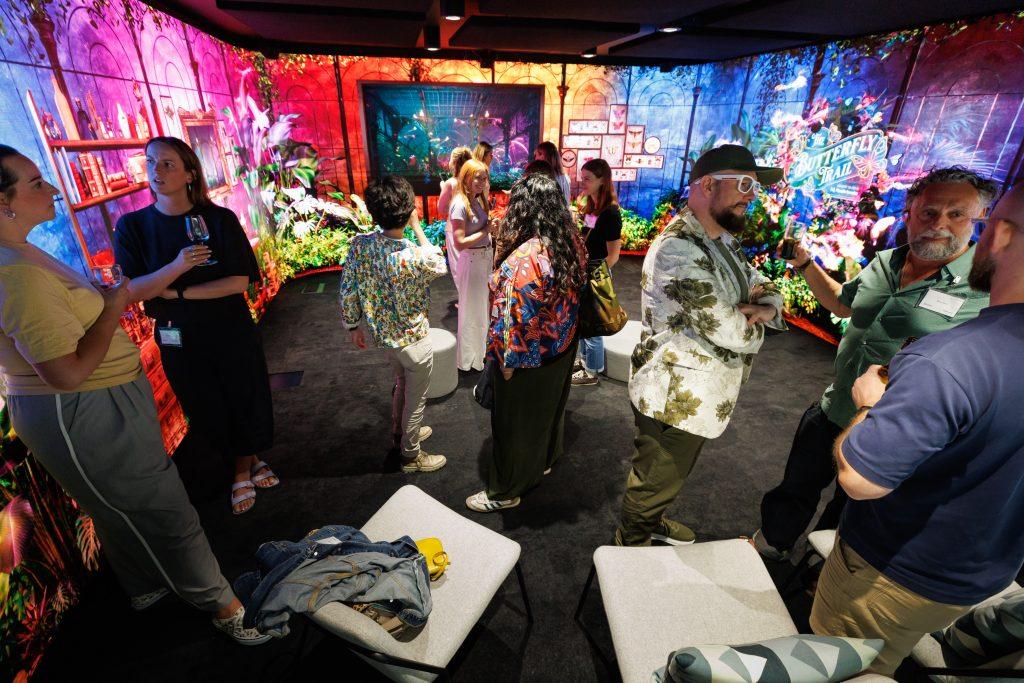
Following the presentations, attendees formed discussion groups to identify the most promising opportunities for functional experiences and consider what an ideal example might look like.
The discussion reinforced the breadth of the category.
Functional experiences could be applied to health, workplaces, education, public space, mobility, entertainment, hospitality and relationships. They could reduce stress, but they could also build confidence, support learning, strengthen connections or encourage cultural understanding.
The strongest opportunities will begin with three clear questions:
- What change are we trying to create?
- How will the experience produce that change?
- How will we know whether it worked?
The commercial case follows from those answers.
An experience that can demonstrate a useful outcome offers more than a temporary attraction. It can provide lasting value for audiences, brands, employers, developers and public organisations.
That may be the real opportunity presented by functional experiences: not bigger spectacles, but better outcomes.
About WXO IRL Campfires
WXO IRL Campfires are a series of in-person meet-ups that translate the World Experience Organization’s popular digital gatherings into live events.
Hosted by WXO friends and partners, IRL Campfires combine expert speakers with guided discussion and networking.
Previous IRL Campfires have taken place in Amsterdam, Los Angeles and London. The next IRL Campfire will take place at Bompas & Parr this October.
Spaces are limited and shared between WXO members and non-members. Keep an eye on the WXO website for details.