
Functional experiences begin with a clear human outcome – then use sensory design, technology and evidence to help achieve it.
No surprises – the experience economy has become very good at capturing attention.
It can attract an audience, stimulate the senses and create a moment people truly remember.
But attention is an activity, not an outcome – and, unless it’s designed well, the outcome that comes along with all that attention isn’t always a desirable one.
- An experience can be engaging while leaving people exhausted.
- It can be memorable because it created anxiety.
- It can achieve high dwell time without improving anything that actually matters to the participant.
Summary: every experience changes human state in some way.
And if that’s the case…
What change are we trying to create?
This Experience Briefing draws on a WXO Campfire with Tom Middleton and distils its most useful ideas for experience leaders.
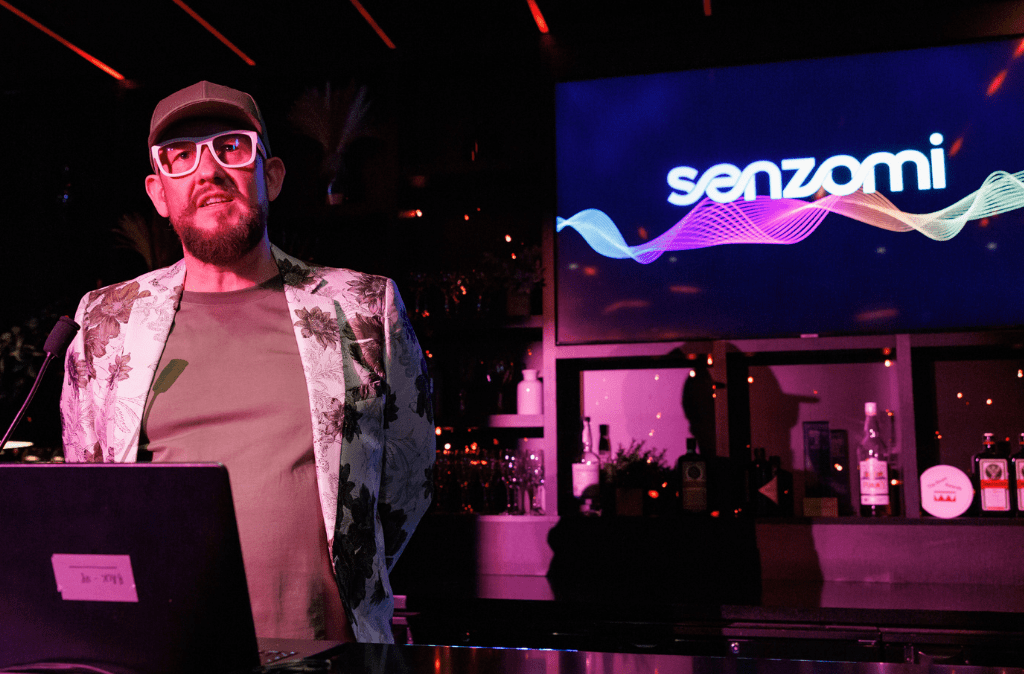
Tom Middleton is the founder of Senzomi, an award-winning composer, sensory designer and creative director working across science, technology, design and human experience. His work spans hospitality, mobility, wellness, entertainment and immersive environments.
Middleton describes an emerging category of functional experiences: experiences intentionally designed not only to entertain or engage, but to support positive, human-centred outcomes such as calm, sleep, recovery, focus, connection, joy or meaning.
The opportunity is not to turn every attraction, event or installation into a health intervention.
It is to recognise that experience design already affects how people feel and behave, then become more deliberate about the result.
“Experiences shape how we feel, and how we feel shapes what we do.”
– Tom Middleton
1. Begin with a human need, not a technology
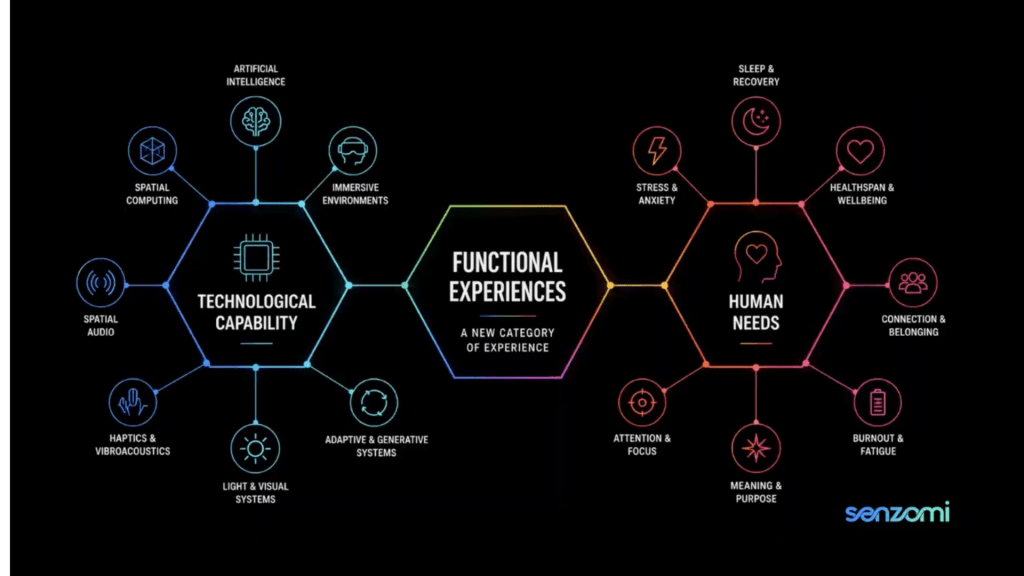
Functional experiences emerge where two forces meet:
- growing technological capability
- persistent human needs
The available tools include artificial intelligence, immersive environments, spatial audio, haptics, biosensors, wearables, responsive systems, light and visual technology.
The human challenges include:
- stress and anxiety
- poor sleep and recovery
- burnout and fatigue
- isolation
- lack of focus
- reduced sense of meaning or purpose
Technology creates the possibilities, but it’s the human need that should determine which possibilities matter.
A brief that starts with “How can we use AI?” or “How can we add haptics?” makes the tool the objective.
A functional brief starts with a person:
- What are they struggling with?
- What do they need to feel or do differently?
- Which part of the experience could support that change?
- Is an experience the right intervention?
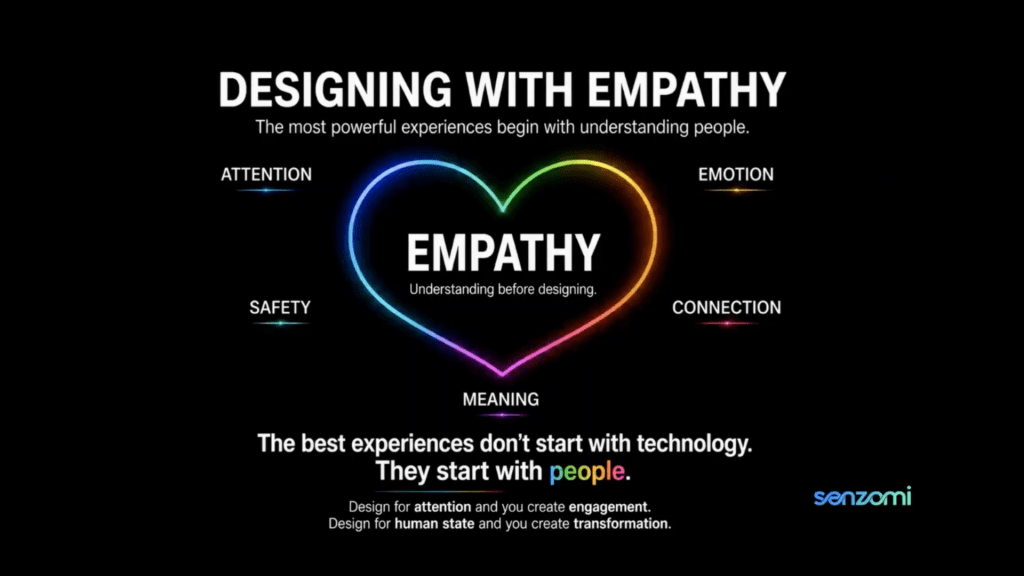
“The best experiences don’t start with technology, they start with people.”
– Tom Middleton
Case study: sound for sleep
Middleton’s early work in electronic music as Global Communication – specifically the 1994 album 76:14 – produced unexpected reports from listeners who used it for relaxation, counselling and other personal purposes.
The important lesson was not that one album could provide a universal health intervention.
It was that music designed for emotional depth was already being used functionally.
Later sleep projects including Spatial Sleep Music and Calm made the intended outcome explicit. Sound, pulse, warm light and automatic fade-outs were designed around the period before sleep rather than around conventional measures such as attention or completion.
The outcome came first.
The technology followed.
2. Define the state change before designing the experience
“Make people feel better” is too vague to guide design.
Functional experiences need a more precise destination.
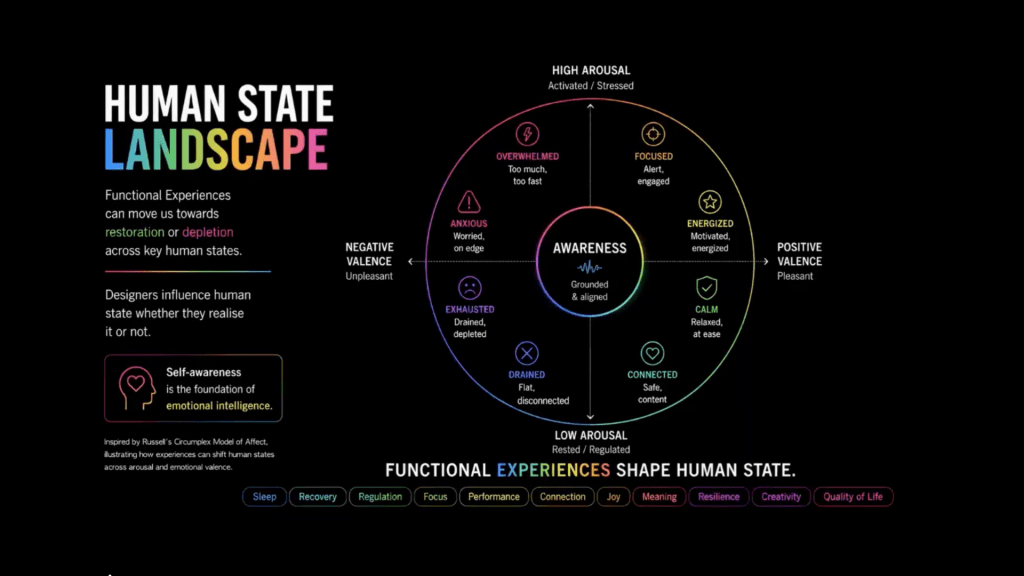
Middleton uses a version of the circumplex model of affect to map emotional states across two dimensions:
- Arousal: from low activation to high activation
- Valence: from unpleasant to pleasant
The circumplex model is widely used to understand emotional states through these two underlying dimensions.
This allows designers to ask where participants begin and where the experience should take them.
A functional experience might move somebody:
- from high arousal and negative feeling towards calm
- from low energy towards alertness
- from isolation towards connection
- from distraction towards focus
- from tension towards safety
Not every useful journey moves directly towards calm.
Examples: A horror experience may intentionally create anxiety before resolving it. A performance experience may raise energy before helping participants return to equilibrium.
The important point is intentionality.
Arousal should not be maximised simply because high stimulation looks impressive.
The required state should determine the design.
Case study: Jaguar Land Rover
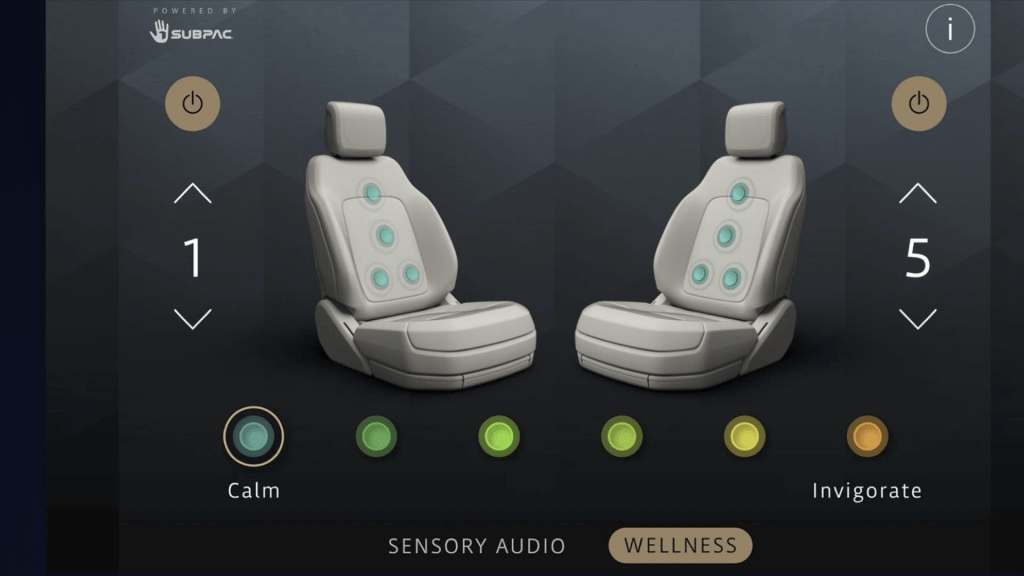
For work with Jaguar Land Rover, sound and vibroacoustic design were explored around two different driving needs.
A stressed or angry driver may benefit from down-regulation towards a calmer state.
A tired driver may need greater alertness and focused attention.
The same sensory tools should not be used in the same way for both people.
The required state change determines the sound, vibration and intensity.
Case study: Equinox Hotels
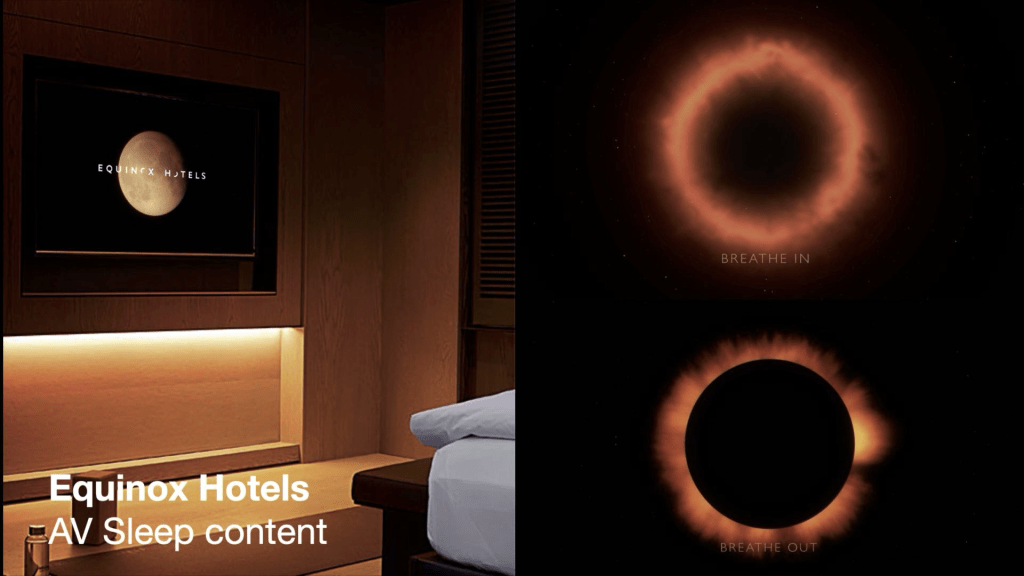
A hotel guest may arrive tired but remain alert because an unfamiliar room creates uncertainty.
This “first-night effect”, in which sleep can be disrupted in a novel environment, is recognised in sleep research.
For Equinox Hotels, the design problem was therefore not simply to create a pleasant room. It was to help guests move from vigilance towards readiness for sleep.
Breathing cues, sound and an ember-like glow on the room screen provided a simple transition. The light and sound then faded without requiring the guest to get up and switch anything off.
The experience addressed a defined state change rather than adding a generic wellness layer.
3. Design through body, context, action and connection
Functional experience design cannot be reduced to content delivered through a screen or speaker.
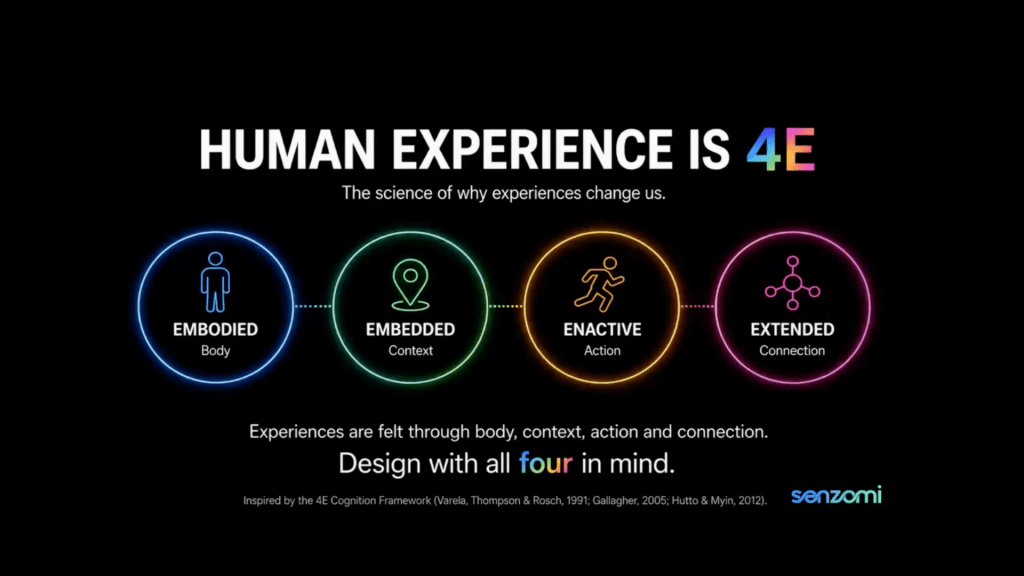
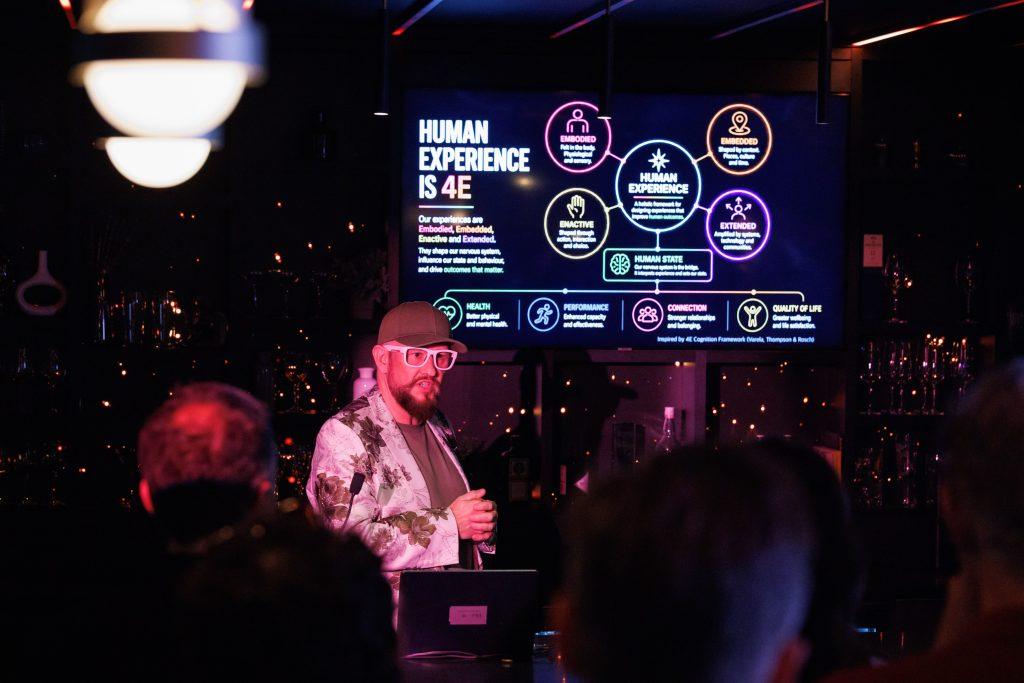
Middleton uses the 4E approach to cognition as a reminder that human experience is shaped through the body, environment, action and relationships.
The established 4E model describes cognition as embodied, embedded, enactive and extended.
For experience designers, that can be translated into four practical questions.
(i) Body
What is happening physically?
Consider posture, breathing, movement, balance, vibration, temperature and internal sensation.
(ii) Context
How does the environment affect the outcome?
Consider spatial layout, light, noise, privacy, social expectations and the transition into the experience.
(iii) Action
What does the participant do?
Consider whether the intended action helps create the state change rather than merely filling time.
(iv) Connection
How do other people influence the outcome?
Consider belonging, trust, collective behaviour, facilitation and shared emotional experience.
A good functional experience engages more than one of these dimensions and ensures they support the same outcome.
Case study: Regenesis Pod
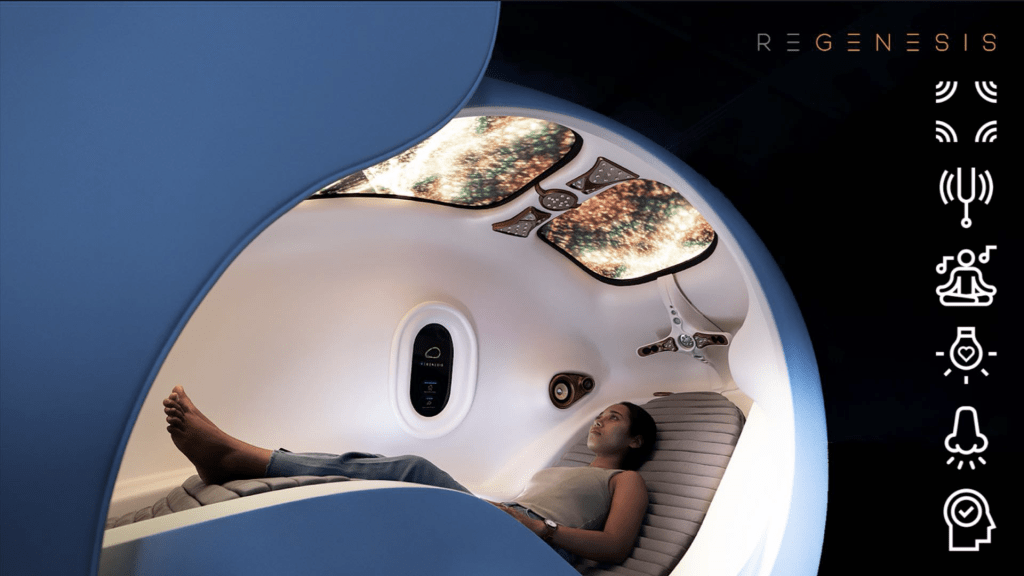
Famously used by tennis star Novak Djokovic, the Regenesis Pod combines light, flicker, sound, vibration and scent around journeys intended to support restoration, recovery and deep relaxation.
The value is not the number of sensory technologies.
It is their congruence.
If the sound signals calm while the lighting creates overstimulation, the experience works against itself. Every element needs to support the intended journey.
Case study: 15 Ton Sound Bath
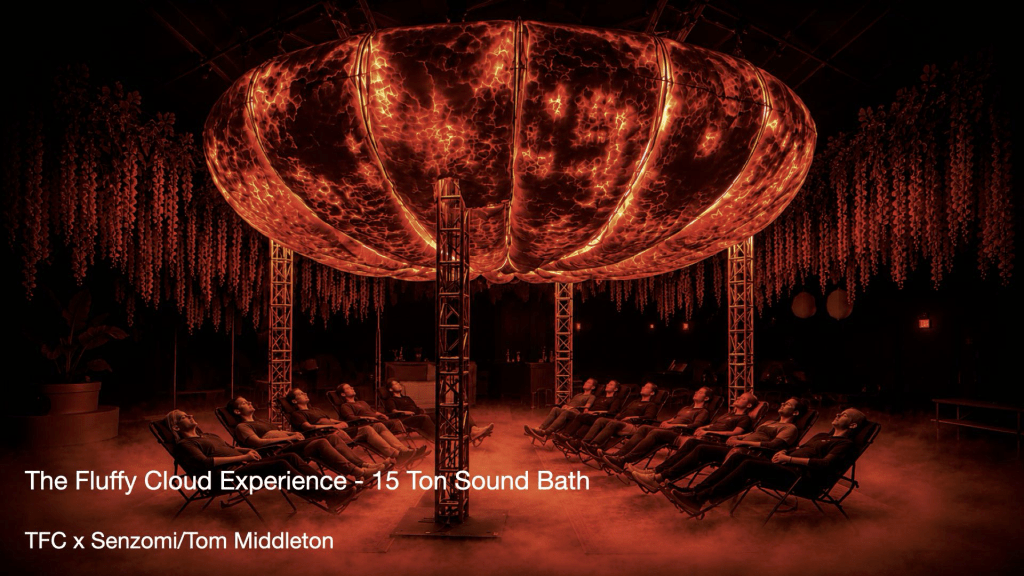
The 15 Ton Sound Bath combines a large-scale sound system with light, scent and other sensory inputs.
Its design demonstrates both the potential and the difficulty of multisensory work.
Adding more senses does not automatically increase value. Each input needs a plausible role, appropriate evidence and a clear relationship to the intended state.
The aim is coherence, not sensory volume or overload.
4. Use sensory design to perform a specific job
Sound, light, touch, scent and temperature can all affect how an environment feels.
But a sensory input becomes useful only when it has a defined job.
That job might be to:
- slow breathing
- support alertness
- reduce distraction
- create a sense of safety
- help somebody become present
- guide movement through a space
- connect different stages of a journey
This is different from adding sensory effects because they make the experience feel more immersive.
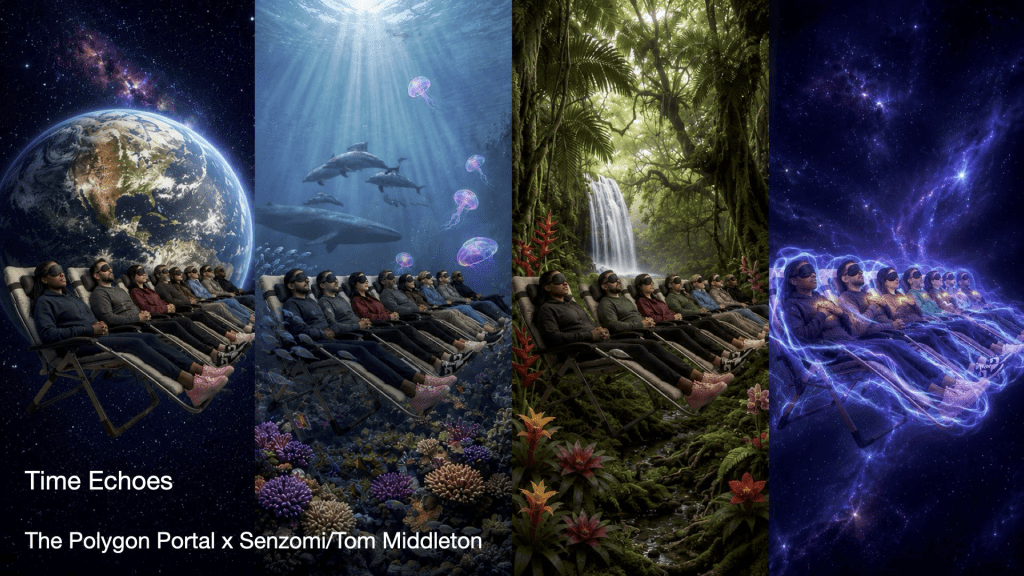
Case study: Time Echoes
Middleton’s Time Echoes uses spatial sound, reclining positions, eye masks and sub-bass vibration to take participants through a journey built around cosmic and environmental sound.
NASA data, natural systems, breathwork and low-frequency sound create a journey that cannot be reduced to a conventional soundtrack.
The environment uses sound as the primary experience rather than as background accompaniment.
The participant’s posture, reduced visual input and proximity to the sound system all affect how the work is received.
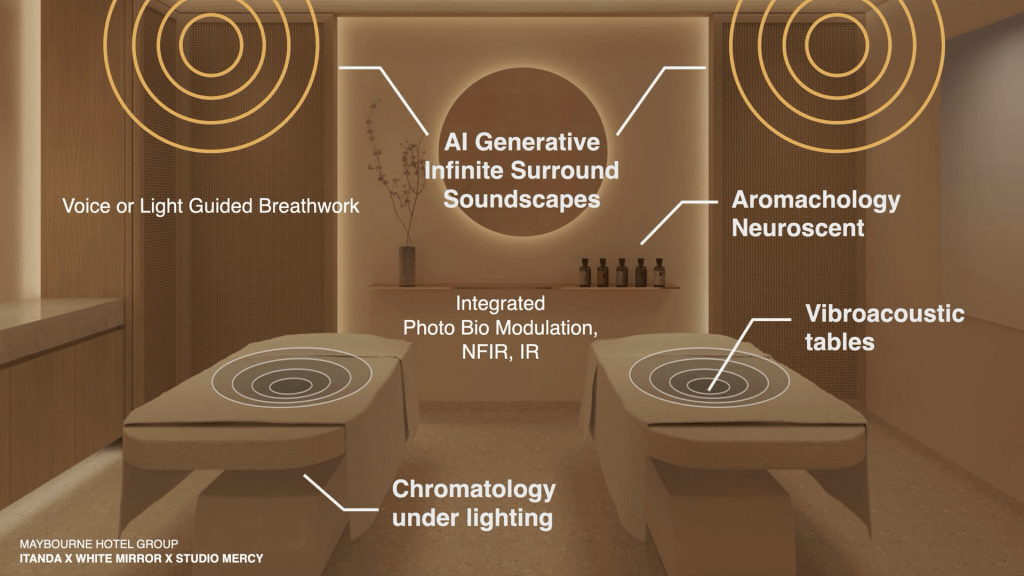
Case study: Maybourne Group
For the Maybourne Group, generative soundscapes were mapped to the energy, mood and intended outcome of different treatments.
Sound, lighting and vibroacoustic surfaces could be adjusted according to the stage of the journey.
This is a useful model for multisensory design:
Do not create one atmosphere and repeat it everywhere.
The intended state may change as people move through an experience. Sensory design can support that progression.
5. Treat every functional claim as a hypothesis
A functional experience makes a stronger promise than an entertaining one.
If a team claims an experience reduces stress, improves sleep or supports focus, it needs evidence appropriate to that claim.
Testing might combine:
- participant self-report
- observation
- breathing patterns
- heart rate or heart-rate variability
- skin temperature
- brain-activity measures
- behaviour after the experience
- repeat use or longer-term follow-up
The aim is not to collect every possible measure.
It is to identify the simplest credible evidence that can show whether the intended change occurred.
A small research lab can help teams test, iterate and refine a hypothesis before investing in a much larger deployment.
It can also reveal that an idea does not work.
That is useful evidence.
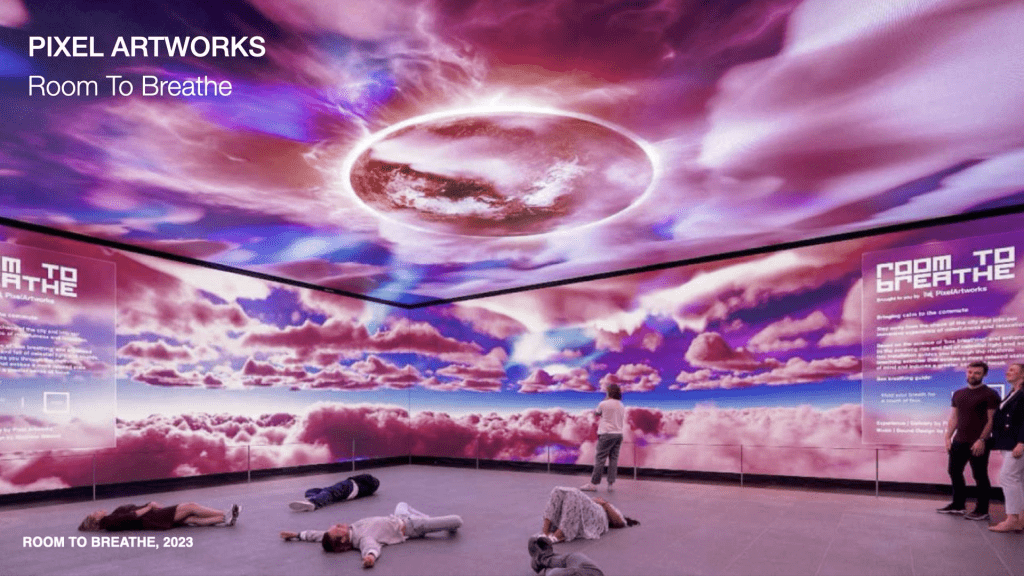
Case study: Room to Breathe
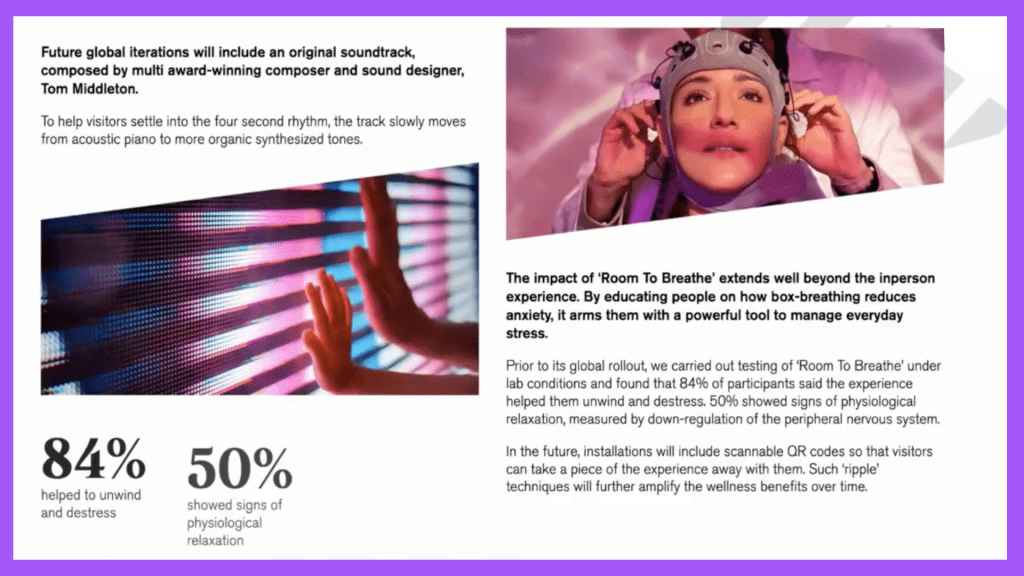
Pixel Artworks’ Room to Breathe teaches a four-count breathing technique through a large oscillating visual form and a synchronised soundscape.
The experience had a clear hypothesis: that visual and audio cues could help people regulate their breathing and relax.
In lab testing, 84% of participants said the experience helped them unwind and de-stress. Half showed signs of physiological relaxation.
These results are more useful than claiming the installation was calming because it ‘looked peaceful’.
They connect the design intent to participant evidence.
The data should still be interpreted within the limits of the test. It does not prove that every participant will experience the same benefit or that the installation is a medical treatment.
It demonstrates a credible, testable effect.
6. Use six principles to keep functional design responsible
Designing for human state creates ethical responsibilities.
An experience that can calm, stimulate, influence attention or shape behaviour can also manipulate, overwhelm or exclude.
Middleton proposes six principles for responsible functional experience design.
1. Design with empathy
Begin with the person’s real situation rather than the outcome the organisation wants to impose.
Understand their needs, anxieties, context and limits.
2. Consider diversity
People do not experience sound, light, crowds, touch or stimulation in the same way.
Design for differences in mind, body, culture and ability.
3. Do no harm
Avoid manipulation, addiction, fatigue, overload and unintended consequences.
Functional intent does not justify removing participant control.
4. Be inclusive by design
Make the experience accessible and welcoming from the outset rather than treating inclusion as a later adaptation.
5. Create collective resonance
Consider connection, belonging and shared human experience alongside individual outcomes.
The most useful result may occur between participants rather than inside one person.
6. Design sustainably
Human flourishing should not come at the cost of environmental wellbeing.
A functional experience needs to consider the wider system in which it operates.
These principles should not appear only in an ethics statement.
They should change the brief, design decisions, testing and operating model.
A practical functional-experience sequence
The research suggests a straightforward process.
1. Define the human need
What problem, frustration or opportunity are you addressing?
2. Name the intended outcome
Should participants become calmer, more alert, connected, focused or capable?
3. Map the state change
Where are they likely to begin, and where should the experience help them move?
4. Design through the 4Es
How will body, context, action and connection support the outcome?
5. Select the inputs
Which combinations of sound, light, touch, scent, space, facilitation or technology are justified?
6. Decide what evidence matters
What is the simplest credible way to test whether the change occurred?
7. Apply the responsible-design principles
Is the experience empathetic, inclusive, safe, socially valuable and sustainable?
The process is simple by design.
Its value comes from forcing teams to define what the experience is actually for.
The bigger lesson
Functional experience design does not reject engagement, entertainment or memorable moments.
It asks what they lead to.
A spectacular experience may still be the right answer. But spectacle becomes a means rather than the objective.
- A wellness experience may look quiet and minimal.
- A performance experience may create excitement.
- A workplace experience may improve focus.
- A hospitality experience may support sleep.
- An attraction may strengthen social connection.
The formats are different.
The design question is the same:
How should people be better because this experience happened?
Business outcomes can follow human outcomes.
- A hotel that helps guests sleep may improve satisfaction and loyalty.
- A transport experience that reduces stress may improve brand perception.
- A public installation that teaches a useful breathing technique may create value beyond the time spent inside it.
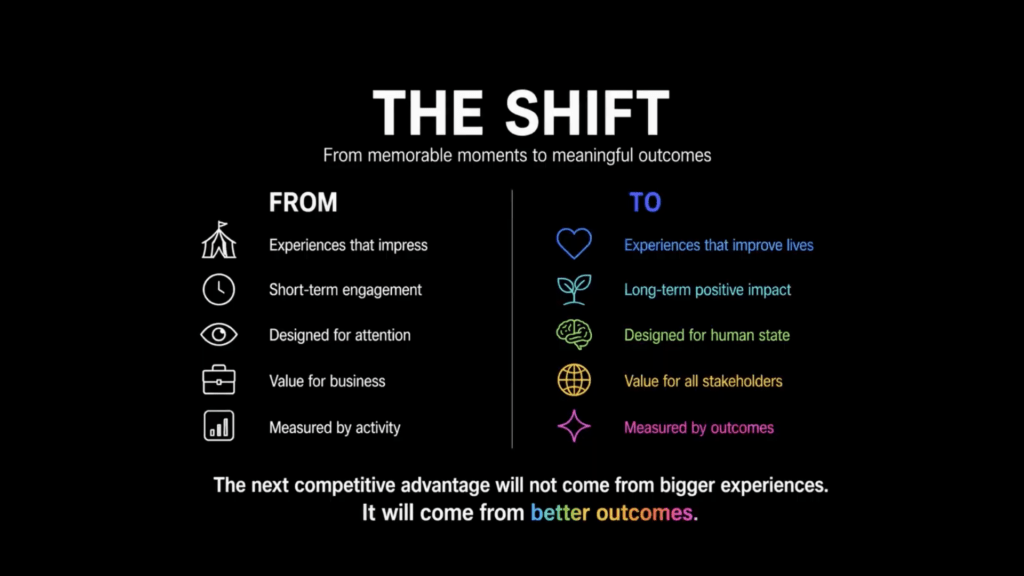
This is the shift from measuring activity to measuring outcomes.
“Design for attention, and you create engagement. But when you design for human state, you create transformation.”
– Tom Middleton
The ambition should be matched by discipline.
Not every experience needs to improve health. Not every state change can be proven through biometrics. Not every sensory intervention will work for every person.
But every experience designer can become more intentional about the state they create.
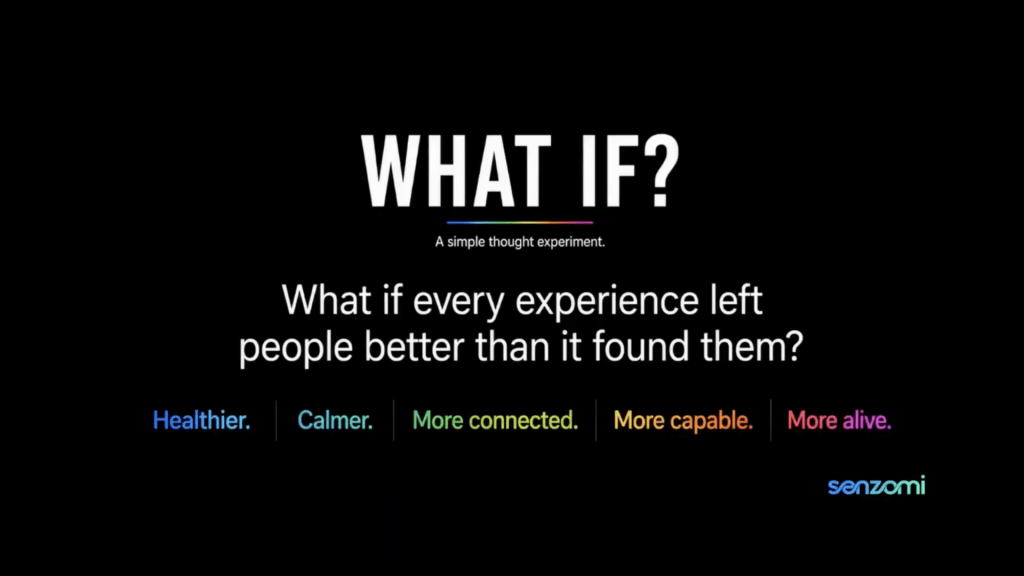
“What if every experience left people better than it found them?”
– Tom Middleton
What to ask in your next meeting
- What human need is this experience addressing?
- How should people feel or function differently afterwards?
- What state change are we trying to create?
- How do body, context, action and connection support it?
- Which sensory or technological choices have a clear job?
- What evidence will tell us whether the experience worked?
- Could the design manipulate, overload or exclude anyone?
- What useful effect can continue after the participant leaves?
The question to take into the room is:
Are we designing something that captures attention… Or something that improves what happens next?
For more Experience Briefings, head here.
For more information on how to join the WXO, head here.