
ARGnet’s Michael Andersen on how A24 turned internet folklore into an experiential campaign of the box office smash.
Speaker: Michael Andersen
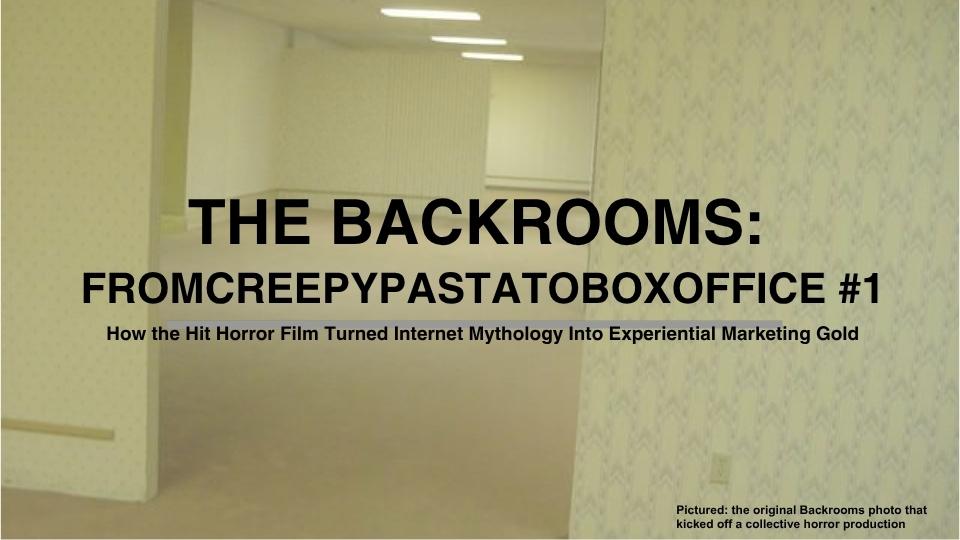
Campfire: Backrooms: From Creepypasta To Box Office #1 — How The Hit Horror Film Turned Internet Mythology Into Experiential Marketing Gold
Date: 10 June 2026
Format: Case study
Core question: How did The Backrooms turn internet mythology into experiential marketing – and what can experience designers learn from it?
Intro: Welcome to the Backrooms…
On Tuesday 10 June, WXO members gathered around the WXO Campfire for Michael Andersen’s Backrooms: From Creepypasta To Box Office #1. The session was nominally about a horror film’s buzzy marketing campaign. In practice, it was about something bigger: how stories move when audiences are treated as investigators rather than consumers.
The original listing for this Campfire asked a smart question: ‘What happens when a piece of community-created internet folklore becomes the number one film in America?‘
The short answer: it becomes a useful case study for anyone building experiences, communities, launches or worlds.
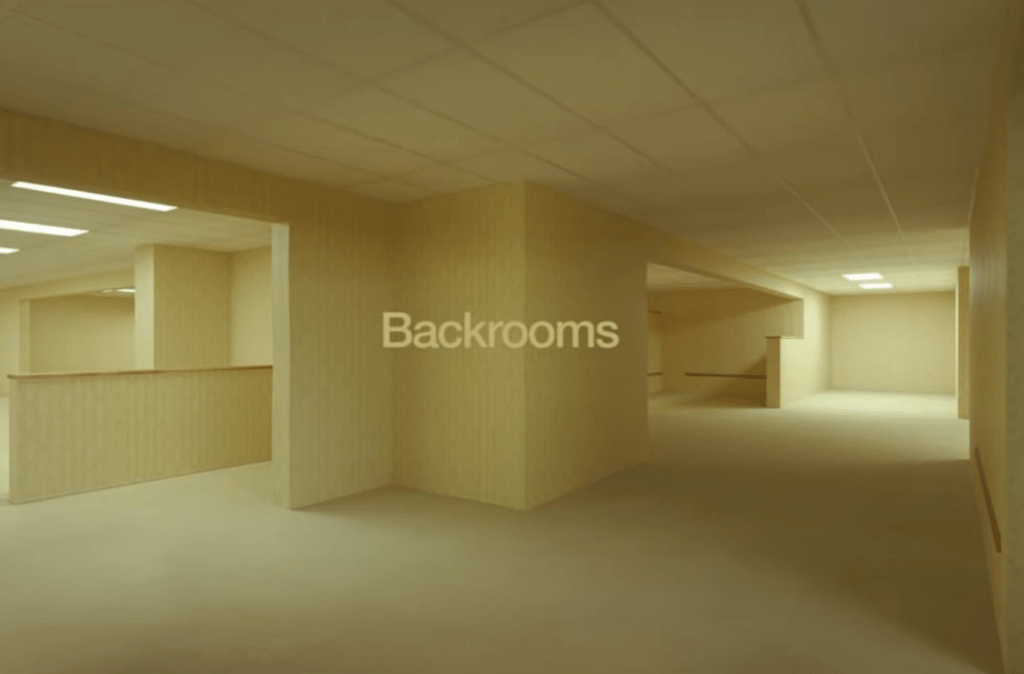
The longer answer is far more interesting. Backrooms began as a single unsettling image (called The Backrooms – check the definite article) online: yellow wallpaper, empty commercial carpet, fluorescent lights, a room that looked abandoned but not quite dead. It became creepypasta. Then unfiction. Then YouTube lore. Then games. Then a major A24 film. And, crucially for this Campfire, it became the subject of a marketing campaign that understood where the story came from.
Michael Andersen, writer, researcher, puzzle designer and long-time chronicler of alternate reality games, did not pretend to be neutral about the subject. He opened with the right mix of enthusiasm and caveat. He had not yet seen the film. He had no involvement in the project. But he had watched the marketing closely – check his original article for ARGNet ‘The Backrooms Viral Marketing Noclips Into An Earlier Era‘ – and he knew the grammar it was using.
“I still have not seen the Backrooms movie,” he admitted to fellow WXO members early on. “So you are getting a lecture from somebody about Backrooms who has not seen Backrooms. To make up for that, let’s look at a brief history of The Backrooms – and how we got to the thing that I didn’t see.”
That could have been a weakness. It was not. It kept the Campfire focused on the experience architecture around the film rather than the film itself.
Not just a film campaign – an invitation to investigate
The original Campfire listing framed the campaign as “a masterclass in modern audience-building”, arguing that the film’s viral marketing embraced its online origins rather than replacing them with traditional studio promotion.
That is the first lesson.
A conventional studio campaign explains. This campaign implied.
It did not simply tell people, “Here is a horror film based on an internet myth.” It released objects, fragments, websites, telephone numbers, fake adverts and location clues into the world. It allowed fans to do what fans of The Backrooms had already been trained to do since its 4chan days: notice, decode, archive, speculate, share.
Andersen’s strongest point was that this was not a niche behaviour. It was not just internet obsessives being internet obsessives. It was a model for how attention works when people feel they have a role.
He began the Campfire with a short video clip full of deliberate nonsense, jingling, attention tricks and Backrooms references. The purpose was not simply comic relief. It set up one of the session’s main arguments: younger audiences do not lack attention spans. They are selective about what earns attention.
“A lot of times people talk about how youths do not have attention spans anymore,” Andersen said. “They do not have time for movies, they do not have time for long form, they do not have time for things that linger. Yet before we started recording this Campfire, most of the people on this Zoom were talking about how they are going to see Backrooms with their kids – and they are going with their kids because their kids were asking for it.”
Then came the useful corrective:
“Part of the mindset we need to break out is not saying, ‘Oh, people aren’t watching our long-form things or doing our long-form things because they don’t have the attention spans.’ They do have the attention spans for that and more. It’s just that the nature of what gets their attention has shifted a little bit.”
“People do have the attention spans for that and more. The nature of what gets their attention has just shifted a little bit.”
That is worth sitting with. Much of the experience industry still talks about attention as if it were a shrinking resource. But attention has not vanished. It has become conditional. The audience is not refusing depth. It is refusing passive depth, badly signposted depth, or depth that offers no role in return.
The Backrooms campaign worked because it understood and embraced that difference. Vive la experience.
The real subject was not the Backrooms. It was ARG thinking
Andersen was clear about the main takeaway. The talk was not really about The Backrooms.
“The point of this talk is not about Backrooms,” he declared. “It’s about alternate reality games.”
He then offered the definition he works from:
“Alternate reality games are stories that play out across multiple platforms, where its players participate as a version of themselves who believes everything is taking place. They have agency – or the illusion of agency – in progressing the story forward.”
That definition matters because it gives experience creators four questions to ask, whether or not they are making an ARG:
- Are we telling a story?
- Is it multi-platform?
- What is the audience’s role?
- Do they have agency?
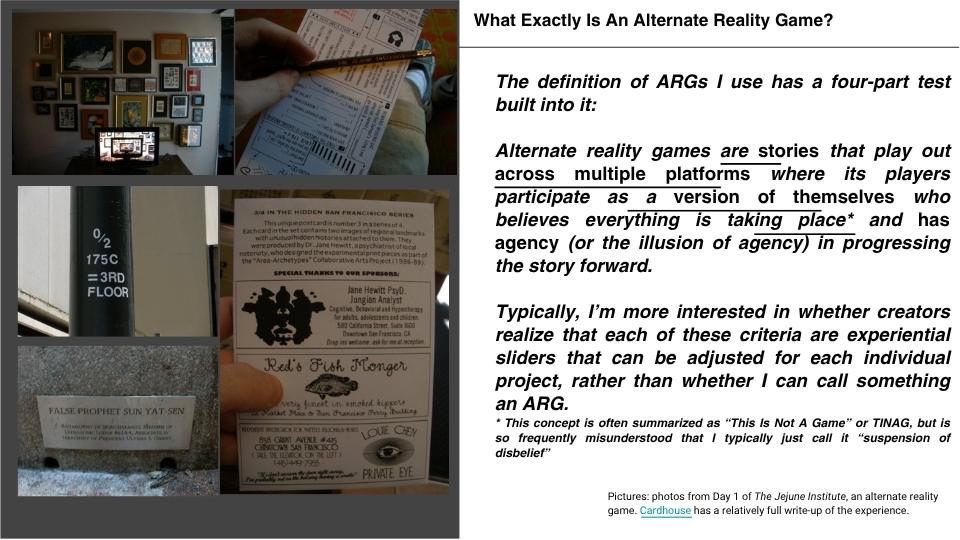
Andersen was not interested in policing the term ARG. In fact, he said the label matters less than the design choices underneath it.
“Do I care if you’re making alternate reality games or not?” he said. “No. What I care about is the factors I talked about. Where do I fall on the slider of what is important. How much am I leaning in? What choices am I making? Because if you are not consciously making these choices, you are unconsciously making these choices – and you might not like the direction some of those choices take.”
“If you are not consciously making these choices, you are unconsciously making these choices – and you might not like the direction some of those choices take.”
That is the most transferable idea in the Campfire.
Every experience casts its audience somehow. It may cast them as spectators, shoppers, witnesses, guests, ghosts, players, pilgrims, citizens, detectives, patients, recruits, fans, members or trespassers. The problem is that many experiences do this lazily or accidentally. They assume audience role will take care of itself.
It rarely does.
If people are supposed to investigate, give them something worth investigating. If they are supposed to play themselves, build the fiction around that. If they are supposed to co-create, give them meaningful tools.
If they are supposed to feel as if they have agency, decide whether that agency is real, perceived, triggered, social or theatrical.
This is not just a puzzle-design point. It is a commercial one. When audiences know what role they have, they know how to behave. When they know how to behave, they are then more likely to share, return, recruit others and care.
A brief history of a room (that should not exist)
To understand why the campaign worked, Andersen took the room back through the strange history of The Backrooms itself.
The now-famous image did not begin as a polished franchise asset. It came out of a real place. As Andersen explained, the story traces back to Rohner’s Furniture in Oshkosh, Wisconsin, a store established in 1928 that later operated out of 807 Oregon Street. Rohner’s closed down in the 1990s. In 2003, Hobbytown USA took over the location and blogged about its refurbishment. During that process, a handful of images were taken, including the one that would later become the iconic Backrooms photo.
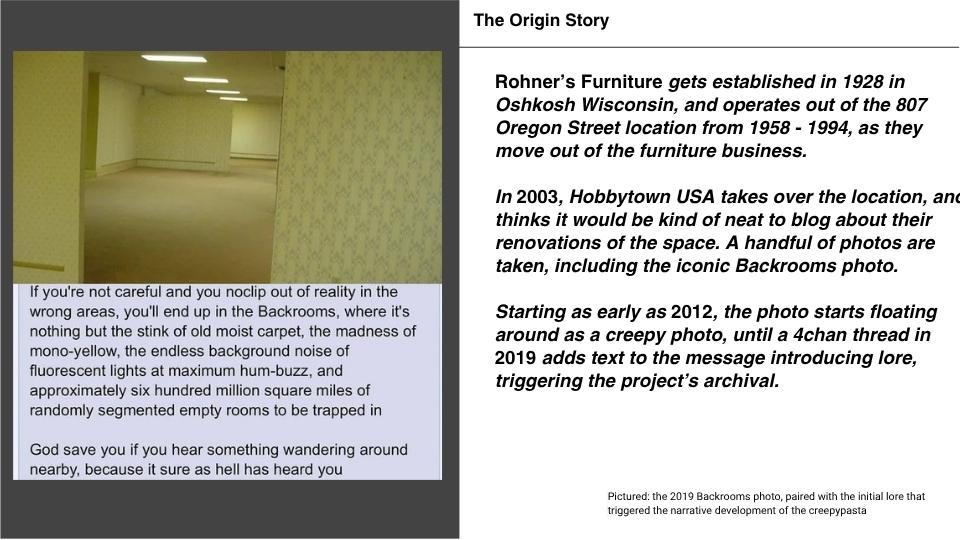
For years, the image appears to have circulated as an uncanny picture of a liminal space. Then, in 2019, it was reposted on 4chan with a short piece of text that gave the image a premise. That text introduced the idea that someone could “noclip” out of reality and end up in The Backrooms: an endless, yellow, fluorescent, damp-carpeted non-place.
Andersen’s point was that here was the moment the image changed category.
“For a while it started out as just that creepy photo until 2019 when it got reposted. One of the original commenters added this one or two paragraph clip that was really introducing not just The Backrooms as a visual, but The Backrooms as a story.”
“The Backrooms as a story then became collective storytelling.”
From there, The Backrooms became collective storytelling.
“The Backrooms became collective storytelling, in the same way that the SCP Foundation is collective storytelling (Beginners should see here – Editor), in the same way that Slender Man is collective storytelling, in the same way that a lot of what we view as modern urban legends are a bunch of people getting together and fleshing out the story.”
That last sentence is a smart description of a lot of contemporary culture. We no longer simply receive myths. We annotate them, remix them, extend them, argue over canon, build wikis, make videos, create games, write theories and police inconsistencies. They are ours to curate and create.
The Backrooms became powerful because it was simple enough to enter and strange enough to expand. It had an image, a feeling and a rule. That is often enough. The rest can be built by the crowd.
Three Backrooms, not one
Andersen separated the various Backrooms into three broad forms: Creepypasta, Kane Pixels and Games.
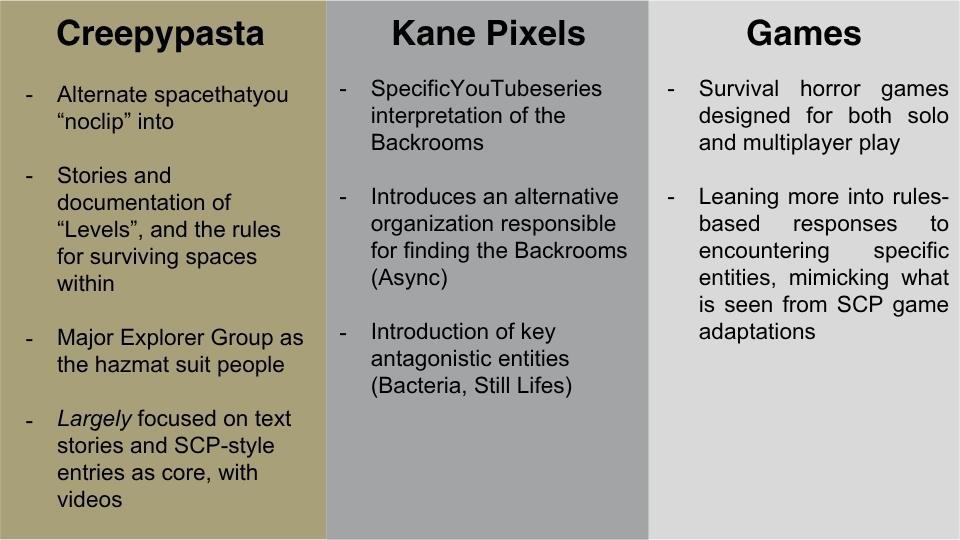
The creepypasta version is text-led and collective. It is full of levels, survival rules, entities and wiki-style documentation. It has a procedural feel: here is a place, here are the rules, here is how you survive.
The Kane Pixels version, created by Kane Parsons on YouTube, is more authored. It draws from the shared Backrooms idea but gives it a more specific story, including Async, the organisation that discovers and studies the Backrooms. It also introduces key entities and visuals that are strongly associated with Parsons’ own interpretation.
As Andersen put it: “One of the things that Kane Pixels brought to the table with his adaptation and series was, yes, there were slight interactive moments of it where you could find hidden videos and uncover the story. But he really brought the focus on, ‘I am telling a story and I am telling my own story that doesn’t necessarily align with a lot of the lore that was built out through the creepypasta side of things.’”
That distinction matters for experience designers. Collective worlds and authored worlds behave differently. A collective world invites contribution and mutation. An authored world can create stronger shape, tone and direction. The best franchise experiences often have to manage both at once.
This is where The Backrooms becomes especially interesting. The film was not adapting a clean piece of IP with one canonical author and one controlled mythology. It was adapting an internet object that had been collectively expanded, then strongly reinterpreted by a particular creator, then absorbed into studio machinery.
That is hard to do without annoying someone.
Andersen briefly dealt with the legal and IP complexity, especially around Creative Commons, the SCP Foundation and Backrooms-adjacent collective storytelling. His disclaimer was admirably clear: he had passed the bar, but was no longer a lawyer and was definitely not anyone’s lawyer. The point for WXO members was not legal advice. It was the strategic challenge: what happens when value is created by a community before a brand, studio or rights-holder arrives?
This is going to matter more, not less. The next generation of entertainment properties will not always arrive as novels, scripts or game bibles. Some will arrive as memes, forums, Discords, found footage, collaborative archives, in-jokes and haunted screenshots. The opportunity is large. The ownership question is messy.
The best response is not to pretend the community was irrelevant. It is to understand what the community made valuable in the first place.
The campaign understood the source material
Once the history was in place, Andersen moved into the campaign itself.
This was where the Campfire became most useful for marketers and experience teams. The Backrooms campaign did not simply borrow the aesthetics of liminal horror. It copied the behaviour of The Backrooms as a culture.
It made people search.
It made people notice.
It made people use old systems.
It made people wonder whether something fictional had leaked into the real world.
The first phase began with a trailer containing a freeze-frame image of Dr Mary Kline’s book, The Window Within, presented as if it had come from a local access infomercial. This was followed by an in-universe ad for Cap’n Clark’s Ottoman Empire, a furniture store. The ad did not announce itself as a Backrooms clue. The only obvious signal was a small A24 logo near the end.
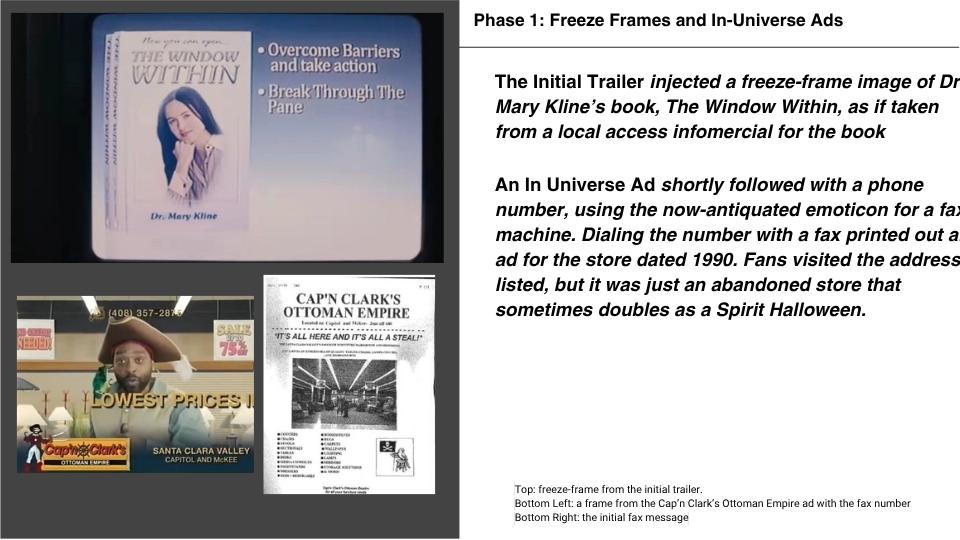
Andersen described the move neatly:
“You also have a fully in-universe advertisement that is saying, ‘Hey, let’s advertise Cap’n Clark’s Ottoman Empire, and not actually tell you that it has anything to do with Backrooms, except for a very small A24 logo that pops up for the last five seconds of the video.’”
Then came the lovely analogue detail. The ad showed a phone number, but the icon beside it was not a telephone. It was a fax machine.
“If you faxed that number at the time, you would get an advertisement for Cap’n Clark’s Ottoman Empire that was an actual location you could actually go to,” Andersen said. “It was a closed down store that sometimes doubles as a Spirit Halloween. I would have loved that to be a real location that actually had something that could be done – but going to an abandoned location is a really close second for this!”
This is smart experiential thinking. Not because fax machines are inherently interesting (they are not). But because the medium matched the world. Backrooms is about obsolete spaces, old infrastructures, dead commercial zones and the feeling that modern reality is built on haunted leftovers. A fax machine is not a gimmick here. It is the right kind of wrong object.
The second phase came when A24 released in-universe Cap’n Clark’s merchandise. Fans noticed the fax number again. This time, the response changed. The fax pointed them toward the South Bay Bulletin Board, a BBS server with another number to call. Calling that number led to an archival project and a request for an email address.
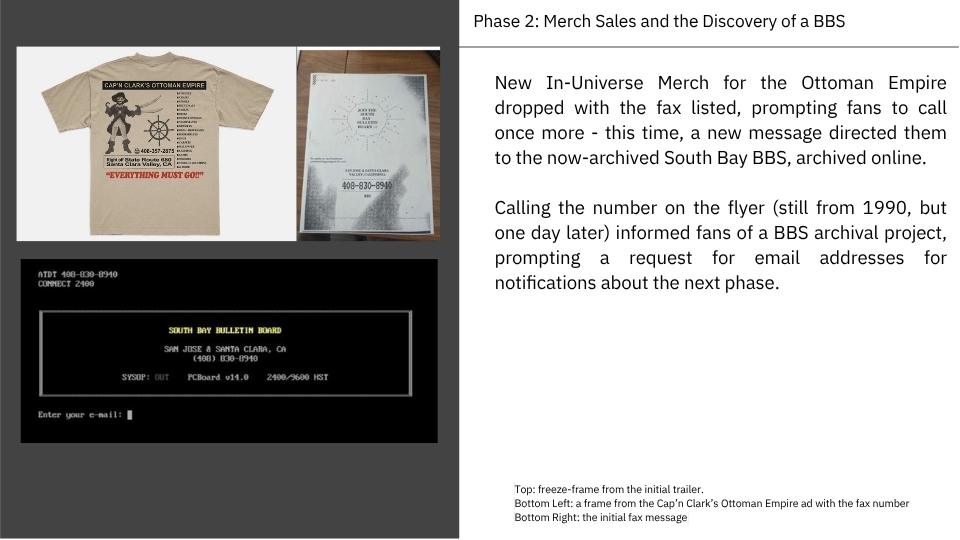
Again, the detail mattered. A BBS is not just retro flavour. It mirrors the Backrooms’ own internet history: an image passed around message boards, gradually acquiring lore. The form of the campaign echoed the form of the myth.
The third phase turned the archive into action. Fans who followed closely received an email saying the BBS had been updated. The updated BBS contained in-universe messages, including an advertisement for a real bookstore whose old location had since closed. It also had a downloadable file pointing to enter.backrooms.mov, where fans could register for a Los Angeles pop-up activation.
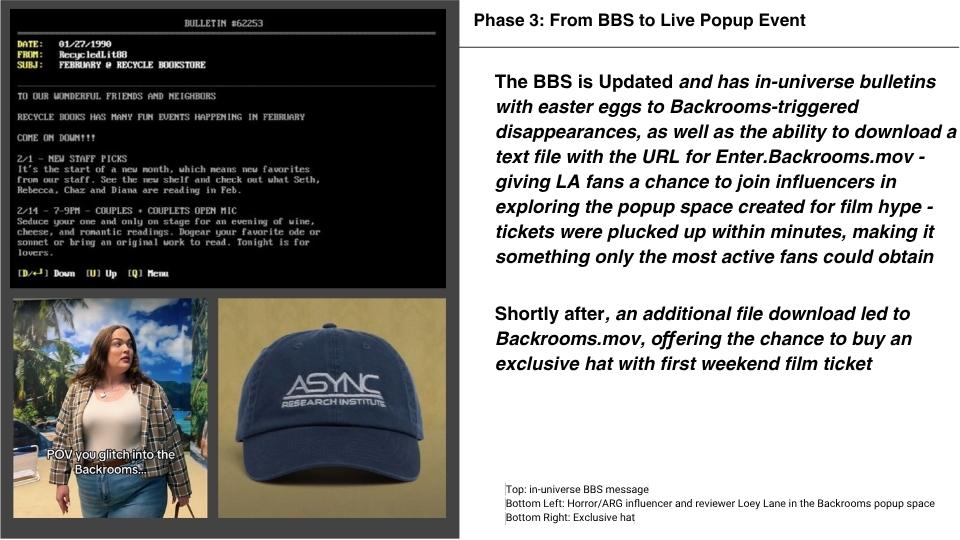
Shortly after, yet another download file offered a way to buy first-weekend movie tickets and access an exclusive Async hat.
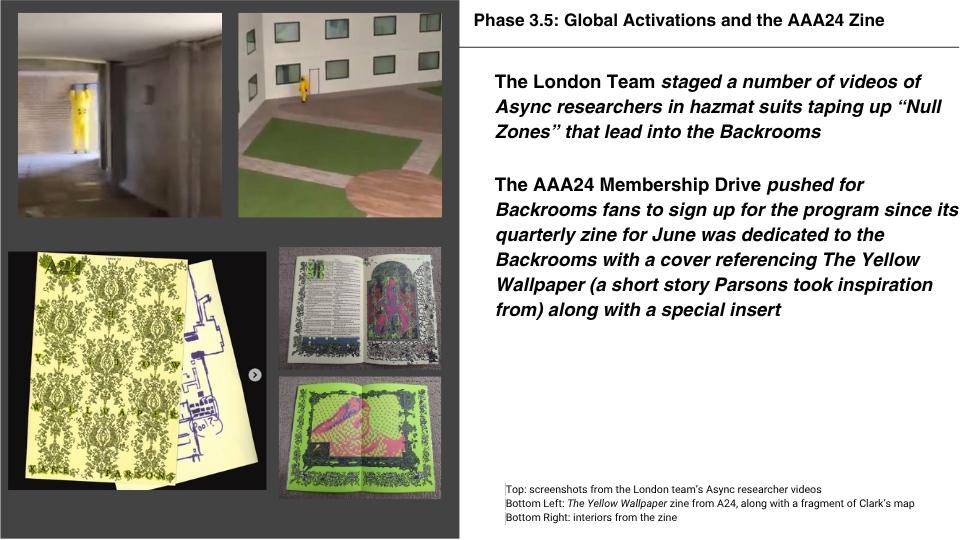
Then came what Andersen called “Phase 3.5”: global activations and the AAA24 zine. In London, the activation team filmed Async researchers in hazmat suits taping up “Null Zones” in real locations. One of those locations was itself a famous liminal space and had appeared in Kane Pixels’ first Backrooms upload.
Why did it work? Because behaved like the thing it was selling
The central horror of Backrooms is the fear that the ordinary world has seams. A wall, hallway, store room, staircase or office can become a threshold. The campaign’s best moments understood this and translated it into marketing behaviour.
“The central horror of Backrooms is that in-betweenness, and baked into every element of this campaign was a celebration of the in-betweenness.”
As Andersen put it:
“Why the Backrooms campaign worked is that in-betweenness. Baked into every element of this campaign was a celebration of that in-betweenness, where you’re seeing in-universe ads pulling through just that little bit. You’re seeing the chance to literally step into those spaces.”
That is the key sentence.
The campaign worked because it did not stand outside the fiction pointing at it. It allowed the fiction to leak out.
The fax, the BBS, the abandoned address, the fake furniture store, the period-appropriate media, the hazmat-suited Async researchers, the Null Zones, the zine… They all did the same job. They made the audience feel as if Backrooms were not only a film world but an unstable layer beneath their own.
This is why the campaign is useful beyond horror. The best experiential marketing does not merely communicate a proposition. It rehearses the experience. It gives the audience a behaviour, a role and a way to feel the world before they buy the ticket.
That is also why nostalgia worked here. Andersen pointed to the “weird 90s” as an important part of the aesthetic, especially for younger audiences. The campaign’s infomercials, fax machines, BBS servers, VHS tapes and floppy disks were not generic retro objects. They were tools for making the past feel… alien.
In the pop-up, influencers including Loey Lane and Jacksepticeye were given access to the space. Inside, there was a literal hole in the wall containing a JanSport backpack stuffed with a VHS tape and floppy drives. The image is almost too perfect: a school backpack hidden inside the wall of an impossible room, full of obsolete media from a recent but unreachable past.
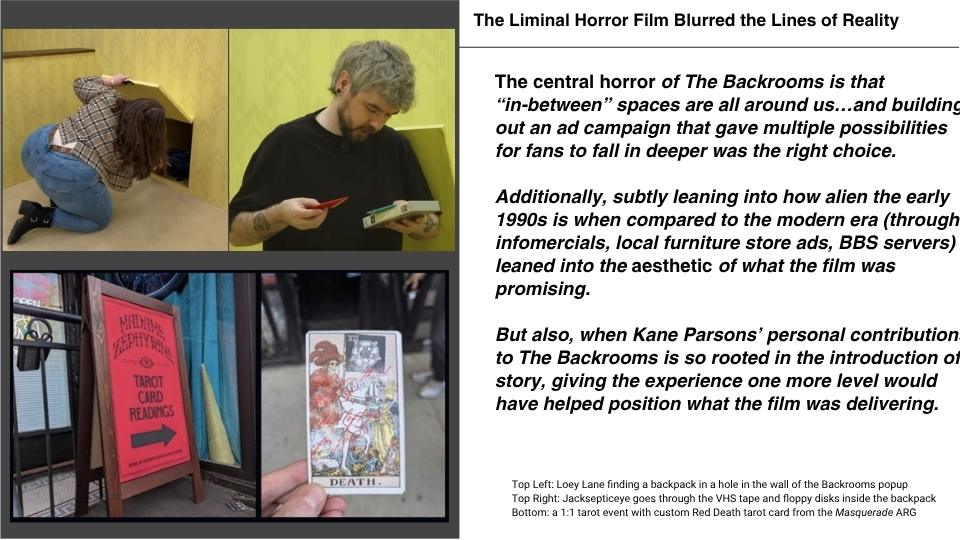
It is easy to sneer at nostalgia as shortcut. Here it was more precise. The campaign was not saying, “Remember the 90s?” It was saying, “The 90s are close enough to remember and far enough away to feel haunted.”
For experience designers, that distinction matters. Nostalgia works best when it is not only decorative. It should create a behaviour, a memory, an unease, a gap. The Backrooms campaign understood the emotional use of outdated media: old technologies make the present feel less stable.
The one thing Andersen wanted more of
The talk was not a puff piece. Andersen admired the Backrooms campaign, but he also wanted more from it.
His critique was specific: the campaign leaned hard into aesthetic and world-feel, but could have leaned further into story and agency.
“This is where we get to my one thing that is bordering on a complaint,” he said. “I wish that given the fact that Kane Parsons built out his particular version of The Backrooms as being so gravitated towards story. I wish they leaned on that element a little bit more heavily, especially because the infrastructure and the framing that they set up for this experience made it so easy to have this space to take that extra step.”
This was not a complaint that the campaign failed. It clearly did many things right. The point was that it had built almost all the infrastructure needed for a deeper audience role.
It had in-universe media.
It had old technologies.
It had physical locations.
It had a BBS (!).
It had email collection.
It had a pop-up.
It had props.
It had a mythology where things slip between times and places.
The missing piece was a stronger sense that the audience’s actions moved a story forward.
Andersen used his four ARG questions to make this clear.
- Was the campaign telling a story? Partially. The film was telling a story. The campaign was “leaning much more heavily on aesthetic” than full storytelling.
- Was it multi-platform? Absolutely. It used period-appropriate media in a way that made sense.
- What was the audience’s role? Somewhat clear. The audience was a present-day version of themselves investigating artefacts from the 1990s.
- Did they have agency? Not really, or not as much as they could have done.
As Andersen put it near the end:
“If we are there as investigators, is there something that we could have pieced together, solved, or discovered other than kind of straightforward trail that we got?”
That question should be pinned above many creative briefs.
- If your audience is cast as investigators, what can they investigate?
- If they are cast as recruits, what can they prove?
- If they are cast as members, what can they access?
- If they are cast as witnesses, what changes because they saw?
The campaign offered discovery. It offered participation. It offered access. But Andersen’s point was that it stopped short of stronger agency.
He gave a concrete example from the pop-up. Fans discovered a backpack in the wall. The team had already produced map fragments connected to Clark, a character in the film. What if those fragments had been found in the backpack? What if the people who attended had discovered something that helped them understand the world, carry a piece of it away, or unlock another layer?
This is the difference between a trail and a role. A trail lets people follow. A role lets them matter.
The Campfire now formally over, the ensuing live discussion sharpened the point.
The Q&A: authenticity may be the wrong word
After Andersen’s talk, QA and talk turned to agency, suspension of disbelief and Gen Z’s supposed love of authenticity. This was a useful question because ARGs are, on one level, profoundly inauthentic. They ask people to act as if something fictional is real. They create false artefacts, fake websites, fictional companies and staged discoveries.
So how does that sit with an audience supposedly obsessed with authenticity?
Andersen’s answer was the best quote of the session for anyone working in marketing.
“When Gen Z says we want people to be authentic, they are not saying ‘I only want nonfiction’,” he said. “Some of what they are saying is ‘I want to feel the connection of I could be pulled in and believe this is real’. So I view a lot of the commentary about authenticity to be a misplaced push for make it easier for me to suspend disbelief. To make it easier for me to lose myself in your work.”
“When Gen Z says we want people to be authentic, they are not saying I only want nonfiction.”
That is a very useful reframing.
In this context, authenticity does not mean literal truth. It means coherence. It means the world behaves properly. It means the artefacts feel native. It means the brand does not break the spell too early. It means the audience is not asked to care while being constantly reminded they are inside a funnel.
Good fiction can feel more “authentic” than bad brand transparency. That is not because audiences are stupid. It is because audiences know the difference between a world that has been built with care and one that has been assembled from trend reports.
Andersen then offered what he called “the easiest design hack for adding agency” without forcing it: design moments in your experiences where audience actions trigger the next beat, but where the action is so likely that someone will almost certainly do it.
He described a show called Escape the Internet Part 1, where the audience could send chat messages onto a theatrical projection. The show’s narrative assumed someone in a crowd of more than 100 people would eventually behave badly enough to trigger the next beat.
“So, the audience agency is, in order to move things forward for the intended playthrough, somebody needs to be an asshole,” Andersen said. “Given an audience of over 100 people with the control to put things on the screen, it is audience agency if they choose to do something. But from the magic trick side of things, ‘that’doing something’ will definitely happen.”
That is a sophisticated design point. Agency does not always mean infinite branching. It can mean designing the conditions under which a predictable human behaviour feels self-directed. Theatre has done this for centuries. ARGs and immersive experiences simply give it new tools.
What experience professionals should take from this
There are at least five practical lessons here.
First, stop treating audience attention as passive. The Backrooms audience did not need things simplified. They needed things worth following. The campaign respected the audience’s appetite for investigation.
Second, match the medium to the world. Fax machines, BBS servers, fake local ads and VHS tapes worked because the Backrooms is a story about obsolete commercial and technological spaces. The media were not decoration. They were part of the world logic.
Third, decide the audience’s role early. The Backrooms campaign cast fans as investigators of 1990s artefacts leaking into the present. That was strong. Andersen’s critique was that the role could have been made more active.
Fourth, distinguish aesthetic from story. Aesthetic can create mood and momentum. Story gives people a reason to keep caring. The campaign had plenty of the former. It had enough of the latter to work. Andersen’s challenge was whether it could have had more.
Fifth, do not confuse authenticity with nonfiction. Audiences are often asking for better suspension of disbelief, not less fiction. They want worlds that hold up.
This is where the Backrooms case becomes useful well beyond film. A brand launch, museum exhibition, festival, retail activation, fan experience or employee event can all ask the same four questions Andersen used:
- Are we telling a story?
- Is it multi-platform?
- What is the audience’s role?
- Do they have agency?
Those questions are plain. They are also hard. They force teams to decide whether participation is real or cosmetic. They expose when a campaign is only scattering assets rather than building a world. They make it clear whether an audience is being asked to consume, collect, investigate, share, solve, perform or belong.
And they help avoid a common failure in experiential marketing: building something that looks participatory but behaves like advertising.
The bigger shift: from campaigns to cultural interfaces
The Backrooms campaign matters because it points to a wider change in how stories are launched.
Studios, brands and experience designers increasingly have to work with audiences that arrive already organised. They have Discord habits, wiki habits, Reddit habits, reaction-video habits, theory habits, clue-hunting habits, fandom habits… They do not need to be taught how to investigate. They need to be given something worthy of investigation.
That does not mean every campaign should become an ARG. Most should not. Bad puzzle trails are exhausting. Fake complexity is worse than simplicity. Mystery without payoff quickly becomes contempt.
But ARG thinking is valuable even when the output is not an ARG. It asks teams to think about story as something distributed across time, media and behaviour. It asks what the audience is allowed to believe. It asks how reality and fiction touch. It asks how much agency is useful. It asks whether a world can leak.
This is the real “experiential marketing gold” in this Backrooms case study. Not fax machines. Not zines. Not influencers in yellow rooms. Those are tactics.
The gold is that the campaign understood participation as culture, not just engagement.
It knew fans would inspect the frame. It knew they would call the number. It knew they would try the fax. It knew they would check the address. It knew they would archive the BBS. It knew they would compare artefacts against lore. It knew they would reward the campaign if the campaign respected their intelligence.
That is the standard now.
The audience does not simply want to be told a story. It wants a place deep in the story’s operating system.
Conclusion: A final lesson from the Backrooms
Near the end of the Campfire, Andersen summed up his critique with a question rather than a verdict.
Could the campaign have taken the extra step from atmosphere into story? Could it have used its channels to tell a side story? Could it have offered a post-release coda? Could the pop-up have given fans something to piece together, solve or discover? Could the abandoned address have contained more than an eerie dead end?
These are fair questions. They are also signs of success. You only ask for more when something has already built enough belief to make more feel possible.
That may be the ultimate lesson for experience professionals. A great campaign does not end with awareness. It creates appetite. It makes people want the next layer.
The Backrooms campaign did that. Andersen’s argument was that it could perhaps have gone one layer deeper.
For experience professionals, that is the practical takeaway. When you build a world, do not stop at making it look real. Ask what people can do inside it. Ask what role they are playing. Ask what they can discover that they could not have discovered from the trailer, poster, press release or paid social ad.
The walls are not enough.
You need to give people a reason to look behind them.
Want the full session?
WXO Campfires are member-only sessions, with members also unlocking access to the organisation’s full on-demand library of Campfire recordings.
The recording, transcript and presentation from this Campfire are available to WXO members inside the membership hub.
You can check out listings for forthcoming Campfires here.
For more information on how to join the WXO, head here.