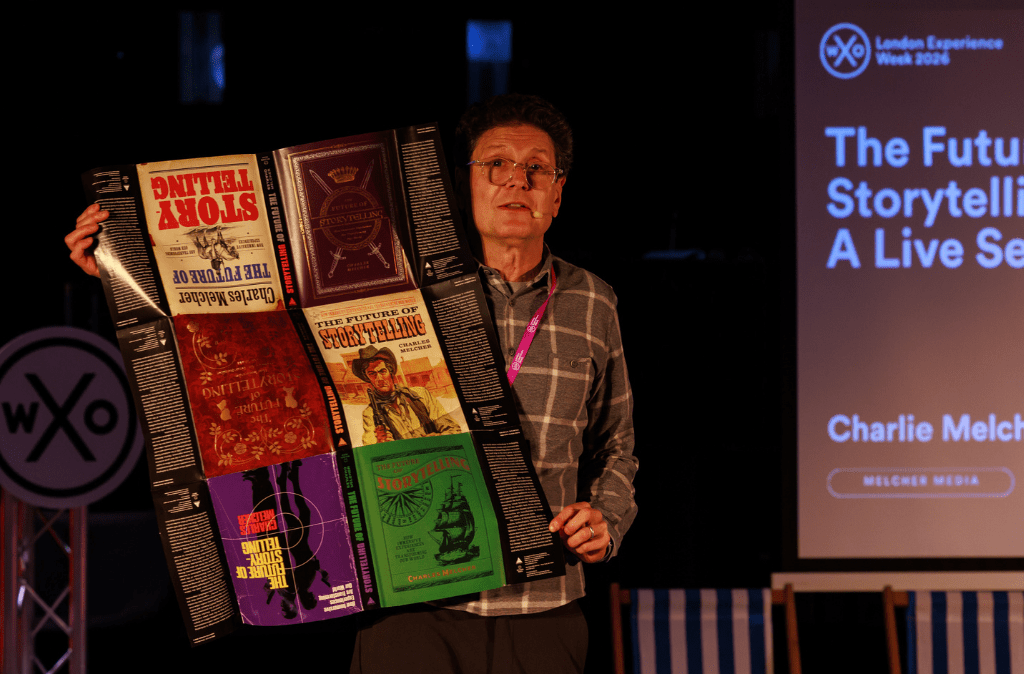

Placing people inside a story is not enough. Charlie Melcher’s six-part framework shows how meaningful choice, world-building, embodiment, responsiveness, social connection and reflection turn spectators into co-creators.
Experience design has inherited much of its storytelling language from books, film and television.
The forms created by this storytelling language are designed to be received.
- The story has already been written.
- The sequence is fixed.
- The audience watches from a safe distance.
An immersive experience however makes a different promise.
It places people inside the story.
But physical presence alone does not deliver on that promise. A participant can enter a detailed environment, wear a headset or move through a theatrical set but still remain fundamentally passive.
The more important shift is from an audience receiving the story to an actience helping to create it.
This Experience Briefing draws on a WXO Campfire with Charlie Melcher and distils its most useful ideas for experience leaders.
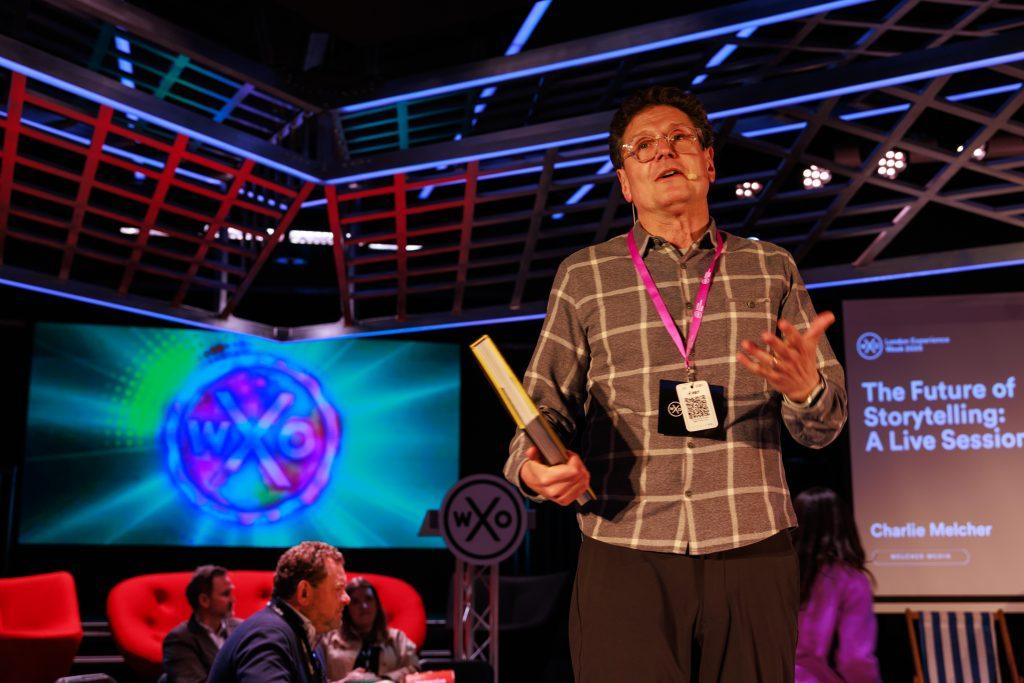
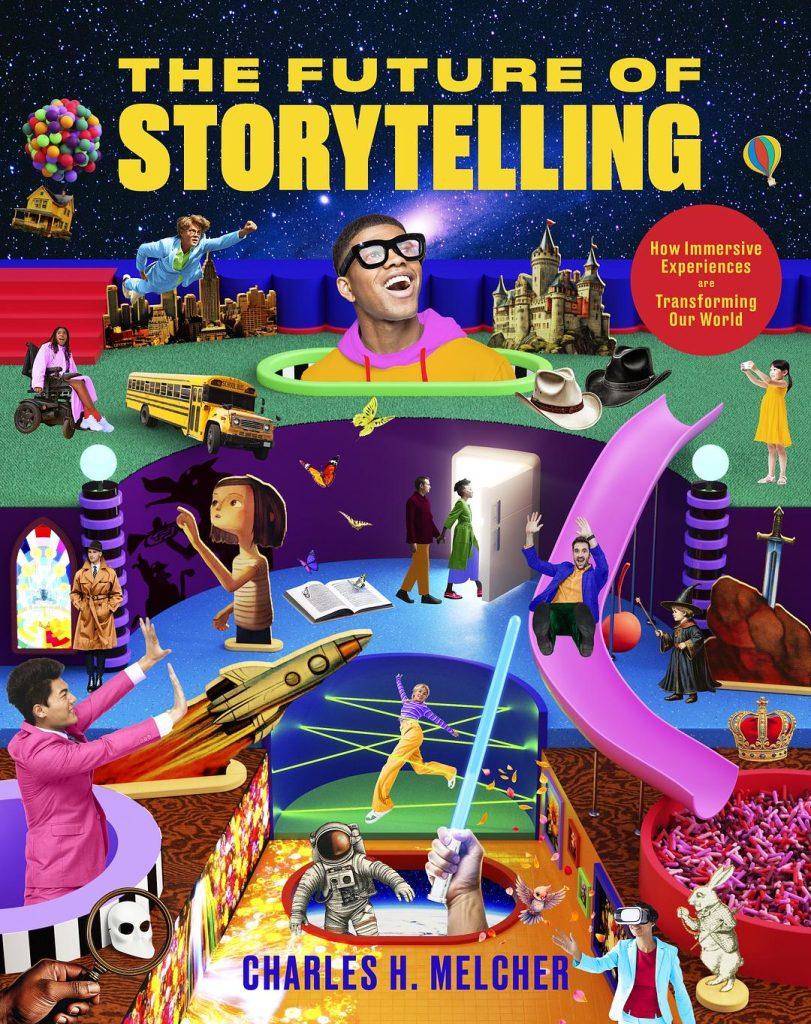
Charlie Melcher is the founder of the Future of StoryTelling, a community and studio exploring how narrative is changing across media, technology and experience. His work brings together creators developing new forms of interactive and immersive storytelling.
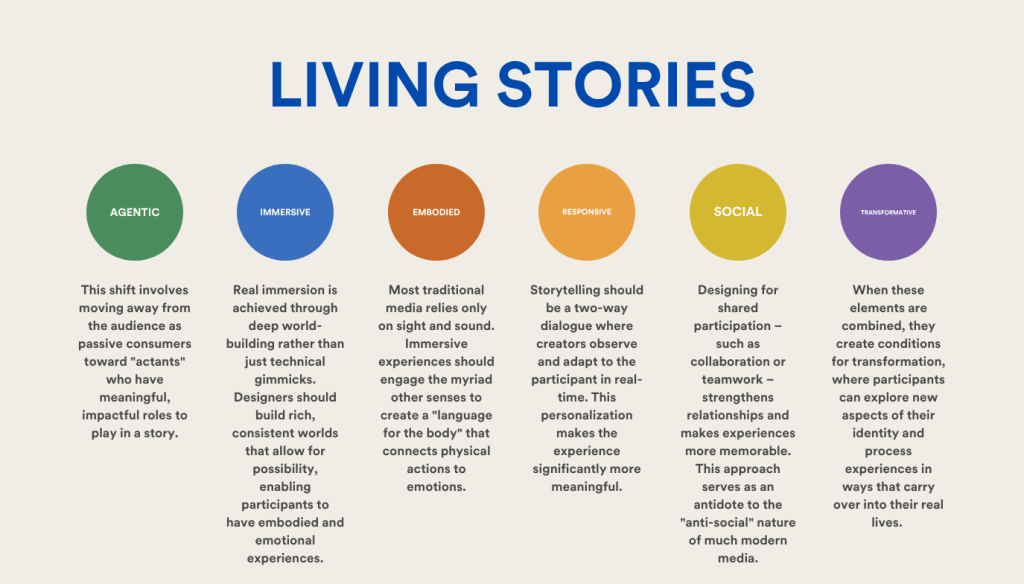
Drawing on 15 years of encounters with immersive creators and projects, Melcher identifies six qualities that the strongest work shares:
- Agentic
- Immersive
- Embodied
- Responsive
- Social
- Transformative
Together, they provide a practical test for whether an experience is becoming a living story or simply presenting a conventional story inside a new format.
1. Agentic: give people choices with meaning
The first shift is from observation to agency.
“We need to give the people formerly known as the audience an opportunity to play a role, to allow them choices that feel impactful.”
– Charlie Melcher
Agency however does not mean or require unlimited freedom.
In fact, offering too many possibilities can leave participants confused, anxious or unsure what the experience expects from them.
The designer’s job is instead to create bounded agency:
- define the available choices
- make the rules understandable
- provide enough support for participants to succeed
- ensure at least some choices have visible consequences
- leave room for people to contribute their own creativity
The aim is not to surrender authorship. It is to give participants enough influence to feel that the story includes them.
Example: Carne y Arena
Alejandro González Iñárritu’s Academy Award®-winning virtual reality experience Carne y Arena places participants within the experience of migrants crossing the US-Mexico border.
At first, the participant appears to be an invisible observer. They can move through the virtual desert and watch events unfold around them.
Then a border guard turns towards them, raises a weapon and orders them to the ground.
The participant is no longer safely watching somebody else’s story. They must react.
“I had gone from being a passive observer to an active participant who is now literally in the dirt.”
– Charlie Melcher
The power comes from a specific change in status.
The experience sees the participant and demands a response.
That does not create a branching narrative with hundreds of possible endings. It creates one choice that feels immediate, personal and consequential.
Apply it
Ask:
- What role does the participant believe they are playing?
- Which decisions genuinely belong to them?
- How does the experience acknowledge those decisions?
- Where can they invest their own creativity?
- Are the choices clear enough to invite action?
2. Immersive: build a world, not a route
Immersion is now applied to almost everything, from digital exhibitions to restaurant packages.
A useful definition has to go beyond scale, projection or visual spectacle.
The most practical answer to that is world-building.
A route tells participants where to go.
A world gives them something to discover.
“Switch your mindset from communicating a story to building a world rich in detail, from which many stories can originate.”
– Charlie Melcher
A convincing story world has:
- consistent rules
- history
- culture
- economics
- physical conditions
- social relationships
- details that may never be explicitly explained
- possibilities beyond the intended central path
This depth allows participants to form their own journeys and interpretations.
It also gives the design team a consistent basis for decisions. Every element can be tested against the world’s rules rather than added because it looks impressive.
Example: Meow Wolf
Meow Wolf begins with recognisable objects and environments, then breaks their familiar logic.
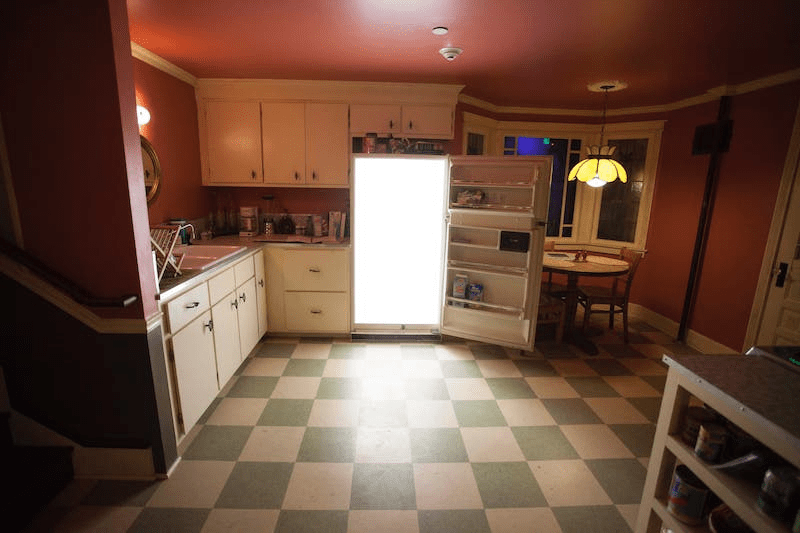
A refrigerator becomes an entrance. Floors, stairs and rooms stop behaving as expected. Ordinary domestic spaces open into impossible worlds.
The effect is not only surprise.
It interrupts the participant’s assumptions about how environments work.
Meow Wolf co-founder Vince Kadlubek described it best:
“If you can provide people with a familiar context, and then break that context with new possibilities, they start to realise they have new possibilities within themselves.”
– Vince Kadlubek
The world creates permission to question reality outside the experience.
Example: Sky: Children of the Light
World-building also includes behavioural rules.
In Sky: Children of the Light, the design encourages players to give gifts to one another. A significant share of in-game spending went towards gifts rather than personal upgrades.
The important lesson is not the precise commercial result.
It is that world-builders determine which behaviours the system rewards.
A world can be designed around competition, generosity, exploration, status, care or cooperation.
Its rules shape the stories participants create within it.
Apply it
Ask:
- What are the rules of this world?
- Which behaviours do those rules reward?
- What can participants discover without being told?
- Is every element consistent with the world?
- Are we designing one ideal journey or a space of possibilities?
3. Embodied: design with more than two senses
Most media is designed predominantly for sight and sound.
Immersive experiences can also use the body.
As Melcher points out, human perception extends far beyond the conventional five senses. It includes balance, spatial orientation, temperature, internal physical sensation and awareness of movement.
“We’ve been painting every painting in two colours. Imagine if you had 30 colours instead of two.”
– Charlie Melcher
The opportunity is not to add scent, vibration or heat as decorative effects.
It is to understand how physical action and sensation change emotion, memory and meaning.
Embodied design can include:
- posture
- gesture
- movement
- resistance
- balance
- touch
- temperature
- proximity
- rhythm
- breath
- bodily effort
These become part of the storytelling language.
Example: The Queen’s Ball: A Bridgerton Experience
At The Queen’s Ball: A Bridgerton Experience, guests could present themselves to the Queen.
The action was simple: approach and bow or curtsy.
But participants brought their own personality, fantasy and creativity to it. Some arrived in full costume. Others wore everyday clothing. The gesture still gave them a physical way to inhabit the world.
“They brought their whole soul to that bow.”
– Charlie Melcher
The interaction at The Queen’s Ball required little technology and even less production complexity.
Its value came from understanding what participants longed to do inside that story world.
The body became the medium through which the fantasy was fulfilled.
Example: lightsaber training
At Disney’s Star Wars: Galactic Starcruiser, participants trained with a lightsaber, blocking incoming blasts through physical movement.
The experience joined story, action, feedback and a long-held fan fantasy.
It did not merely show people a lightsaber.
It gave them evidence that, within the rules of the experience, they knew how to use one.
Apply it
The recommendation is to experiment with the body.
Try the gesture. Adopt the posture. Move through the space. Notice how the action changes confidence, tension, vulnerability or attention.
Ask:
- What does the participant physically do?
- How should that action make them feel?
- Are bodily actions meaningful or merely functional?
- Which underused senses could strengthen the idea?
- Does the experience help people inhabit a role, rather than simply observe one?
4. Responsive: create a dialogue
Personalisation is not the same as responsiveness.
A personalised experience may use somebody’s name or select content based on a questionnaire.
A responsive experience listens, interprets and changes while the participant is inside it.
“Stories need to stop being one way and fixed, and they need to start to be two ways and responsive.”
– Charlie Melcher
Responsiveness can be delivered through advanced technology, but it does not depend on it.
- A skilled performer can respond to tone, body language and decisions.
- A host can adapt a challenge.
- A digital character can remember previous interactions.
- A system can change content according to behaviour.
The important outcome is that participants feel:
- seen
- heard
- understood
- acknowledged
- able to affect what happens next
Example: The Drowned Man
In a one-to-one interaction during Punchdrunk’s The Drowned Man: A Hollywood Fable, a performer invited Melcher into a private audition.
The performer responded to him in real time. He had to make decisions and participate in what he describes as a dance between actor and participant.
The scene became meaningful because it could not have happened in exactly the same way without him.
Example: Alice, The Virtual Reality Play
In this VR experience, a digital White Rabbit spoke directly to the participant, reacted to what they said and could appear to touch them.
The experience combined a live performer in motion capture with an unseen physical facilitator who ensured real objects aligned with the virtual world.
When the participant reached for a digital mushroom, they could pick up and taste a real sweet.
The effect was not simply technical novelty.
The character could converse, tease, respond and share a physical world with the participant.
Example: The Johnnie Walker Experience
At The Johnnie Walker Experience on Princes Street in Edinburgh, visitors answer a small number of questions about their tastes. The system then predicts their flavour preferences and serves a drink designed around them.
The responsive element solves a real experience problem: people who assume they do not like whisky are more likely to enjoy their first drink.
The technology is useful because it changes the relationship between participant and product.
Apply it
Ask:
- What can the experience learn about the participant?
- What changes because of that information?
- How quickly does the experience acknowledge their input?
- Does the response feel meaningful or cosmetic?
- What would make the participant feel recognised rather than processed?
5. Social: make people need one another
Traditional media is often consumed alone, even when millions of people receive the same story.
Living stories can create relationships between participants.
“Everything is actually more meaningful when it is shared.”
– Charlie Melcher
A social experience does more than place people in the same room.
It gives them reasons to:
- communicate
- coordinate
- rely on one another
- contribute different skills
- share awe
- celebrate a collective achievement
- create a story they can later retell together
Example: escape rooms
Escape rooms make social behaviour structural.
Participants cannot succeed by remaining isolated. They must share discoveries, divide tasks, interpret information and combine solutions.
The social element is not an additional benefit placed around the experience.
It is how the experience works.
Example: Secret Cinema’s The Shawshank Redemption
Melcher entered Secret Cinema’s The Shawshank Redemption alone.
Inside the prison world, one participant began to sing. Others joined. Eventually, hundreds of people were singing together beneath the authority of the fictional institution surrounding them.
The shared action gave the group a sense of collective power.
“I left feeling more connected to humanity than I had ever in an immersive experience before.”
The moment was not memorable because everybody saw the same thing.
It was memorable because they created it together.
Apply it
Ask:
- What can participants achieve only together?
- Does each person have something useful to contribute?
- Where can strangers safely acknowledge one another?
- Is the social interaction integral or optional?
- What shared achievement will the group remember?
6. Transformative: design for what happens afterwards
An experience can be enjoyable, impressive and memorable without being transformative.
Transformation means that something changes beyond the immediate encounter.
The participant may understand an issue differently, discover an unfamiliar part of themselves or behave differently when they return to everyday life.
Two ideas suggest themselves from live-action role-play:
- Alibi: The experience gives participants permission to behave as somebody other than themselves.
- Bleed: Something discovered through the role passes into the participant’s real identity or behaviour.
“When people have alibi to be something other than themselves, they can get to explore new parts of their personality.”
– Charlie Melcher
Transformation requires both freedom and safety.
Participants need permission to enter unfamiliar emotional territory, but they also need to know that they can step away. Emotional and physical safety allow people to participate more deeply because they retain control over their involvement.
Example: A Little Bit of Loving
FoST researcher Sarah Lynne Bowman participated in a live-action role-play set during the AIDS crisis in 1980s New York.
By inhabiting a fictional character over an extended period, she encountered questions about mortality that affected how she understood her own life.
The role created an alibi.
The insight bled into reality.
Example: Crossroads Foundation
Crossroads Foundation‘s Global X-perience programmes create immersive simulations around issues such as forced displacement and poverty.
Participants do not simply receive information. They must navigate uncertainty, limited resources, language barriers and systems beyond their control.
Melcher describes people emerging from the experience feeling that a few hours of participation had taught them more than years of reports and papers.
The claim should not be that one simulation permanently changes every participant.
The design lesson is that lived perspective can create a form of understanding that explanation alone may not reach.
Reflection completes the experience
Transformative work needs space for processing.
Participants need to interpret what happened, connect it to their own lives and retell the story in their own words.
LARP communities sometimes call this process “frothing”: named after the foam of a pint of beer usually enjoyed post-experience, participants gather afterwards and recount what they did.
In the retelling, they make sense of the experience and become the hero of their own version of the story.
“Because of that, it sticks with them, it stays with them, it can be transformative.”
A debrief, conversation, journal prompt, shared meal or follow-up action can therefore be part of the designed experience rather than an optional add-on.
Apply it
Ask:
- What identity can participants safely explore?
- What insight might carry into their real lives?
- Where is the balance between aliveness and safety?
- Can people step away without penalty?
- How will they reflect, process or retell what happened?
- What action becomes possible after the experience ends?
The Quality Framework: a six-part test
Melcher’s framework is most useful when treated as a design test rather than a list of desirable qualities.
For each quality needs evidence as much as it does questioning:
| Quality | Design question | Evidence to look for |
|---|---|---|
| Agentic | What meaningful choice belongs to the participant? | A decision with a visible consequence |
| Immersive | What makes this a world rather than a route? | Consistent rules, depth and discovery |
| Embodied | What does the participant physically feel or do? | A purposeful action or sensory experience |
| Responsive | How does the experience recognise their input? | A change in character, content or service |
| Social | Why do participants need one another? | Collaboration or shared achievement |
| Transformative | What can continue after the experience ends? | Reflection, identity insight or further action |
Not every experience needs to maximise all six qualities.
A museum installation may offer limited agency but exceptional embodiment and reflection. A competitive socialising venue may prioritise social action and responsiveness. A one-to-one performance may create deep personal responsiveness without a large story world.
The value of the framework is that it prevents vague claims.
Rather than saying an experience is immersive, interactive or transformative, a team can identify the design choices that make those qualities real.
The bigger lesson
The progression from audience to actience is not simply a change in terminology.
It changes the responsibility of the designer.
An audience can be shown a complete story.
An actience needs:
- a role
- understandable rules
- permission to act
- feedback
- other people to act with
- time to process what happened
Thewider argument is that this matters beyond entertainment.
Passive stories repeatedly teach people that events will unfold whether or not they act. Living stories can allow people to experience themselves as capable of affecting outcomes.
“Imagine a world where every one of the stories you’ve experienced since childhood, you and your parents or your friends have been able to be the heroes.”
– Charlie Melcher
That is an ambitious claim. No single experience proves that participatory storytelling will produce a more agentic society.
But it gives experience designers a worthwhile standard.
The aim is not merely to place people closer to the action.
It is to help them recognise that they are part of it.
What to ask in your next meeting
Work through the framework in order:
- Agentic: What meaningful choice does the participant control?
- Immersive: Which rules and details make the world coherent?
- Embodied: What does the body contribute to the story?
- Responsive: How does the experience recognise and react to the participant?
- Social: What do people need to do together?
- Transformative: How will they process what happened and carry it forward?
Then ask the harder question:
What evidence do we have that each of these qualities exists in the actual participant experience, rather than only in our intention?
For more Experience Briefings, head here.
For more information on how to join the WXO, head here.